
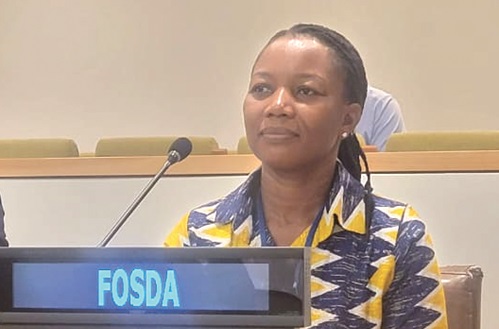
The Foundation for Security and Development in Africa (FOSDA) has called on states to strengthen political commitment and take concrete action to prevent the diversion of small arms and light weapons (SALW) into illicit markets.
It warned that diversion remained one of the greatest threats to peace, security and development across Africa and beyond.
The Executive Director of FOSDA, Theodora Williams Anti, made the call during the Ninth Biennial Meeting of States (BMS9) on the United Nations Programme of Action on Small Arms and Light Weapons (UNPoA) and the International Tracing Instrument (ITI), held at the UN Headquarters in New York, America.
Conflicts
The conference was held at a time of growing global insecurity fueled by armed conflicts, terrorism, violent extremism and organised crime.
Ms Williams Anti emphasised that while significant progress had been made in strengthening international arms control frameworks, the continued diversion of legally manufactured and transferred weapons into illicit circulation remained a major challenge.
She questioned how non-state armed groups, terrorists, insurgents and criminal networks continued to acquire weapons despite existing national, regional and international control measures.
“The reality is that many of these actors are not manufacturing the weapons they use.
Weapons are often diverted from legal production, legal transfers or national stockpiles before finding their way into illicit markets and ultimately into the hands of unauthorised users.
“The continued leakage of weapons from legal to illegal channels undermines peacebuilding efforts, fuels conflict, enables terrorism and contributes to widespread insecurity," she explained.
Ms Williams Anti stressed that if the international community was serious about reducing armed violence, it must be equally serious about addressing the pathways through which weapons are diverted into illicit circulation.
Challenge for Africa
For Africa, she said the challenge was urgent, adding that across the continent, illicit small arms and light weapons continued to fuel armed conflicts, violent extremism, terrorism, communal violence and transnational organised crime.
She expressed concern that from the Sahel to the Gulf of Guinea, armed groups continued to exploit weaknesses in stockpile management, border controls and regulatory systems to acquire weapons that are later used against civilians and state authorities.
The consequences, Ms Williams Anti said, were devastating, adding that communities were displaced, livelihoods destroyed, development gains reversed and public confidence in state institutions weakened.
Diversion
She said preventing diversion, therefore, “goes beyond arms control to peacebuilding, governance and development.”
Ms Williams Anti said her organisation believed that preventing diversion was essential to the effective implementation of key international and regional instruments, including the UNPoA, the ITI and the ECOWAS Convention on Small Arms and Light Weapons, their ammunition and other related materials.
She said those frameworks provided states with important commitments and practical measures for regulating the transfer, possession, tracing and management of small arms and light weapons.
