

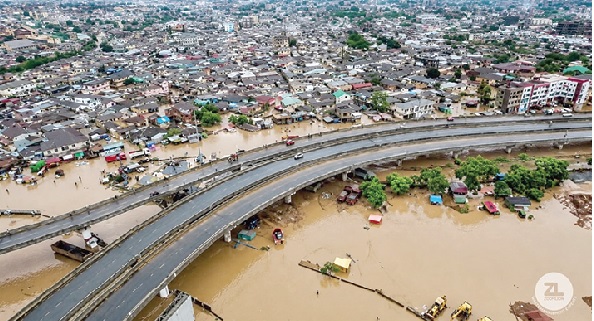
The Ghana Government announced a special two-day national general cleaning exercise— Friday, 10 July and Saturday, 11 July 2026—for the seven regions affected by the recent floods to desilt choked drains, clear sand, weeds and debris from roads and gutters, and undertake all other activities that would reduce the risk of further flooding.
Security agencies and waste management companies were called upon to be part of the process, as well as Ministers, Members of Parliament and government appointees.
The worthy exercise, which was on the theme, “Our Actions, Our Future: Cleaning Ghana after the Floods”, was also a gentle reminder that if we do not manage our actions with discipline, the calm water we see around us could become stormy!
As it turned out on June 29, record rains turned streets into rivers as choked gutters and overwhelmed drainage lines gave way.
The fact that, for most of the year, Accra’s gutters, drains, and the Odaw River, for example, were quiet, with calm, slow-moving water, almost made us all forget that there was a need to ensure they remained clear.
When the clouds gathered on Sunday, June 28, and it started raining, by Monday, June 29, in a matter of hours, we all remembered what it feels like when calm water gets stormy.
In fact, according to experts, the 140 mm of rain experienced that day was the highest in several years.
Between Sunday night and Monday morning, Accra recorded about 140mm of rain in a single day, which was nearly triple last year’s high.
According to President John Mahama, it was “the highest experienced in several years”.
Records available show that the rain started around 3:00 am on Monday, June 29, and did not let up. Roads turned to rivers quickly, and reports showed that within Kaneshie, Odawna, Adabraka, and the Kwame Nkrumah Circle enclave, water rose to vehicle headlights within hours.
In Tse Addo, boats were used to rescue at least 15 children and an infant from flooded homes. And the human cost was immediate too, with deaths recorded in low-lying Alajo and other areas. The latest count puts the death toll at more than 30.
Accra is no stranger to June rains. In the 15 June 2015 edition of this column, I wrote about the unfortunate 3 June rain cum fire debacle that took many lives.
In part, this is what I wrote about that incident: “The image beamed on television sets was grim, and storytelling indeed. Yes, for the first time to many, water seemed unable to quench a raging fire or at least control it to an extent!
Rather, it was the water that was on fire…literally. What played out to ironic thoughts and confused minds was a scene of fire in a sea of water. Yes, the water was on fire! Many may have certainly wondered!”
“The loss of lives and property is yet to be fully ascertained, but the number of dead counted upwards of 170 indicates even to the novice that this was certainly a catastrophe of some sort.
I am referring here to Black Wednesday, June 3, which will forever remain in the memory of most people for years to come.
This was the day to remind you that, amidst torrential rain, an explosion at a fuel station provided more than a warming comfort to the many who had gathered there, perhaps wet and waiting for the rain to subside, and others trapped in their homes because of the adverse weather conditions outside.
Picture the case of either staying in your home to be drowned or stepping outside to face a serious blaze.
That indeed was the picture of many of the dead, those who, unfortunately, are not around to tell their own story. May their gentle souls rest in perfect peace. Amen.”
And may the gentle souls of those who have departed in the most recent flooding rest in perfect peace, too!
The floods feel different now, and we are reliving the same story every rainy season… When it rains like this, we know trouble is coming!According to meteorologists, as little as 30mm of rain is now enough to inundate parts of Accra since natural retention areas that once held water have been built over.
Drainage channels are narrow, blocked, or inadequate. And runoff no longer spreads over land, and the narrow gutters cannot contain the rainwater. Once volume exceeds capacity, the water spills out.
President Mahama pointed to both climate and conduct: “That aspect of the problem is beyond our control because it is driven by changing climatic conditions,” but also “the issue of human behaviour” — building in watercourses and resisting demolitions.
This is where we need to remind ourselves once again that our actions will determine our future on this planet.
The government has announced “aggressive anti-flood measures,” including enforcement to remove structures on watercourses, but the storm will not be over if we don’t change course by adopting environmentally friendly practices.
Accra’s floods are not only about rain. They are about what we do when the water is still calm. Once it turns stormy, there’s no time to negotiate with gravity, drainage, or blocked channels.
As I explained in the 27 June 2026 edition of this column, environmental degradation is behind the extreme weather conditions experienced today in every part of the Earth.
We are still putting too much carbon into the atmosphere. A Global Carbon Project report released in
December 2023 showed global carbon emissions from fossil fuels hit record levels again in 2023. This year is tracking the same path”, I wrote in the referenced edition.
To stop extreme weather from growing more violent, emissions must plummet, and our conduct must improve in ways that support a clean environment.
