
The successful implementation of the first phase of the government's flagship 'Nkoko Nkitinkiti' Programme has set the stage for the rollout of its second and more transformative phase—the commercialisation of Ghana's poultry industry, the Minister for Food and Agriculture Eric Opoku has said.
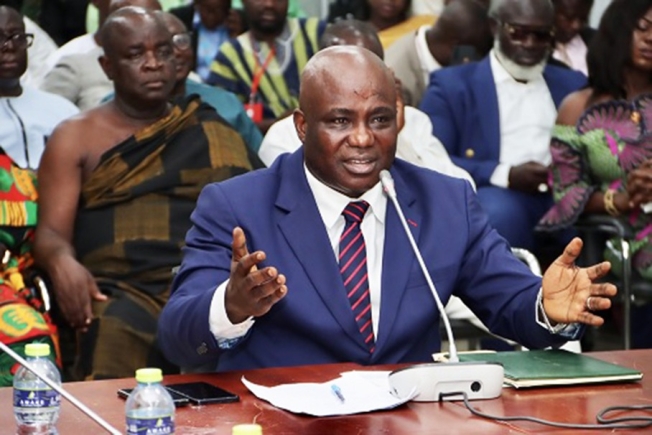
Speaking to journalists after briefing Parliament on the progress of the programme, the Minister described the household and domestic poultry production phase as highly successful, saying the overwhelming response and encouraging outcomes had given the government every confidence to expand the initiative into large-scale commercial production.
According to Mr Opoku, the success recorded under the domestic production phase demonstrates that the policy is not merely an agricultural intervention but a practical blueprint for rebuilding Ghana's poultry industry from the grassroots upward. He noted that the programme is gradually laying the foundation for a self-sustaining poultry sector capable of creating thousands of jobs, improving household nutrition, reducing Ghana's dependence on imported frozen chicken, and conserving millions of dollars in foreign exchange.
The Minister's assessment provides perhaps the strongest justification yet for the transition into the commercialisation phase.
For decades, Ghana has spent millions annually importing frozen chicken, an expenditure that has continued to drain the country's foreign exchange while creating jobs and economic value in other countries instead of within Ghana. It is this long-standing economic imbalance that the Nkoko Nkitinkiti Programme seeks to reverse.
From an economic perspective, the policy represents one of the country's most ambitious import-substitution initiatives in recent years. By encouraging domestic production before scaling up to commercial operations, the government is pursuing a deliberate strategy aimed at strengthening food security, stimulating agribusiness, empowering women and young people, revitalising rural economies, and retaining more national wealth within the local economy.
With the first phase now yielding encouraging results, attention is increasingly shifting to the commercialisation agenda, which is expected to deepen investment across the entire poultry value chain—from hatcheries and feed mills to processing plants, cold-chain logistics, packaging, transportation, and retail distribution.
