Disaster, ambulance and blood services are handled by an array of hospitals and organisations in Ghana, but in Israel, there is one organisation that does it all — Magen David Adom.
On May 9, 2001, it took the loss of 127 lives at the Accra Sports Stadium through a stampede to start a conversation on a National Ambulance Service in Ghana.
Emergency medical experts, then, noted that many of those lives could have been saved with prompt, structured pre-hospital care. Ghana had none at the time.
In 2004, the National Ambulance Service (NAS) was born through a collaborative effort between the Ministry of Health and the Ghana National Fire Service.
Beginning with a few Emergency Medical Technicians (EMTs), fewer than 10 ambulances, and seven stations across three regions, the Ghana NAS has grown into a nationwide network that now operates in every district of Ghana, answering over 20,000 calls annually and training the next generation of emergency medics at its own dedicated school.
Charles Amissah incident
At age 29, Charles Amissah was an engineer who had already carved a path of excellence at Promasidor Ghana, where his colleagues admired his diligence and creativity. He was the kind of person who believed that Ghana could rise to greatness through innovation, discipline and compassion.
He, however, died of the injuries he suffered in a hit-and-run road accident as a car knocked him off his motorbike while riding home from work on February 6, 2026, in Accra.
His sudden death became a national wound when details emerged on how the system, meant to protect lives, failed.
The independent investigation, chaired by renowned pathologist and former Director-General of the Ghana Health Service, Prof. Agyeman Badu Akosa, found that Amissah did not die instantly from the road accident injuries, but from prolonged, preventable blood loss (exsanguination) due to failure of emergency medical care.
The report said Amissah was alive at every stage — from the accident scene to the Police Hospital, Greater Accra Regional Hospital and Korle Bu Teaching Hospital — but none of those facilities provided timely life-saving intervention such as bleeding control, IV fluids or blood transfusion.
The report stated that pathology confirmed a “slow death from medical neglect”, emphasising that early intervention at any point could have saved his life.
Basic life support training for all
The fatal injury — a deep arm wound damaging major blood vessels — was survivable with basic emergency care, the report said.
The committee, in a key finding, indicated that the death of Amissah could have been avoided by the application of compression on the laceration and packing of the deeper wound during transportation in the ambulance and the administration of intravenous fluids in the ambulance during transportation.
It was clear that even though the NAS responded promptly, what was required as first aid to save the life was not fully applied, aside from the issue of medical negligence and “no bed syndrome” at the three hospitals that contributed to the death of Amissah.
It is based on this that the investigative committee recommended that Ghana should ensure basic life support (BLS) and advanced cardiac life support (ACLS) training for health workers, pupils, students and the public in general.
Magen David Adom’s example in Israel
This is where what I learnt and observed at the national centre of the Magen David Adom (MDA) in Israel ambulance service caught my attention, suggesting that that example is worth emulating in Ghana.
Ghana’s NAS, after 22 years in existence, is doing well, but a further push with the Magen David Adom in Israel example can take it a step higher in meeting its mission and vision.
Magen David Adom in Israel is the only national emergency medical service and blood services organisation, responsible for emergency pre-hospital medical care in Israel.
It is responsible for teaching first aid and emergency medicine to all and provides professional services, including blood services, using technological devices in accordance with the common protocols for cardiac treatment.

Volunteers, private defibrillator ownership, registration
MDA operates 1500 emergency vehicles and three helicopters from over 200 stations across Israel.
Over 30,000 of the trained personnel are volunteers; the other 10 per cent are employees of MDA. In Israel, military service is compulsory as national service for all citizens, and an option to opt out is to become a volunteer at Magen David Adom.
A heart attack, for example, according to medical experts, typically lasts from 15 to 20 minutes on average, though symptoms can persist for several hours.
If a heart attack leads to cardiac arrest, where the heart stops beating, the brain is deprived of oxygen, and without immediate medical intervention or CPR, this lack of oxygen quickly leads to permanent brain damage and death.
In Israel, private ownership of defibrillators, that is, the medical device that delivers an electrical shock to the heart to restore a normal rhythm during sudden cardiac arrest, is encouraged.
By interrupting chaotic electrical activity (like ventricular fibrillation), it allows the heart's natural pacemaker to reset and pump blood effectively.
All these privately owned defibrillators are registered and mapped out on a system operated by MDA, such that when one is needed, a volunteer picks it up for an emergency before an ambulance arrives at the scene.
During my recent tour of Israel together with other journalists from Ghana, Liberia and Sierra Leone at the invitation of the Israeli government, we visited the MDA national centre, located at Ramla, a city with less than 100,000 people, and just half an hour’s drive from southern Tel Aviv, the economic hub of Israel.
The MDA centre handles all emergency medical services across Israel, relying on trained volunteers, private citizens and the few permanent staff (10 per cent).
Unlike Ghana, where there are different organisations, for example, the National Ambulance Service, the Ghana National Fire Service (GNFS), the National Disaster Management Organisation (NADMO), the Ghana Red Cross Society or the St John Ambulance, Magen David Adom is in charge of all emergency ambulance services in Israel as one organisation that does it all.
Although MDA’s role is mandated by the Israeli government, it is not a government agency.
It is Israel’s official representative to the International Red Cross, and its role precludes it from accepting governmental support for its general operations.
Because of this arrangement, it relies on support from donors and payment for services rendered under health insurance to keep its dispatch systems, training and equipment running.
— DailyGraphic GraphicOnline (@Graphicgh) July 13, 2026
How does MDA work, respond to cases in less than 3 minutes?
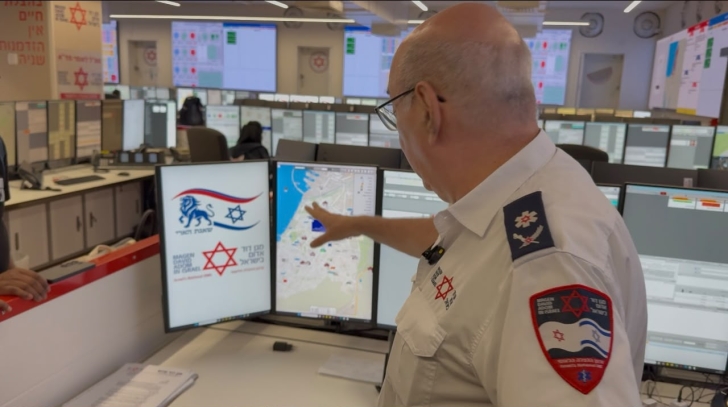
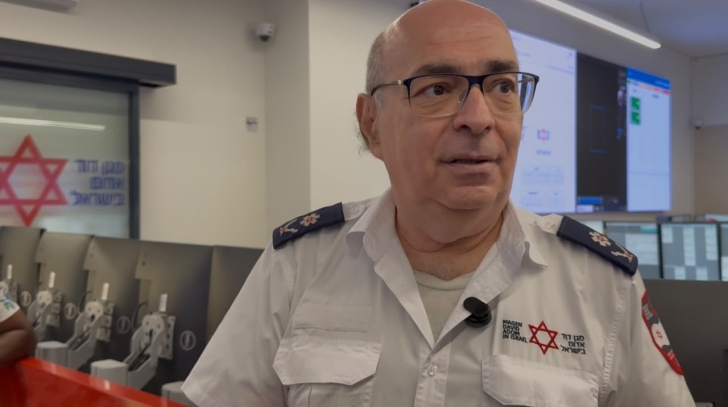
During the visit, the Coordinator of International Cooperation at MDA, Chaim Rafalowski, explained that when a patient makes an emergency call, the system creates a flag on the map of Israel, which is a geolocation of the patient.
If the person cannot give a geolocation or an address, the staff at the control centre sends a WhatsApp for the person to share location and if possible send images from the scene of incident.
At the same time, the system allocates all the ambulances that are close to the scene and, in real time, calculates based on the way and the time of arrival, depending on traffic, and suggests to dispatchers to make a suitable decision on the best approach and which ambulance to send to the scene.
Training
Aside from the ambulances, the MDA trains private citizens and volunteers who live in various communities and provides them with kits with their locations on the map.
The idea is that these first aiders, when their services are required, are alerted on a mobile app, for them to respond to provide first aid even before an ambulance arrives.
Some of them run on foot to a scene, rely on bicycles, scooters and motorcycles to provide first aid, and the goal is to respond to a patient in less than three minutes before an ambulance arrives at the scene.
All this is coordinated at the national centre. Due to the volunteer system, young adults looking for an impactful experience join peers from across the country and the globe, working side-by-side with MDA’s paramedics and EMTs on ambulances throughout Israel.
They gain invaluable emergency medical training and field experience, as well as the satisfaction that comes from saving lives.
This is the example that Ghana can emulate with the graduate national service scheme, for example, in collaboration with the NAS, as persons trained in basic life support can readily be available everywhere with the growing national population.
This could enable the NAS to increase its presence in communities in training the next generation of emergency medics in line with its mission to provide integrated, high quality, pre-hospital emergency and medical care, health transport, medical retrieval and education services to all people in Ghana and also in line with its vision to be a world class
Emergency Medical Service that provides the highest quality and most cost-effective emergency health care to the people of Ghana.
As I was told, Magen David Adom is already open to international collaborations, and if there is currently no existing collaboration with the NAS, I will suggest we start looking at collaborating in that example.
Writer's email:
Follow @enochfrimpong Follow @Graphicgh