
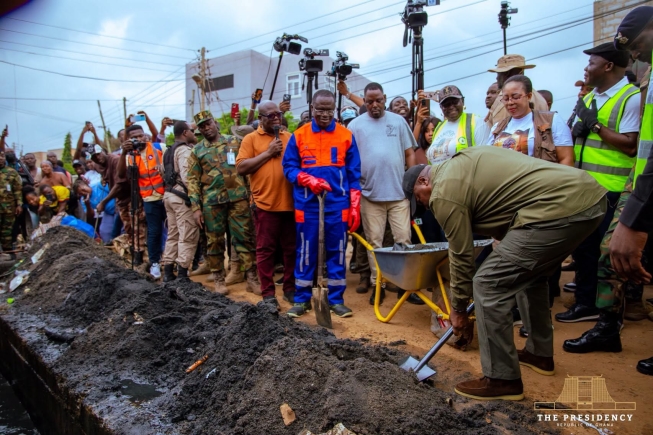
President John Dramani Mahama has directed the immediate operationalisation of six waste transfer stations which were built and being managed by Zoomlion Ghana Limited to accelerate refuse evacuation and strengthen waste management systems in the Greater Accra Region, following the recent floods.
The stations were built about nine years ago, but have remained idle, forcing waste collectors to travel to distant disposal sites instead of using nearby transfer points for efficient waste evacuation.
Addressing residents at the cleanup site at Alajo in Accra last Saturday, the President said: "Unfortunately, they were not put into operation.
So, we have asked the contractor, Zoomlion, to open the transfer stations so that the tricycles and others can take the garbage to the transfer stations".
The situation often left waste removed from drains and gutters during clean-up exercises along roadsides, where subsequent rains washed them back into the drains, undermining the purpose of the exercise.
The six transfer stations, located at Achimota, Teshie, Kpone, Ashaiman, Pantang and Adipa, will serve as temporary collection points where waste can be compacted before being transported to final disposal facilities, including the Accra Compost and Recycling Plant (ACARP) and the Accra Integrated Recycling and Compost Plant (IRECOP).
Under the arrangement, Zoomlion Ghana has deployed 150 haulage trucks, 30 compactors, road sweepers, more than 2,000 tricycle waste operators and over 1,000 operatives, with an additional 60 long-haul trailers deployed on the second day of the national clean-up exercise to increase evacuation capacity.
In addition, the company deployed more than 2,000 sanitation personnel, heavy-duty equipment and logistics to support the just-ended two-day National General Clean-up Exercise in flood-affected communities.
Continued clean-up
President Mahama stated that the activation of the transfer stations formed part of measures to ensure that refuse removed from drains and gutters during the national clean-up exercise was immediately evacuated instead of being left by the roadside.
He added that tricycle operators and other waste collectors participating in the exercise had been directed to deposit refuse at the nearest transfer station, from where heavy-duty trucks would transport them to the approved treatment and disposal facilities.
President Mahama explained that although the two-day national clean-up exercise had recorded an impressive turnout, the volume of waste generated after the floods meant the exercise could not be completed within the scheduled period.
He said the Ghana Armed Forces and other state agencies would continue the evacuation exercise after the official clean-up exercise to ensure that all refuse removed from drains and public spaces were transported to the disposal sites.
He appealed to residents who had not yet joined the exercise to participate actively, stressing that maintaining a clean environment required the collective efforts of all citizens.
Building a resilient city
The President stated that the operationalisation of the transfer stations marked an important step towards establishing a more efficient and sustainable waste management system for the national capital.
He explained that improving sanitation required not only investments in waste management infrastructure but also responsible waste disposal practices by the public to prevent drains from becoming choked again.
Expressing optimism about the city's recovery, President Mahama stated that Accra would emerge stronger from the recent floods through sustained collaboration between the government, private sector partners and residents.
"Ghana is a resilient country, Accra is a resilient city, and we will bounce back better than before," he added.
Zoomlion’s commitment
Responding to the President’s directive, the Executive Chairman of the Jospong Group of Companies, Joseph Siaw Agyepong, welcomed the move, and reaffirmed Zoomlion’s commitment to supporting government efforts to restore environmental sanitation after the floods.
He explained that the second day of the exercise had shifted into a major waste evacuation operation, with large volumes of refuse removed from homes, drains and public spaces requiring significant logistical support.
He said Zoomlion, in collaboration with the Environmental Service Providers Association (ESPA), metropolitan, municipal and district assemblies (MMDAs) and other stakeholders, had expanded its operations across the Greater Accra Region to ensure effective waste removal.
Deployments
Mr Agyepong stated that the operation was being carried out simultaneously across all 29 MMDAs in the Greater Accra Region, with teams deployed to communities affected by the floods.
He said collected waste would be channelled through designated transfer stations before being transported to approved treatment and disposal facilities, ensuring that debris removed from drains and streets did not remain in communities.
Mr Agyepong appealed to residents to support sanitation efforts by adopting responsible waste disposal practices, stressing that much of the refuse removed during the exercise had accumulated over several years.
Background
The activation of the transfer stations formed part of the two-day National General Clean-up Exercise declared by the government following the recent floods that affected seven regions of the country.
The exercise, held on the theme: "Our actions, our Future: Cleaning Ghana after the floods", was also attended by the Vice-President, Prof. Naana Jane Opoku-Agyemang; the Ga Mantse, King Tackie Teiko Tsuru II; Governor of the Bank of Ghana, Dr Johnson Pandit Asiama; and First Deputy Governor of the Bank of Ghana, Dr Zakari Mumuni.
The Minister of Local Government, Chieftaincy and Religious Affairs, Ahmed Ibrahim; the Greater Accra Regional Minister, Linda Ocloo; the Chief Executive of the Accra Metropolitan Assembly, Michael Kpakpo Allotey; security agencies, MMDAs, and thousands of residents and volunteers were among the dignitaries who participated in the exercise.
The clean-up targeted flood-prone communities and major public areas, including Alajo, Tse-Addo, Nungua Market, Agbogbloshie Market and Kwame Nkrumah Circle, with activities focused on desilting drains, clearing debris and evacuating waste to prevent further flooding.
