
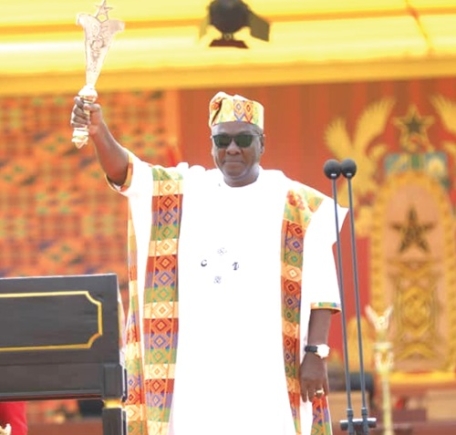
In my book on John Mahama's first presidency, I mentioned that contesting the 2020 and 2024 elections constituted a search for redemption.
Research and interviews pointed to one conclusion: the dominant narrative of his government’s performance in 2016 was incomplete and required revision.
Yet redemption, as I frame it, was conditioned by forces beyond his campaign alone — principally, voters' willingness to grant it, and the governing record of his successors after 2016.
I contend that these two factors, in combination with others, created the conditions that ultimately returned him to office.
This is the context that keeps me watching John Mahama’s presidency very closely — the gains being made, the pressures being navigated, and whether the redemption story will find its proper ending.
It is also what prompted me to look at the Institute of Economic Affairs (IEA) May poll and think carefully about what it tells us about what voters may be signalling and the road ahead for President John Mahama.
Approval rating
The IEA poll found that nearly six in ten Ghanaians — 58.9 per cent — approve of the president's job performance. In an environment defined by high voter expectations and a fiercely active political opposition, that figure is noteworthy.
What gives me pause, however, is the nine-percentage-point drop in approval between December 2025 and May 2026.
The President must guard against this – the temptation to write off the poll numbers in terms of the drop in approval rating.
Even accounting for the poll's margin of error, a decline of that magnitude is not noise; it is a signal of something voters are trying to communicate.
However, it is a two-sided signal.
The first side of the signal points to voters who broadly recognise the administration's progress.
As the poll itself notes, those who approve of the President’s performance cite the economy (73.5 per cent) as their main reason.
This is not surprising, given the current state of the economy’s key indicators.
On the other side of the signal, the decline in performance approval suggests lingering voter grievances that the administration has not yet sufficiently addressed.
Ghanaian voters have become increasingly vocal about what troubles them - their willingness to speak plainly makes the task of identifying their pinch points very straightforward.
The more challenging task is what happens beyond knowing voters' pinch points.
What voters will be judging the administration on is how it translates the awareness of their pinch points into action, and action into satisfactory outcomes.
Bouncing back
It is not entirely impossible to bounce back from low approval ratings, and this President’s historical trajectory is a testament to that. In Afrobarometer Round 6 (2014), his approval of job performance was low (37 per cent), improved to 48 per cent (July 2016) and further improved to 53 per cent (October 2016), as captured by two CDD-Ghana Pre-election surveys.
Former President Kufuor never struggled with low overall approval.
His ratings held firm — 74 per cent in Afrobarometer Round 2 (2002), 76 per cent in Round 3 (2005), and 78 per cent in Round 4 (2008).
But his government did face a decline in how voters assessed its handling of specific policy issues between 2002 and 2005.
That decline, however, was only short-lived.
By Round 5 in 2008, performance approval across all policy areas had recovered so strongly that it reached levels no Ghanaian government has since matched in the history of Afrobarometer surveys in the country.
A similar pattern is observable in the Akufo-Addo presidency.
Afrobarometer Round 7 (2017) recorded strong public approval of the administration's handling of key policy issues, followed by a notable decline in Round 8 (2019). That decline, however, did not persist.
CDD-Ghana's pre-election survey conducted in October 2020 indicated a substantial rebound in approval ratings. In fact, I believe this recovery helped the President’s re-election bid in 2020.
The takeaway point is simply this.
The pattern suggests that such approval dips need not define an administration's ultimate standing with the public. Trajectories are reversible, but it does not happen automatically.
Redemption
At the end of the book, I sit with a difficult question: Does the 2024 electoral victory finally deliver redemption? My answer was deliberately cautious.
The victory opened the door to redemption and nothing more.
Whether redemption follows depends entirely on what the President does with the mandate now in hand.
More especially, what he does with the signals from this poll. I repeat my concluding statement from the book: “May good things happen.”
And if I may add, “may the redemption story become complete by the end of this presidency.”
The writer is the Project Director, Democracy Project.
