
Smartphones have become the primary internet device for the majority of people worldwide, yet security habits have not kept pace with the growing volume of sensitive data stored on these devices, a new Kaspersky survey has revealed.
The global survey found that 58% of respondents now consider their smartphone their main device for accessing the internet, with the trend even more pronounced among Gen Z users, where 67% of those aged 18-28 choose their mobile phone as their primary device. This marks a significant shift away from traditional desktop and laptop computers.
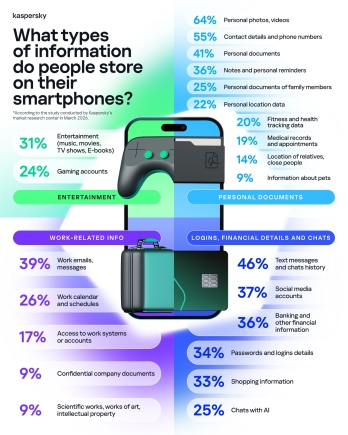
But as phones have become more central to daily life, the amount and sensitivity of data stored on them has increased considerably. Personal photos and videos lead the pack, with nearly two-thirds of users storing visual memories on their devices. Close behind are contact details (55%), text messages and chat history (46%), and important personal documents such as IDs and passports (41%).
Critically, around 54% of users also store work-related data, including emails, calendars and access to corporate systems, blurring the line between personal and professional life. Financial credentials and login details appear on roughly a third of devices, while emerging categories like AI chat histories (25%) and gaming accounts (24%) signal new types of personal data now held on smartphones.
According to Kaspersky, more than 2.67 million attacks using malware, adware or unwanted mobile software were prevented in the first quarter of 2026 alone, with over 306,000 malicious installation packages discovered during the same period .
"Now our smartphones serve as full-featured assistants that touch every aspect of our lives. The data we entrust to them goes far beyond photos, phone numbers or text messages," commented Anton Kivva, cybersecurity expert at Kaspersky . "Consequently, the main question is no longer 'what we store,' but 'how we protect it,' requiring security to become as integral to the device as the data it carries."
Three steps for mobile data security
Kaspersky experts have issued a three-step security plan to help users protect their mobile data.
First, they warn that no data should live on a phone only. Without reliable backups or cloud sync, accidental deletions, loss or hardware failure can make recovery impossible. The most sensitive data, such as passwords, IDs and financial details, should be kept in a protected format using a dedicated security solution.
Second, users must guard against digital threats. Mobile devices require comprehensive protection to scan apps for potential threats upon installation and block malicious and phishing links in real time.
Finally, users should plan for the "what if" scenario of phone loss. This includes turning on location services, enabling automatic backups, configuring instant auto-lock, and keeping the device physically safe in public spaces.
“We often underestimate how much valuable information we keep on our mobile devices and how vulnerable that data truly is,” Kivva added. “While most users automatically think of security software for their computers, phones lag. It’s time to give your everyday digital companion the same robust cyber-protection it deserves.”
