
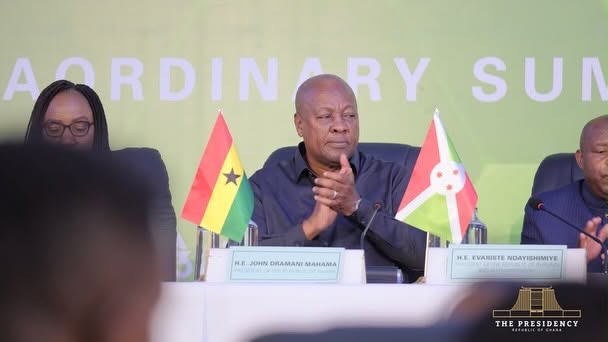
President John Dramani Mahama has urged African nations to break free from dependence on external partners and build self-reliant health systems at the opening of the African Union Extraordinary Summit on Universal Health Coverage and Ending AIDS in Accra yesterday.
The three-day summit, which brings together African heads of state, health ministers and global health experts, is on the theme: "Building a Resilient and Self-Reliant African Health System".
In his opening address, President Mahama drew parallels between the current health challenges and the continent's historical struggle for political independence.
"Accra has always been a city where Africa has gathered to shape its destiny," President Mahama stated, recalling how Osagyefo Dr Kwame Nkrumah convened the All-African Peoples Conference in December 1958.
"Today, 68 years later, Africa gathers once again in Accra to confront a different struggle. The liberation we seek today is not from colonial rule but from inequality, preventable disease, maternal deaths, weak health systems and dependence on others for our healthcare."
The President's address comes at a critical moment when development assistance for health has declined sharply from nearly $50 billion to just over $39 billion within a single year, yet many African countries still rely on external partners to finance almost half of their health budgets.
"This is not the time to speak the language of hopelessness but the language of determination, resilience and action," President Mahama declared.
Accra reset
He announced the "Accra Reset Initiative," a new vision for African health sovereignty, which includes a High-Level Panel on Global Health Architecture and Governance to rethink systems and policies that shape global public health.
The initiative is supported by the Health Investment National Gateway Enablers (HINGE) and the Reform Interlock Observatory.
President Mahama also highlighted Ghana's contributions to the continental effort, including the Ghana Medical Trust Fund, popularly known as Mahama Cares, which protects families from the financial burden of chronic diseases.
The summit will deliberate on financing, governance, local manufacturing and leadership, culminating in the adoption of the Accra Declaration.
"My appeal is that the Accra Declaration should become a living commitment rather than another well-written document.
"We must hold ourselves accountable through regular monitoring, peer review and measurable progress," President Mahama said.
The President expressed full support for Tanzanian President, Samia Suluhu Hassan, in her role as African Union Champion for Maternal and Child Health, pledging Ghana's collaboration through the Accra Reset Initiative to advance the Mother Africa Call to Action.
On local pharmaceutical manufacturing, President Mahama said while Africa still imported about 70 per cent of its medicines and over 90 per cent of its medical devices, encouraging progress was being made with vaccine manufacturing expanding across the continent.
"New scientific capacity is emerging in Dakar, Cape Town, Kigali and many other parts of the continent.
“Ghana is equally investing in vaccine production through the Ghana Vaccine Institute to strengthen Africa's manufacturing capacity," he said.
The President recalled the painful lessons of the COVID-19 pandemic when African nations waited in long queues while wealthier countries secured vaccines first.
Twenty-five years after African leaders pledged in Abuja to allocate 15 per cent of national budgets to health, President Mahama urged that commitment to "move beyond words and become measurable action."
"Let history record that when the old systems began to fail, African leaders gathered once again in Accra and charted a new path towards health sovereignty and total liberation," he said.
The summit continues with closed-door sessions expected to focus on financing mechanisms and the implementation roadmap to 2030.
WHO
Addressing the Summit, the Director-General of the World Health Organisation (WHO), Dr Tedros Adhanom Ghebreyesus, urged African leaders to strengthen health systems and make health sovereignty a political priority.
He warned that Africa could lose decades of progress in the fight against HIV, tuberculosis, malaria and other diseases unless governments step up domestic investment to fill the gap left by declining external funding.
Dr Ghebreyesus assured the gathering that the Organisation remained committed to supporting African countries with technical guidance but stressed that political leadership and investment decisions must come from African governments themselves.
“Only African leaders can provide the political will and investments needed at this moment,” he said.
He encouraged countries to prioritise domestic financing, invest in primary health care, expand local manufacturing and use available data to protect vulnerable populations.
Dr Ghebreyesus added that conflicts, poverty, inadequate education, insecurity and gender inequality also contributed to Africa’s health challenges and must be considered when developing health policies.
Internal support
Addressing the summit, the Chairperson of the AU Commission, Mahmoud Ali Youssouf, said Africa could no longer depend on external financing decisions to protect the health of its people.
“The health sovereignty of the continent can no longer remain dependent on external budgetary decisions. We must finance our health, train our talents and produce our solutions,” he said.
Mr Youssouf said achieving health sovereignty required increased domestic resource mobilisation, stronger involvement of the private sector and African philanthropy, as well as greater investment in healthcare workers, including doctors, nurses, midwives and researchers.
He said the AU Roadmap to 2030 and Beyond could only be achieved if Africa developed a complete health value chain.
“This includes the production of vaccines and medicines, improved regulation through the African Medicines Agency and strengthened disease surveillance through the Africa Centres for Disease Control and Prevention (Africa CDC),” Mr Youssouf said.
Commitment
For his part, the Chairperson of the AU and President of Burundi, Évariste Ndayishimiye, urged Member States to renew continental commitment towards strengthening political leadership, increasing domestic health investments, improving accountability and expanding equitable access to quality health care.
He highlighted Burundi’s community health approach, which focused on health education, vaccination, hygiene promotion and early disease detection, as an example of how locally-driven interventions could improve health outcomes.
She called for such experiences to be shared across the continent, stressing the importance of building health systems that could anticipate challenges rather than only respond to outbreaks.
“The solidarity of African health should not remain an aspiration, but become an architecture; an Africa that heals itself, produces its own solutions and anticipates,” he said.
