
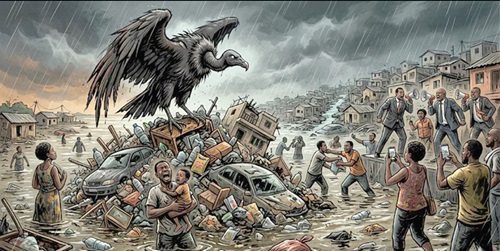
We are a nation of undertakers, waiting for our own country to die so we can pick at the scraps.
There is a specific, putrid quality to the Ghanaian way of life that we rarely acknowledge in polite society.
We call it "resilience."
We call it "getting by."
We call it "survival."
But let’s stop the charade.
What we are witnessing, and actively participating in, is a vulture mindset.
We have become a society that thrives on rot, ignores the decay until the stench is unbearable, and then, when the inevitable disaster strikes, we turn our suffering into a grotesque form of entertainment.
Look at how we respond to the floods.
Every year, like clockwork, the rains come.
Every year, like clockwork, the water rises, the homes we were too lazy to plan correctly are submerged, the filth we tossed into the gutters clogs our own veins, and Ghanaians drown.
And every year, the reaction is the same: we do not fix; we perform.
We scream at the politicians.
The politicians promise "drastic action" that they have no intention of taking.
The pastors pray for the rain to cease.
The citizens stand in the floodwaters and take photos for social media. And then?
The sun comes out.
The water recedes.
The drains remain clogged with plastic, the houses remain in the water’s path, and we immediately return to the real business of our lives: weddings, naming ceremonies, political rallies, and throwing our trash into the streets as if the earth were a personal garbage bin.
It is not just negligence.
It is a deadly attitude. It is a collective commitment to suicide by mediocrity.
The architecture of our own destruction
We have built our cities like unplanned graveyards.
We allow "developers" often the same people who claim to love this nation the most, to pave over wetlands and block natural watercourses for the sake of a quick profit.
We call this "entrepreneurship."
I call it domestic terrorism.
When you build where the water needs to flow, you are not just building a house; you are building a trap for your children. And we, the public, cheer it on. We are so obsessed with the aesthetics of success of the party, the flashy car, the oversized house that we have become blind to the infrastructure of survival.
We care more about being seen at a funeral on Saturday than we care about the state of the culverts in our own neighbourhoods.
We are a nation that would rather spend a month’s salary on a celebration of the dead than spend a single Saturday digging a drain to protect the living. That is the vulture mindset.
We are obsessed with the rituals of consumption, completely oblivious to the fact that the carcass we are picking at is our own future.
The performance of blame
There is nothing more pathetic than the Ghanaian cycle of accusation.
When the disaster hits, we act like the victims of an external force, as if the rain were a foreign invader rather than a natural occurrence.
We blame the government.
The government blames the "indiscipline of the people."
The people blame the lack of drainage.
The cycle closes, the debate ends, and we go back to our "vulture" ways.
We use these moments to avoid the only thing that would actually save us: discipline.
A nation is not built on speeches.
A nation is built on the mundane, boring, exhausting work of maintenance.
It is built by people who don't throw plastic in the street because they respect the space they occupy.
It is built by leaders who have the courage to demolish a multi-million cedi building if it blocks a storm drain. It is built by a citizenry that values order over the chaos of their own convenience.
But we hate order.
We equate order with "oppression."
We equate the enforcement of laws with "persecution."
We have turned our lack of discipline into a point of pride, a symbol of our "hustle."
The stench of our stagnation.
Let’s be honest: We are disgusting
Walk through any major city in this country.
You will see people with degrees, people in suits, people in luxury cars, all casually tossing plastic bags out of windows or dumping refuse into the shadows of the night.
We have internalised the idea that the "public space" belongs to no one, and therefore, it can be treated like a toilet.
Is this the behaviour of a sovereign people?
Is this the behaviour of a nation that claims to be the "Black Star of Africa"?
A star shines; it doesn't rot.
We are a nation of hypocrites.
We complain about the state of the nation, yet we are the very architects of the filth that defines it.
We want the benefits of a first-world country, the roads, the light, the clean water, the safety but we are unwilling to exert the third-world effort required to stop being the cause of our own misfortune.
The day of reckoning
The vulture thrives when there is death.
If we do not stop this cycle, we will continue to pick at the remains of Ghana until there is nothing left.
The floods are not just a weather phenomenon; they are a symptom of a terminal illness.
They are nature’s way of saying that we are not fit to inhabit the land we claim to own.
If you are a Ghanaian and you are not outraged by your own behaviour, you are part of the problem.
If you look at our streets and feel nothing but a mild inconvenience, your soul is as clogged as our gutters.
We are running out of time.
The rains will come again.
And again. And again.
And each time, they will take more from us, more property, more pride, and more lives until we are forced to realise that the enemy was never the politician, the enemy was never the rain, and the enemy was never the "system."
The enemy is the person you see in the mirror.
The enemy is the "vulture" who thinks he can survive by feasting on the decay of his own home.
Stop throwing trash in the street.
Stop building on watercourses.
Stop waiting for a miracle to solve a mess you created with your own two hands.
We are a nation of scavengers, and until we choose to become a nation of builders, we will continue to drown in the filth we have so lovingly cultivated.
The question isn't whether the country can be saved.
The question is whether we are actually worth saving.
