
As the 2026 FIFA World Cup races towards its climax next week, another story is unfolding alongside the battle for football's greatest prize.
North America has become football's farewell stage of a generation that defined the modern game.
Cristiano Ronaldo, Neymar, Luka Modrić, Manuel Neuer and Guillermo Ochoa have all taken what is expected to be their final bows on the sport's biggest stage, bringing to a close an era that has shaped world football for almost two decades and inspired billions of fans across the globe.
Only Lionel Messi remains standing, with the Argentine maestro preparing for a quarter-final showdown with Switzerland in Kansas City early tomorrow morning.
Regarded by many as the greatest player of all time (GOAT),Messi carries not only Argentina's hopes but also the final chapter of a generation that transformed world football.
Whether Messi extends his journey or not, the transition has already begun. The World Cup belongs increasingly to Kylian Mbappé, Erling Haaland, Jude Bellingham, Vinícius Júnior, Jamal Musiala, Lamine Yamal and the next generation ready to inherit football's biggest stage.
The passing of the baton has become one of the defining themes of a tournament that has already shattered records.
The tournament itself has already rewritten history. The first 48-team World Cup has generated more than 20 billion video views across digital platforms, attracted over 6.25 million spectators and filled stadiums to an astonishing 99.7 per cent capacity ahead of next weekend's final at New York/New Jersey Stadium in East Rutherford.
Nonetheless, long after the champions lift the trophy, many supporters will remember something even more emotional: football's greatest performers taking one final bow.
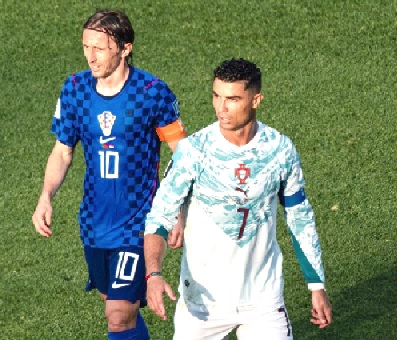
One of the tournament's defining images came in Vancouver, where Ronaldo and Modrić embraced after Portugal edged Croatia 2-1 in a dramatic Round of 32 contest. It was a meeting of two old masters who had shared countless battles at the highest level.
Modrić, gracious in defeat, acknowledged the Croatian supporters before disappearing down the tunnel, while Ronaldo celebrated what proved to be Portugal's final victory of the tournament.
Days later, it was Ronaldo himself saying goodbye. Portugal's Round of 16 defeat to neighbours Spain in Dallas ended the remarkable World Cup journey of the 41-year-old, whose eyes betrayed the heartbreak of knowing there would be no seventh appearance.
He departed as the only footballer to score in six different FIFA World Cups, and as the men's all-time leading international goalscorer with 146 strikes.
His tournament ended without the one prize that had always escaped him, but his legacy never will.
Brazil's exit delivered another emotional farewell. Iconic forward Neymar returned to this tournament after three injury-ravaged years that once threatened to end his international career altogether.
The hope was that football's greatest entertainer might yet enjoy one final run at the trophy that had haunted him throughout his career, including the 2014 tournament hosted by Brazil.
Instead, Brazil were stunned 2-1 by Norway, with Erling Haaland scoring twice to announce, perhaps more symbolically than anyone realised at the time, that the future has already arrived.
Neymar departs as Brazil's all-time leading scorer and one of the most gifted players his country has ever produced. Few footballers combined imagination, improvisation and technical brilliance quite like him.
Croatia's elimination likewise closed an extraordinary World Cup career for Modrić. Across five tournaments — 2006, 2014, 2018, 2022 and 2026 — the elegant midfielder became the heartbeat of Croatia's greatest generation, as he captained his nation to the 2018 final, won the
Golden Ball as the tournament's outstanding player and inspired another remarkable run to third place in Qatar four years later.
Vision, intelligence and leadership became Modrić's trademarks, proving that football's greatest weapon has always been the mind.
The goalkeeping fraternity also witnessed the end of two remarkable careers. Germany’s Neuer fundamentally changed how elite goalkeepers play the game, his fearless interpretation of the sweeper-keeper role transforming the position, and encouraging an entire generation of coaches to rethink what was possible from a goalkeeper.
Mexico's Guillermo Ochoa leaves behind a different legacy. For many years he became the face of his country's resilience at successive World Cups, producing spectacular performances that repeatedly frustrated the world's finest forwards.
His farewell, following Mexico's elimination by England, was among the tournament's most poignant scenes for the veteran goalkeeper whose career began with Club América in 2004 before taking him across France, Spain, Belgium, Italy and Cyprus.
This World Cup has felt like the closing chapter of a remarkable football generation, yet new heroes are waiting in the wings to carry the torch.
Young superstars such as Mbappé, Haaland, Bellingham, Musiala and Yamal are already reshaping the sport and preparing to dominate the decade ahead.
