
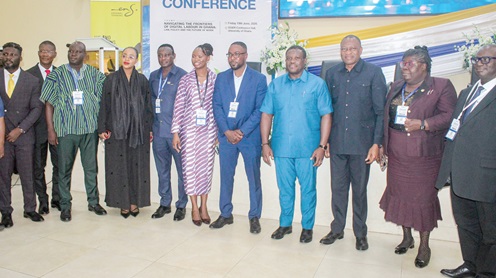
Ghana’s labour laws must evolve to address the realities of the digital economy as technological advancements continue to transform traditional employment relationships, speakers at the Annual Labour Law Conference have stated.
They observed that the increasing use of digital platforms, app-mediated work and algorithmic management was creating new forms of employment that were not adequately contemplated by the country’s existing labour legislation, particularly the Labour Act, 2003 (Act 651).
The speakers stressed the need for legal, policy and institutional reforms to ensure that workers engaged in the digital economy enjoy adequate labour protections, access to social security, and effective mechanisms for the enforcement of their rights.
They further underscored the importance of collaboration among lawmakers, the judiciary, academics, legal practitioners and labour institutions in shaping a regulatory framework capable of responding to the changing world of work.
The speakers were the Majority Leader and Member of Parliament (MP) for Bawku Central, Mahama Ayariga, and a Justice of the Supreme Court of Ghana, His Lordship Patrick Gabriel Pwamang.
The issues came to the fore at the annual labour law conference and the inauguration of the Labour Law Society of Ghana at the University of Ghana School of Law in Accra on the theme: “Navigating the Frontiers of Digital Labour in Ghana: Law, Policy and the Future of Work.”
Legislative reforms
Delivering his speech at the conference last Friday, Mr Ayariga said the country’s economy was undergoing significant digital transformation while the labour laws had not kept pace with emerging forms of work.
He said many digital workers, including ride-hailing drivers, delivery couriers and microtask workers, often operated outside the protection afforded workers in conventional employment relationships because they were classified as independent contractors.
Such arrangements, he said, exposed workers to income insecurity, limited bargaining power, lack of social protection and challenges arising from algorithmic management systems that determined work allocation, performance assessments, and other employment-related decisions.
He proposed a three-pronged legislative approach involving amendments to the Labour Act, or the enactment of a standalone Digital Employment Act, mandatory social security and healthcare contributions by digital platforms and stronger safeguards against unfair algorithmic practices.
The Majority Leader also advocated legal reforms that would enable Ghanaian workers to seek redress in local courts where their labour rights were violated, irrespective of contractual provisions requiring disputes to be resolved in foreign jurisdictions.
Judicial perspective
Justice Pwamang said in his keynote address that although the Labour Act was considered robust and innovative when enacted in 2003, it did not anticipate the emergence of digital platforms, app-based work arrangements and algorithmic management systems that now shape employment relationships in many sectors.
Justice Pwamang added that existing legal concepts of workers, employers and employment contracts did not neatly fit many forms of digital labour, creating challenges for labour adjudication and the protection of workers’ rights.
He said that while labour institutions had engaged with some of these emerging issues, the country’s judicial jurisprudence had yet to fully address the legal realities of platform-based employment.
Referring to ride-hailing drivers and delivery riders, he questioned what remedies would be available to such workers when their services were terminated, and it became difficult to identify a conventional employer.
Preparing workers for AI era
A panel discussion session focused on the impact of artificial intelligence, automation and digital technologies on employment, labour rights and future workforce requirements.
The Minister of Labour, Jobs and Employment and MP for Wa Central, Dr Abdul-Rashid Hassan Pelpuo, said workers would increasingly be required to upgrade their skills to remain relevant in a rapidly changing labour market.
The Minister of Communication, Digital Technology and Innovations and MP for Ningo-Prampram, Samuel Nartey George, said the formal recognition of gig and platform workers would require broader policy discussions involving taxation and regulation.
The Chairman of Parliament’s Select Committee on Employment, Labour Relations and Pensions and MP for Afram Plains South, Joseph Appiah Boateng, acknowledged that resource constraints continued to affect institutions responsible for labour regulation and enforcement.
He said Parliament remained committed to scrutinising budget allocations and advocating adequate funding, staffing, logistics and capacity-building support for labour-related agencies, including the National Labour Commission.
