
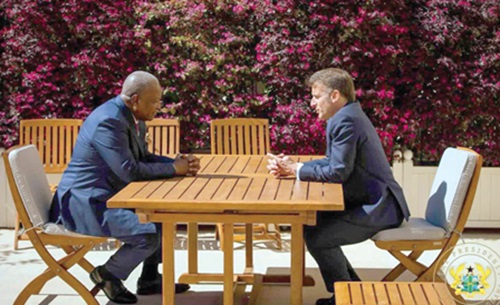
French President Emmanuel Macron has reaffirmed France’s commitment to reparatory justice, declaring the French government’s will to join Africa and the Caribbean in laying down the first steps towards repairing, reconciling and sharing a common future.
President Macron, who joined the Next Steps Consultative Conference held in Accra from the Élysée Palace in France last Thursday, said his country had heard the message adopted by the UN General Assembly on March 25 during the International Day of Commemoration of the Victims of Slavery and the Transatlantic Slave Trade.
He added that the UN Resolution deeply echoed the work France had been committed to for a long time, especially since the adoption of the law recognising slavery and trafficking as a crime against humanity 25 years ago.
France’s position
Explaining France’s abstention on the UN Resolution, President Macron said it was neither by indifference nor by retreat, but because the French government had become attached to a universal and universalist conception of memory as a crime against humanity, and vigilant to never establish a hierarchy in horror.
“I do not want to allow any misunderstanding; France fully supports the call launched by the General Assembly.
This call is to establish historical truth in all its depth, in all its complexity, to make victims of slavery and victims of trafficking live their memories with dignity, lucidity and fidelity,” he said.
The French President indicated that more than 15 million women, men and children were torn from their homes, deported, dehumanised, reduced to the state of commodities.
This tragedy, he said, had sustainably shaped societies, economies, imaginations, and relations with the world which could not be forgotten.
France’s abolition history
President Macron recalled France’s complex history with slavery, stating that it abolished slavery for the first time during the French Revolution in the wake of the Declaration of the Rights of Man and of the Citizen and re-established it a few years later under the Empire before it was definitively abolished in 1848.
He said a century later, in Paris, the Universal Declaration of Human Rights was proclaimed, adding that the 20th century had also seen the birth of an international human rights law, patiently built to oppose arbitrary justice and human dignity at the crossroads.
Ongoing joint work
He listed ongoing French efforts to confront colonial and slavery history, including work with Rwanda and Algeria through a “mixed joint commission that we wanted to launch on colonisation,” and Cameroon through “the work of history, which was also led by a joint commission on the war after colonisation.”
He also referenced the joint work that “we started with Haiti, with the UN, with experts, historians on both sides, jurists, to come back to the history and the debts between our two countries.”
Domestically, he said French higher education and research would continue to support the work devoted to colonial history, the history of slavery and that of treason, and continue to advance it.
Reparations
On reparations, President Macron said the forms could be reduced to a simple logical count, stating that it included precisely giving place to the scientific and historical truth.
“It is recognising it, it is building monuments, it is teaching, searching, repairing and restoring works of art that have been stolen in these periods. Repairing is also being able to redeploy situations, as we are doing with Haiti,” he said.
He cautioned that in no way can repairing be a final point, a chief fact that would mean ending a history, ending it; adding, “it will continue, and they will continue to carry these names, these memories, these faces, to repair, to move forward, to talk about life.”
President Macron assured the summit of France’s full determination to pursue the path of historical recognition with all its partners, and expressed hope that all parties would advance together to build a common approach based on knowledge, dialogue and justice.
