
The Ministry of Transport is pursuing a multi-pronged approach to address the nation's escalating urban traffic congestion which is imposing significant economic and environmental costs on the nation.
In the short term, the ministry Is focusing on immediate infrastructure expansion and increasing vehicle fleets. These include various state owned transport institutions increasing their fleet to cater for the increasing number of passengers.
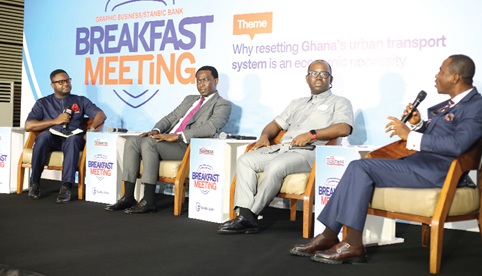
The Director of Policy and Planning at the ministry, Eric Tetteh Addison, said this during a panel discussion of the first edition of the 2026 Graphic Business/Stanbic Bank Breakfast Meeting held at the Labadi Beach Hotel in Accra yesterday.
It was on the theme: "Why resetting Ghana's urban transport system is an economic necessity", said the government had long realised the economic cost to traffic congestion.
Clarification
Mr Addison clarified the division of responsibilities between the Transport Ministry and Ministry of Roads and Highways.
“While the Ministry of Transport regulates and supervises service provision, road infrastructure falls under the Ministry of Roads and Highways.
If the infrastructure is not there, you cannot provide the service," he said, and called for more collaboration to maintain and expand existing roads while exploring alternatives.
Mr Addison said that his outfit was promoting multimodal transport options which included coastal sea transport along the shoreline to shift passenger movements from roads to the sea, and through the Volta Lake which was expected to move cargo northward and southward also by water.
On the persistent problem of disabled vehicles blocking major roads, he said that regulations were advancing through Parliament's Subsidiary Legislative Committee.
And once approved, vehicle registration at the DVLA would include a mandatory towing fee.
“Drivers will register with service providers for prompt removal and after 30 minutes, if you don't come, National Road Safety Authority itself will come and pick it to a designated point where they will charge you for that," he said.
Reflections
The Executive Head of Marketing at Stanbic Bank Ghana, Mawuko Afadzinu, reflected on past efficient transport systems and critiqued failed initiatives like the Ayalolo bus rapid transit and a collapsed revolving fund for new buses.
He cited a Glimmer Research study which estimated GH¢4.5 billion in annual economic losses from congestion, with time lost accounting for 71 per cent, alongside environmental impact of 73,000 tonnes of avoidable CO2 emissions.
Professor Enoch F. Sam of the University of Education, Winneba, a co-panellist, provided academic context on systemic urban planning and transport constraints across sub-Saharan Africa.
While Isaac Simpson, Head of Financial Advisory and Equity Capital Markets at Stanbic Bank Ghana, discussed financial burdens on drivers and the potential for modal shifts through reliable mass transit.
