
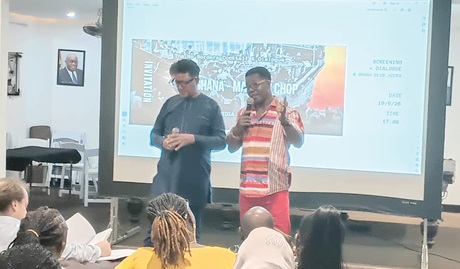
A coalition of civil society organisations, diplomats and filmmakers gathered at the Ghana Club in Accra last Friday for a retrospective screening of a documentary on migration within the sub-region.
Dubbed "Omo Ghana – Man for Chop," the 61-minute documentary was used as a launchpad to drum up support for a new feature, "No Borders," aimed at countering rising xenophobic and afrophobic sentiments across the continent.
The screening, which was organised by AI Media, producers of the documentary, the Coalition of CSOs on Migration, Ghana (CCMG), the Ghanaian-European Centre for Migration and Development (GIZ-MEG) and Ghana Club, drew African high commissioners, embassy officials, policymakers and migration-focused CSOs.
Documentary
"Omo Ghana" chronicled the 1983 expulsion of about two million West Africans, including one million Ghanaians, from Nigeria.
Excerpts shown at the event also traced earlier expulsions — the first in 1954, the 1969 Aliens Compliance Order in Ghana and the 1983 deportation of undocumented Ghanaians from Nigeria under the Shehu Shagari administration.
The film featured testimonies of traders and skilled workers, including accounts linked to Enugu and the Enugu–Onitsha Expressway and scenes from Agege Market in the days before the expulsion.
It also documented Ghanaians who returned home after the ousting of Hilla Liman, journeys from Tetteh Quarshie to Tema, with survivors such as Agya Ntow and Twumasi sharing their bitter experiences from the expulsion.
Another victim, Asabea, who left her child behind in Ghana due to economic hardship, also recounted the trauma of leaving the country due to the harsh economic realities of the time, with Mr Azamati, another contributor, recounting the tragedy of those who did not survive the ordeal, including drowning at sea, stories he said were never fully told.
Focus
Speaking on the sidelines of the screening, AI Media's Director and Chief Strategist, Kwame Boadi, said the documentary was meant to confront historical amnesia around the expulsions.
"We realised that lots of the so-called Gen Zs didn't have this history, so we thought we should capture it, especially in today's world where there's xenophobia, Afrophobia and the migrant is vilified," he said.
He added that the upcoming "No Borders" documentary would pivot from trauma to commonality, focusing on Ghana, Nigeria, Benin and Togo to show shared language, music, food and fashion that predated colonial borders drawn in Berlin in 1884.
The Technical Director, Oliver Safo, said the goal was to educate young people weighing emigration to "go with the best of information" while also urging Ghanaians to welcome incoming migrants, citing recent events in South Africa as a cautionary example.
The duo said "No Borders" would build on the same Ghana-Nigeria-Benin-Togo axis, using shared cultural ties to make the case for a united, freely mobile Africa, with comparisons drawn to the European Union's economic integration.
Ratification
National Coordinator of CCMG, Eric Boakye Peasah, used the platform to push for ratification of the African Union's Free Movement Protocol, which requires 15 countries to ratify before it takes effect. Only five countries have done so.
"The major bottleneck is that every country is looking at security issues, but ratification doesn't mean you don't have laws," he said, citing Rwanda's economic gains from ratifying the protocol and calling on Ghana to champion the cause.
For his part, GIZ-MEG Head of Programme Andreas Berding said the German Development Cooperation's support for technical and vocational education in Ghana was aimed at giving young people marketable skills both for the local job market and the international stage, as migration narratives shifted from crisis framing towards development opportunity.
A Pan-Africanist, Ebenezer Alabi, said it was time for governments on the continent to commit to a borderless continent, citing the successful expansion of Kasapreko into the Nigerian market and the expansion of Nigerian banks into Ghana.
