
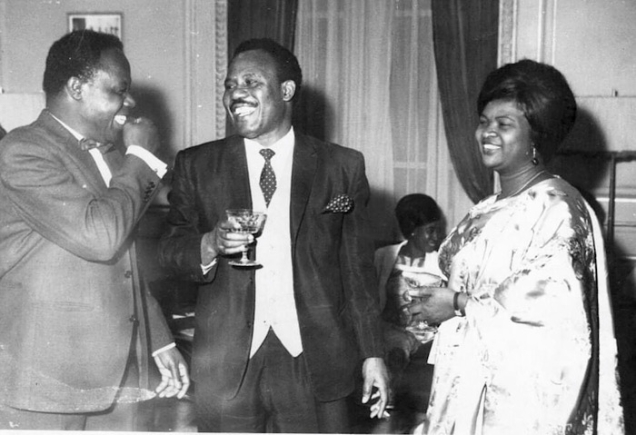
D. K. T. Djokoto advised Ghana's delegation at the 1963 UN Vienna Conference, arguing a position at the heart of consular law that still holds today
In March 1963, delegates from across the globe gathered in Vienna for one of the twentieth century's quieter diplomatic exercises: the United Nations Conference on Consular Relations. Over seven weeks, the conference produced the Vienna Convention on Consular Relations, the treaty that still governs how consulates operate, how consular officers are protected, and how nations manage the everyday business of their citizens abroad.
Among the advisers representing the Republic of Ghana was Prince Daniel Kojo Tɛŋgɛ Djokoto, an Aŋlɔ royal from the lagoon island of Anyako who had travelled from a colonial classroom to the Bar of England and Wales within little more than a decade. His name doesn't appear in the history books alongside Nkrumah, Danquah or Gbedemah. But at the Fifteenth Meeting of the First Committee in Vienna, Djokoto, working alongside T. R. D. Addai of Ghana's Ministry of Interior, advised the delegation and strongly argued a position on a point that remains central to consular law today: that no state should be required to explain itself when refusing to grant an exequatur, the official recognition that allows a foreign consul to take up their post.
It was a technical point, but not a small one. The principle protects a state's sovereign right to decline a diplomatic appointment without justifying that decision to another government, a safeguard consular officers and foreign ministries still rely on. Djokoto's advocacy for it, as part of a delegation led by Theo O. Sowa, Ghana's Consular-General in New York, put a young Ghanaian lawyer inside the negotiating rooms where modern consular law was drafted, less than six years after Ghana had won its own independence. It's a small but telling chapter in a life spent moving between two worlds: the customary authority of an Aŋlɔ royal household, and the emerging institutions of a modern African republic.
Born on the Lagoon
Daniel Kojo Tɛŋgɛ Djokoto was born on 26 May 1924 in Anyako, an island town on the Keta lagoon in the Aŋlɔ State, in what was then the Gold Coast. He was the second son of King Apewu Tɛŋgɛ Dzokoto III, Dufia (City Ruler) of Anyako, who also served as Miafiagã, Commander-in-Chief of the Left Wing division of the Aŋlɔ State, from 1921 until 1946. His reign was marked by internal rebellion and protracted litigation to defend his authority, and by an eventual consolidation of power so complete that he earned the title "Defender of the Dynasty." He also laid the groundwork for the Dufiafe, the local government structure meant to preserve the island's political order and the prestige of its throne.
Daniel's mother, Martha Agluma Gbormittah, came from a prosperous merchant family in the port town of Simpa, now known as Winneba. Agluma was, by the standards of her time, a modernist, drawn to the Victorian fashions and manners that had filtered into Gold Coast port towns since Christian converts first began importing European dress in the mid-nineteenth century. In towns like Simpa, western style had become a marker of status. Daniel's father took the opposite view. King Tɛŋgɛ Dzokoto III was an ultra-conservative Aŋlɔ traditionalist and committed anti-imperialist who regarded British fashion, and the ideas that came with it, as a slow erosion of Aŋlɔ culture. The tension between his parents shaped much of Daniel's own outlook.
In 1932, after a long negotiation between his parents over these competing values, Daniel was sent to the African Methodist Episcopal Zion School in Simpa for his elementary education. The school was a fully African-owned institution, shaped by intellectuals such as Samuel Richard Brew Attoh Ahuma and James Emmanuel Kwegyir Aggrey, and built around an ethos of African liberation. Daniel excelled there, passing his Standard VII certificate examination with distinction.
His father's reign continued to be tested through the 1930s and into the 1940s, and he met those challenges through the courts and, by his family's own account, through the loyalty of a tightly bound household and security apparatus.
The Green Hill Years
In 1939, on a scholarship, Daniel enrolled at Prince of Wales College, one of the Gold Coast's most prestigious secondary schools. There, on what alumni fondly called "the green hill," he developed lasting interests in rhetoric, poetry and music, alongside weightlifting, martial arts and lawn tennis. In 1946, King Tɛŋgɛ Dzokoto III died, ending his twenty-five-year reign.
The following year, Daniel joined the post-secondary teacher-training department at Prince of Wales College and, once qualified, was retained as a teacher for about a year. It was a turbulent period for the wider colony. On 20 February 1948, the Ex-Servicemen's Union, demobilised soldiers led by B. E. A. Tamakloe, assembled at the Palladium Cinema in Accra to rally the city's market women and men struggling to support their households. Eight days later, on 28 February, the group broke from an agreed route and marched instead toward Christiansborg Castle. Police responded with tear gas and gunfire; twenty-nine people died in total and 237 were injured. That day is widely regarded as a turning point in Gold Coast nationalist politics, one that helped set in motion the movement that led to independence a decade later.
Later that same year, Daniel began reading Classics at Prince of Wales College under Professor P. Guerrey, and, during a trip to Winneba, met a young woman named Agatha Quansah, who was living there with her maternal uncle, Joseph Wellington Taylor. It was also around this time that Daniel came under the influence of a fellow old boy of Prince of Wales College: Komla Agbeli Gbedemah.
Gbedemah, Nkrumah, and the Making of a Nationalist
Gbedemah, born on 17 June 1913 in Warri, Nigeria, and raised with roots in Anyako, would go on to become one of the most consequential political figures of Ghana's independence era, the strategist widely credited with propelling Kwame Nkrumah to national prominence. As an indigene of Anyako, Gbedemah was, in the strict customary sense, one of Daniel's own subjects as a royal of that town. That didn't stop him from persuading the young prince toward a very different vision of political life: a modern, fully autonomous democratic republic. Gbedemah remained a dominant figure in Ghanaian politics for decades, until his death, at 85, on Saturday, 11 July 1998.
Daniel, handpicked by Gbedemah, joined the Committee on Youth Organisation, the youth wing of the United Gold Coast Convention (UGCC). At the time, participation in the UGCC's social and political life was effectively reserved for the literate and educated. That began to change in January 1948, when Nkrumah, a committed Marxian socialist who had arrived in the Gold Coast the previous December on the recommendation of barrister Ako Adjei, was installed as the UGCC's general secretary at a salary of £20 a month. His first act was to rewrite the organisation's constitution, expanding its membership well beyond the educated elite.
The move unsettled the UGCC's existing leadership almost immediately. Nkrumah later wrote in his autobiography that he was prepared to "come to loggerheads" with the UGCC's Executive if he judged their course reactionary, and UGCC vice-president R. S. Blay worried openly that Nkrumah "would use the Convention as if it were his own organization." Danquah pressed him on how he reconciled his pan-African ambitions with the UGCC's narrower domestic aims. Even Nkrumah's use of the word "comrade" alarmed committee members wary of its political connotations.
The uneasy coexistence between Nkrumah and the UGCC's Working Committee lasted until mid-1949, when he was suspended as secretary. Weeks later, at a meeting in Nana Ofori Atta's Accra home, coinciding with a controversial Nkrumah publication in the Accra Evening News, Sekondi timber merchant George "Pa" Grant, who had founded the UGCC, demanded Nkrumah's removal. Compromise proposals followed, ending with Nkrumah accepting the honorary treasurership in November. But by February 1949, with the Committee on Youth Organisation rallying behind him in Kumasi, the rupture was complete. Nkrumah broke away to found the Convention People's Party (CPP), and the UGCC became, in the family's account, a determined rival to the new party.
The CPP's base differed sharply from the UGCC's, drawing heavily on the urban poor and lower middle class: students, teachers, junior civil servants and traders who felt shut out of modernisation's promises. As historian Kwesi Armah later put it, the divide was between the "old and conservative UGCC and the young and radical CPP." Daniel, along with most of the UGCC's membership, moved swiftly to Nkrumah's side, leaving only a small remnant loyal to the party's founders.
Daniel's own political identity was more layered than a simple defection. A committed nationalist shaped by direct exposure to colonial rule, he became, in the family's telling, a "constitutional progressive" after joining the CPP: supportive of its radical, populist energy in principle, while remaining privately uneasy, as a member of a conservative elite, about some of the very people who formed its backbone. He also broke from the party's own optimism about constitutional reform, disagreeing with the Coussey Report's recommendations and maintaining that they vested real policy formulation in the hands of the colonial governor rather than an elected body. The CPP itself denounced the report as a "Trojan gift horse," and Nkrumah toured the country arguing that the indigenous leaders who sat on the Coussey Committee had betrayed the push for self-government by accepting continued ex-officio colonial oversight of the cabinet.
Daniel also backed a parallel front of resistance: Nii Kwabena Bonne's anti-inflation boycott against the Association of West African Merchants, whose price-gouging on imported goods had become a flashpoint for ordinary consumers. The campaign forced price reductions and showed that Ghana's political energy was shifting from the Legislative Assembly into the streets, a lesson not lost on Nkrumah, or on Daniel.
Building a Business Before Building a Legal Career
In 1950, still in his mid-twenties, Daniel founded D. K. T. Djokoto & Co., a family office that took over financial and administrative management for the Tɛŋgɛ Dzokoto royal family of Anyako. From a modest office, the firm drafted promissory notes, financed coastal merchants, offered bookkeeping services to traders in the Atlantic import-export trade, and brokered commodity prices for farmers and fisherfolk selling into a produce market still dominated by expatriate firms.
The venture was an attempt to give an old royal institution, founded in 1776 and built on two centuries of customary statecraft, a modern commercial foundation. Daniel trimmed unnecessary expenses, diversified the family's assets, and treated goodwill and client confidentiality as core assets in their own right.
In 1952, Daniel became one of the first students to move from Achimota to the newly established campus at Legon Hill, joining the University College of the Gold Coast as a founding member of Legon Hall, alongside contemporaries including Emmanuel Noi Omaboe and Joseph Henry Mensah, men who would themselves go on to shape Ghana's post-independence institutions.
Around the same time, the Anyako royal family, increasingly conscious of its diminished standing since King Tɛŋgɛ Dzokoto III's death, concluded that it needed a barrister among its own princes. The reasoning was practical: as English legal proceedings became a viable route for subjects to challenge royal decisions, the family's authority could no longer rest on custom alone. Daniel, with his academic record and bureaucratic instincts, was considered an ideal candidate, though his path would carry him well beyond that original brief.
From Aŋlɔ Counsel to Pan-African Idealist
With encouragement from Gbedemah, Daniel's ambitions shifted from serving as counsel to the Anyako Kingdom toward a broader engagement with the pan-African project Nkrumah was championing. He grew steadily more detached from his family's long-running effort to restore the Aŋlɔ State to something like full autonomy, even as he remained tied to it by birth and loyalty. He described his own worldview as a kind of enlightened ethnocentrism, in which solidarity with kinsmen didn't need to come at the expense of a wider African fraternity.
Funded by the royal family, he undertook a three-month study tour of the United Kingdom during his final year of study, drawing inspiration, by his family's account, from the diplomatic legacy of his grandfather, Tɛŋgɛ Dzokoto II. On his return to the Gold Coast, he told his family he intended to pursue law professionally, and they agreed to finance his education abroad.
The political backdrop was moving quickly. In July 1953, Nkrumah moved a motion in the Legislative Assembly demanding that Britain grant the Gold Coast its independence. The resulting constitutional changes abolished the European-nominated Assembly members who had represented the Chambers of Commerce and Mines, produced the first All-African Cabinet, and created a fully elected Legislative Assembly. By 1954, independence was effectively a foregone conclusion awaiting formal ratification, which arrived in 1957.
London, Marriage, and the Bar
On 6 May 1955, Daniel enrolled at the Inns of Court School of Law at the University of London, earning his Bachelor of Laws in 1958. That same year, he asked Agatha Quansah, the young woman he had met years earlier in Winneba, to join him in Britain. She crossed the Atlantic by boat, a six-week journey, and the two married shortly after. Agatha trained and worked as a teacher, beginning at Our Lady of Apostles Girls Senior High School and later St Michael's. The couple settled into a modest villa at 552 Finchley Road in north-west London, home for six years and, in time, to five children: three daughters and two sons, Catherine, Anthony, Helen, Vincent and Juliana.
Theirs was, by the family's description, a marriage built on affection rather than shared professional ambition. Agatha had little appetite for diplomacy or politics, focusing instead on social and ceremonial life: hosting the steady procession of officials through their home, accompanying Daniel on public functions and foreign visits, and cultivating friendships across interests ranging from museums and historic palaces to Catholicism and cookery.
In 1960, Daniel was admitted to the Bar of England and Wales as a member of the Inner Temple. His career had already turned toward diplomacy: while still at the Inns of Court School of Law, he was appointed by President Kwame Nkrumah as Second Secretary responsible for foreign policy at the Ghana High Commission in London.
A Republic Comes of Age
The same year brought sweeping constitutional change at home. A plebiscite held in April 1960 elevated Ghana's Third Parliament to full democratic autonomy, ending the tenure of the colony's last Governor-General, the Earl of Listowel. On 2 July 1960, the first Parliament of the new Republic convened to elect its Speaker and Deputy Speaker; later that day, Nkrumah assumed the role of Commander-in-Chief of the armed forces. That same year, seventeen formerly colonial African states, including Togo, Mali, Senegal, Nigeria, the Congo and Ivory Coast, achieved independence, part of a continental wave of decolonisation Ghana had led.
Daniel's diplomatic career advanced alongside these events. He was promoted in 1961 to First Secretary in charge of consular affairs at the Ghana High Commission in London, and later became Minister-Counsellor, a post he held until 1966. It was from this platform that he travelled to Vienna in 1963 as an adviser to Ghana's delegation at the UN Conference on Consular Relations, the setting for his intervention on the exequatur question.
His diplomatic portfolio extended well beyond consular law. In 1964, as part of a delegation led by Susanna Al-Hassan, Deputy Minister of Education, he represented Ghana at the Third Commonwealth Education Conference, a natural extension of his own background as a trained teacher. In 1965, alongside Shipping Commissioner Y. K. Quartey, he represented Ghana at the Intergovernmental Maritime Consultative Organisation. And, working with K. Gyeke Darko, then Ghana's Principal State Attorney, he served on the Asian-African Legal Consultative Committee across eight sessions in Bangkok, contributing to work on refugee rights, double taxation and fiscal evasion, the codification of principles of peaceful coexistence, and the International Court of Justice's rulings on the South West Africa cases.
Agatha, meanwhile, built her own record of quiet public service. In 1964, she launched the Sakumo Lagoon, the Black Star Line's first cargo liner, ordered from the Swan Hunter shipyard, at Tyneside in England, a marker of Ghana's young merchant marine ambitions and of Agatha's own public role alongside her husband's.
Cairo, War, and a Return Home
Ghana's political order shifted abruptly on 24 February 1966, when a coup toppled Nkrumah's government. In its aftermath, Daniel was reposted as Chargé d'Affaires at the Ghana Embassy in Cairo, then part of the United Arab Republic, a post he held until 1970. In Cairo, Agatha founded a Diplomatic Wives Association to support the spouses of newly arrived diplomats adjusting to life in a new country. The family was living there during the Arab-Israeli Six-Day War of 1967, a period of acute regional instability that placed Ghana's mission in the middle of one of the defining conflicts of the era.
He continued to travel back to Ghana during this period, including for an appointment in 1967 to a four-member commission investigating the affairs of the State Fishing Corporation. Chaired by S. A. Wiredu, the commission held 258 sittings, heard 243 witnesses, and examined 256 exhibits before presenting its findings to A. A. Afrifa, chairman of the National Liberation Council.
When the Busia-Akufo-Addo administration later offered him the post of Ambassador to Italy, Daniel declined, choosing instead to return permanently to Ghana, pursue a seat on the bench, and reinvest in the rebuilding of Anyako and the wider Aŋlɔ state. He was called to the Ghana Bar Association in 1971.
A Judgeship, and a Sudden End
Djokoto was subsequently appointed a judge in the Judicial Service of Ghana, a position he held only briefly. He died at 48 at the Amishadai Lawson Adu Lodge, an official government residence near Christiansborg Castle where he lived. His family's account describes a life young but already well ordered, its affairs settled.
He left behind a reputation, in his family's words, as debonair, charming and kind: a genuine cosmopolitan and lifelong supporter of African unity, but above all a Ghanaian nationalist with a deep attachment to Anyako, the island of his birth.
A Life at the Hinge of Two Eras
Djokoto's story is worth retelling for the arc it traces: a royal household adapting, in real time, to the collapse of colonial rule and the construction of a modern African state. Born into a system where authority ran through bloodline and customary title, educated in institutions built to produce African leadership, drawn into the CPP's populist energy despite his own reservations about it, he ultimately found his fullest expression of public service not on a royal stool but inside the technical machinery of international law: at the UN in Vienna, at the Commonwealth Education Conference, in Bangkok's Asian-African Legal Consultative Committee sessions, and at diplomatic posts in London and Cairo during two of the most turbulent decades in modern African and Middle Eastern history.
The Vienna Convention on Consular Relations remains, more than six decades later, the backbone of how nations manage embassies, protect their citizens abroad, and resolve diplomatic disputes. Ghana's contribution to the negotiations that produced it, through a prince from a lagoon island barely a decade after his country's independence, advising on a principle still central to that law, is a detail largely absent from standard accounts of Ghana's early diplomatic history. The people who built that framework weren't only the statesmen whose names are widely remembered; they included advisers like Djokoto, whose arguments, made in committee rooms rather than headlines, still echo in how the world's diplomats operate today.
