


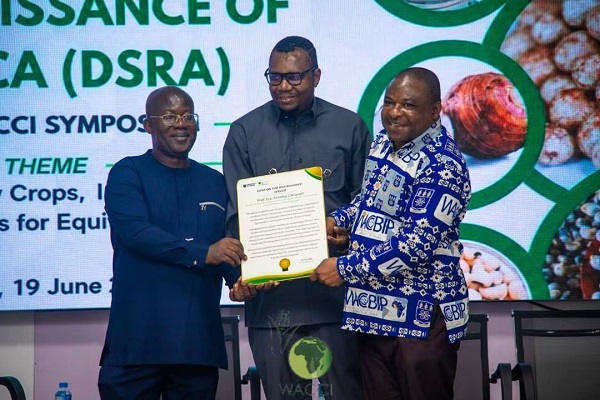
A Founding Director of the West Africa Centre for Crop Improvement (WACCI), Professor Eric Danquah, has called on the government to make strategic investments in agricultural research, innovation and improved seed systems to help reduce the country's food import bill by more than 60 per cent.
This, he said, was significant to boosting local food production, enhance food and nutrition security, create employment opportunities along agricultural value chains, conserve foreign exchange and strengthen the national economy through increased agricultural productivity and industrial growth.
Speaking at the WACCI Day of Scientific Renaissance of Africa (DSRA) at the University of Ghana in Accra last Friday (June 19), Prof Danquah stated that the country had the scientific capacity and expertise needed to transform its agricultural sector and boost local food production.
“If we target reducing our import bills by more than 60 per cent, we can do it, but not through business as usual.
“The sustained investment in science, technology and innovation would help close crop yield gaps, improve food security, create jobs and strengthen Ghana’s economy,” he said.
The WACCI Day
The WACCI Day of Scientific Renaissance of Africa (DSRA) was organised to promote the role of science, innovation and partnerships in driving Africa's agricultural transformation and sustainable development.
On the theme, “Opportunity crops, innovation, and partnerships for equitable development,” the symposium formed part of activities marking the University of Ghana's 2026 DSRA celebration.
It brought together stakeholders from academia, government, industry, development organisations and the student community to explore strategies for advancing opportunity crops and building resilient agrifood systems across the continent.
Capacity building
Prof. Danquah stressed that Africa's growing population required deliberate investments in scientific capacity, research and innovation to drive agricultural transformation and economic growth.
He said countries such as China, Brazil and Malaysia had successfully used science and technology to improve crop productivity and reduce food insecurity, and urged Ghana to emulate their example.
He called for sustained government support for research institutions, arguing that centres such as WACCI had demonstrated their value through the development of improved crop varieties and the training of plant breeders across Africa.
He added that placing agricultural research and innovation at the centre of national development planning would help create jobs, strengthen food systems and transform scientific knowledge into national prosperity.
Opportunity crops
The Director of WACCI, Prof. Daniel Dzidzienyo, said Africa possessed enormous agricultural potential, but many opportunity crops with the capacity to improve nutrition, create jobs and boost economic growth remained underutilised and underfunded.
He stressed that unlocking the potential of such crops would require effective seed systems, supportive policies, private-sector investment and strong partnerships across the agricultural value chain.
Prof. Dzidzienyo added that WACCI remained committed to advancing science, innovation and human capital development to build resilient agrifood systems and promote equitable development across Africa.
Investing in Africa's scientific future
The Provost of the College of Basic and Applied Sciences (CBAS), Prof. Sandow Yidana, said the Day of Scientific Renaissance of Africa was a reminder of the continent's rich scientific heritage and its potential to drive sustainable development through research and innovation.
He stated that institutions such as WACCI had demonstrated how strategic investments in science, partnerships and human capital development could generate solutions to pressing agricultural and societal challenges across Africa.
Prof Yidana urged governments, development partners and the private sector to increase support for scientific research and innovation, stressing that Africa's transformation depended on sustained investment in knowledge, technology and the next generation of scientists.