
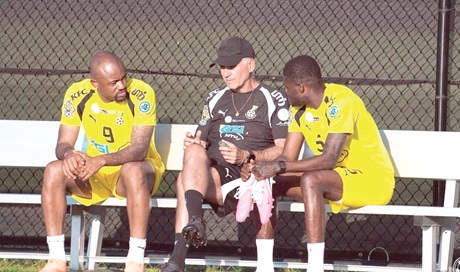
When the Ghana Football Association announced the appointment of Carlos Queiroz as head coach of the Black Stars, reactions were divided.
For some, the departure of Otto Addo signalled the end of an era that had failed to fully convince supporters despite flashes of promise.
For others, the arrival of the veteran Portuguese coach raised questions about whether a 73-year-old manager was the right man to lead Ghana into the future.
Yet, football has always been a game of first impressions and Queiroz's debut on the Black Stars bench against Wales appeared to have softened some of the scepticism.
While one match cannot define a coach's tenure, it offered a glimpse of the qualities that have made Queiroz one of the most respected international football managers of his generation.
More importantly, it reminded Ghanaians that the man now entrusted with leading the Black Stars to the 2026 FIFA World Cup is no stranger to football's biggest stage.
Few coaches in world football can boast a résumé as diverse as Carlos Queiroz.
Born in Angoche, Mozambique, Queiroz first rose to prominence not through club football but through youth development.
His breakthrough came with Portugal's Under-20 national team, where he guided a golden generation to FIFA World Youth Championship titles in 1989 and 1991.
Those successes established his reputation as a coach capable of identifying talent and building winning teams.
Over the following decades, his journey took him across the footballing world. From the Gulf states of Oman, Qatar and the United Arab Emirates to national team assignments in South Africa, Portugal, Iran, Colombia and Egypt, Queiroz built a career defined by adaptability and experience.
His club career was equally impressive, including high-profile roles with Manchester United and Real Madrid, where he worked alongside some of football's greatest players and managers.
Such experiences have given him a unique understanding of different football cultures and tactical systems—an asset that could prove invaluable for a Ghana team preparing to compete against the world's elite.
What makes Queiroz's appointment particularly intriguing is his proven track record in World Cup qualification.
Long before arriving in Ghana, he had already guided multiple nations to football's grandest stage.
His first major World Cup achievement came with South Africa, helping the nation qualify for the 2002 tournament.
He later steered Portugal to the 2010 FIFA World Cup after navigating a difficult qualifying campaign.
At the tournament in South Africa, Portugal produced one of the standout results of the group stage with a stunning 7-0 victory over North Korea. Draws against Côte d'Ivoire and Brazil secured progression to the knockout rounds before eventual champions Spain ended their journey.
Yet, it was perhaps in Iran where Queiroz left his greatest international legacy.
Taking charge of a nation seeking greater consistency on the global stage, he introduced several players from the Iranian diaspora and created a more competitive and organised national team. The results were remarkable.
Iran qualified for consecutive FIFA World Cups in 2014 and 2018, becoming one of Asia's strongest football nations under his tenure.
Although they failed to progress beyond the group stage on both occasions, Iran's performances earned widespread respect.
The team became known for its discipline, tactical organisation and fighting spirit—qualities often associated with Queiroz's coaching philosophy.
One of the defining characteristics of Queiroz's coaching career has been his ability to build structures that outlive individual tournaments.
Whether in Portugal or Iran, he focused heavily on creating a strong team identity.
Rather than relying solely on star players, his teams were built around collective effort, organisation and tactical understanding.
This approach may be precisely what Ghana needs.
For years, the Black Stars have possessed talented individuals capable of competing at the highest level. However, converting that talent into a cohesive and consistent team has often proved challenging.
Queiroz's greatest strength may lie in addressing that problem.
As Ghana prepares for the 2026 FIFA World Cup, expectations will be high.
The Black Stars remain one of Africa's most recognisable football brands and carry a proud history of World Cup participation.
Supporters will demand more than qualification; they will want a team capable of competing with the best.
His appointment may initially have divided opinion, but his experience, achievements and proven ability to build competitive teams suggest he possesses many of the qualities required for the task.
Whether he ultimately succeeds will be determined on the pitch.
But if history is any guide, Ghana's new coach knows exactly what it takes to navigate the demanding road to the World Cup and prepare a team for football's biggest occasion.
