
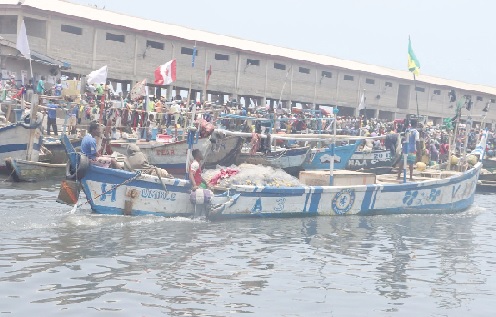
On June 2025, the Ministry of Fisheries and Aquaculture Development announced it was suspending enforcement of the annual fishing closed season for artisanal fishers across the country’s coastline – from Jomoro to Aflao, an exemption some fishermen and other stakeholders claim is doing more harm than good.
A year after the exemtption, some industry players indication have not yielded any improvement in gains for the fisheries.
They indicate the exemption has rather opened the floodgates for illegal and unregulated fishing practices to thrive.
Some artisanal fishermen and their council are of the view that governments past and present should stop interfering in the activities of the fishermen and focus on strict enforcement of the laws governing the industry.
Blackmail
They stated that the inability of the regulators to enforce the law allows fishermen to act with impunity; don’t follow the rules and blackmail and manipulate politicians with their votes.
In an interview, the Secretary of the Western Regional Branch of the Ghana National Canoe Fishermen Council (GNCFC), which is the apex advocacy body for the artisanal fishing sector, representing canoe owners, crew, and fish processors, Mike Abaka Adu said nothing had changed.
He said it was time to see fishing as a business and a space governed by law, with actors committed to planning the sustainability of their businesses on and off season to avoid interventions.
He said in the ideal situation, the canoe owners and the real stakeholders in the industry would wish the closed season remain untouched.
“As far as I am concerned, nothing has changed, a year on. It rather gave room for some to continue illegal methods for profit that destroy the sea.”
“The key stakeholders in the industry now are those who have invested in the industry and want uninterrupted fishing and want their canoes to be at sea at all costs.
“Those of us who are canoe owners, and see the industry as their only way of livelihood and pass it on to the next generation, will want the sea to rest. To us, the introduction of the close season was a good start for the sea recovery. “Even with our traditional knowledge, we have set various days aside for the sea to rest,” he said.
Mr Adu said compared to the farmer, the truth is that, in the fishing industry, fishermen employ all forms of illegal methods and harvest all sizes of fish, those that are yet to spawn, unregulated; “we the fishermen refuse to allow the small fish to grow and the sad aspect is that we have a ready market for it.
He said implementing regulatory bans and restrictions on semi-industrial (inshore) and industrial fishing to combat severe overfishing and restore declining marine stocks without including the artisanal fishermen who carry out more harmful methods is not the best.
Asked if the canoes after the observation of the close season in the past brought them great catches – he responded in the affirmative, “after the close season, since its introduction we get more fish, even some species of fish that we have not seen for a long time.”
He said one important thing the ministry should work at was the enforcement of the law on the use of chemicals and light-fishing – these activities introduce toxic substances directly into the water to stun, incapacitate, or kill fish for effortless harvesting.
These toxic compounds, such as carbide, DDT, dynamites, among others, he said, had contaminated the marine ecosystem and rendered the catch dangerous for human consumption.
Unapproved gear
The use of fishing nets with small mesh sizes, specifically those below the legally prescribed 2.5 cm threshold, is strictly prohibited.
These killer-nets are illegal because they indiscriminately trap juvenile fish and fingerlings before they reach reproductive maturity, contributing to the rapid collapse of essential fish stocks like sardinella.
Additionally, monofilament nets are on record that it was explicitly banned for artisanal marine fishing due to their non-biodegradable nature and the risk they pose as ghost gear.
“Therefore, a month closure or closed season allows the sea to replenish itself; at least the coast sees some fresh waters and fishes come to shallow waters for fish spawning, which is the primary reproductive method,” he said.
The coast, Mr Adu said, illegal fishing methods broadly categorised as Illegal, Unreported, and Unregulated (IUU) fishing, and these were strictly prohibited under the Fisheries Act 625 of 2002.
Mr Philip Pra of the Friends of the Nation, a non-governmental organisation, said what was needed currently was the strict enforcement of the laws regulating the sector.
Despite the regulatory frameworks managed by the Ministry of Fisheries and Aquaculture Development, he said many highly destructive practices continue and unyielding behaviours of some of the fishermen.
That, he said, continued to threaten not only the industry but also marine biodiversity, human health and coastal livelihoods.
“What we are witnessing today cannot continue for the safety of the environment, sustainability and above all the health of the people.”
The reality playing against the fishing industry, their own livelihoods, and the health of millions of Ghanaians who depend on the sector for their protein requirement is the resolve by many of the fishermen to stop the illegal fishing methods.
He said there are estimated 14,000 artisanal canoe fishermen with open access to the sea, while semi-industrial fishermen need to be registered and licensed with devices that will make it easy to monitor them. “But for some time now they do not comply; it is only the industrial fishing that does that”.
He said the impunity was affecting the industry, “with the artisanal, you only need sometimes to go to the landing beach or a community, speak to the chief fisherman and others, then you launch into the industry”.
Experts
The deputy Director of Hen Mpoano, Stephen Kankam for his part said there was the need for the ministry to provide that to that effect and that the fishermen had the better story to tell if the exemption for the artisanal operators was the best.
He expressed the hope that the sector ministry would come up with data on the closed season policy and others as they continue to partner government and local communities to secure food sources, combat overfishing, mitigate climate change, and support community-led conservation projects.
