
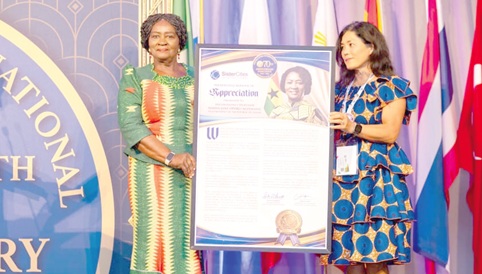
The Vice-President, Professor Naana Jane Opoku-Agyemang, has called for stronger and more practical cooperation among cities across the world, stressing that city-to-city partnerships can play a critical role in addressing shared global challenges and advancing development.
She stressed that city partnerships could serve as platforms for the exchange of knowledge, innovation and expertise, particularly between cities in developed and emerging economies.
Prof. Opoku-Agyemang made the call at the 70th Anniversary Homecoming of Sister Cities International in Washington, D.C.
The landmark celebration brought together citizen diplomats, mayors, municipal officials, diplomats, business leaders and representatives from sister cities across the United States and around the world to commemorate seven decades of international partnerships built on friendship, cooperation and mutual understanding.
The opening ceremony featured remarks from the Mayor of Washington, D.C., Muriel Bowser, while Prof. Opoku-Agyemang delivered the keynote address.
It was hosted under the banner of Sister Cities International, an organisation dedicated to fostering partnerships among communities across borders.
The anniversary programme also featured a special mayors' panel examining how sister-city relationships could generate impact at the local level and contribute to broader national and international development.
The panel, titled “Amplifying Local Impact — How Sister Cities Expand the Homefront”, brought together municipal leaders from the United States and abroad.
Also in attendance were volunteers, diplomats, business leaders and municipal officials with a shared commitment to international understanding and cooperation.
Practical partnerships
In her address, Prof. Opoku-Agyemang emphasised the importance of practical partnerships among cities in a rapidly changing world.
She said cities increasingly faced challenges that could not be addressed by individual countries acting alone.
“Cities face challenges that no nation can confront alone. Urban planning, climate shocks, public health and disaster preparedness increasingly need cross-border cooperation,” the Vice-President said.
She highlighted Africa's youthful population as a major asset for meaningful collaboration, emphasising that young Africans were not merely seeking to participate in the economies of the future but were poised to help shape them.
Professor Opoku-Agyemang further highlighted the potential for sister-city relationships to facilitate the exchange of skills, innovation and entrepreneurial expertise, describing Africa's youthful population as a significant asset for future global partnerships.
She also noted that cities across the world were already developing innovative responses to issues including flooding, waste management and clean energy.
“Cities are developing innovative responses to flooding, waste management and clean energy, becoming laboratories for solutions whose value extends well beyond our continent.”
Practical cooperation
The Vice-President stressed that the true strength of city diplomacy lies in practical cooperation rather than symbolic relationships.
She said partnerships were most effective when they focused on sharing expertise, strengthening institutions and building relationships that produced measurable benefits for communities.
Building bridges
Reflecting on the history of Sister Cities International, Prof. Opoku Agyemang noted that the organisation's founding idea and its relationships between communities had strengthened understanding between nations. She added that the relationship had grown into a global movement connecting cities and municipalities across the world.
She said those principles remain as relevant today as they were when the movement began and would continue to shape its future.
Professor Opoku-Agyemang also extended an invitation to the international partners to join Ghana as the country prepares to celebrate its 70th anniversary of independence in 2027.
The organisation's President and CEO, Ricki Garrett, PhD, described the anniversary as a celebration of “70 years of building peace”, and welcomed participants from the United States and other countries to Washington, D.C.
