
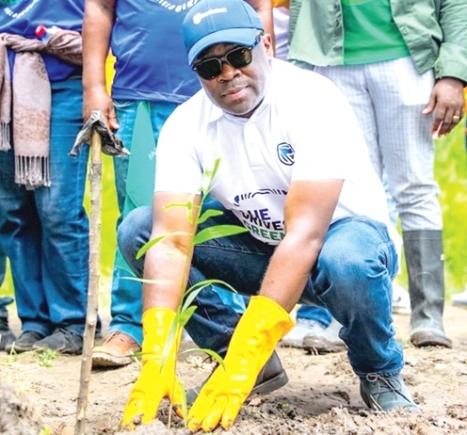
Stanbic Bank Ghana has reaffirmed its commitment to environmental sustainability through a tree-planting exercise aimed at supporting Ghana's climate resilience efforts and reducing carbon emissions.
The initiative, which formed part of the bank’s Environmental, Social and Governance (ESG) agenda, saw hundreds of staff participate in planting more than 10,000 trees at Chipa in the Greater Accra Region, Juaso in the Ashanti Region and Tamale in the Northern Region.
The exercise would contribute to the bank’s broader target of planting 50,000 trees this year and one million trees in the long term.
The Chief Executive of Stanbic Bank Ghana, Kwamina Asomaning, said the programme reflected the bank’s belief that economic growth and environmental responsibility must go hand in hand.
He said the increased impact of climate change, rising temperatures and unpredictable weather conditions demanded practical and sustained action from institutions and individuals alike.
Mr Asomaning said tree planting remained one of the most effective natural ways to absorb carbon dioxide emissions, which continues to contribute significantly to global warming.
“The tree planting exercise is our contribution towards addressing one of the most pressing environmental challenges of our time. We believe that sustainability must be reflected not only in our operations but also in the activities of the stakeholders we support,” he stressed.
He said the initiative had become an annual exercise for the bank over the past three years, and it intends to scale up its efforts in the coming years.
He said beyond the current planting drive, Stanbic Bank was exploring plans to extend greening activities into urban areas, particularly within Accra’s central business district and ceremonial routes to improve vegetation cover and help lower city temperatures.
“We want to contribute to making Accra greener and more climate-resilient. Urban tree cover plays an important role in improving air quality and reducing heat levels, and we believe corporate institutions have a responsibility to support that effort,” he added.
The Head of ESG and Sustainability at Stanbic Bank Ghana, Francis Ayisi, said the exercise formed part of the bank’s long-term climate commitments and support to global efforts to achieve net-zero emissions.
Quoting Native American environmental advocate Chief Seattle, Mr Ayisi stressed the importance of safeguarding the environment for future generations.
“The earth is not ours to own permanently; it is something we hold in trust for generations yet unborn.
That understanding should guide the way institutions and individuals treat the environment,” he added.
He said Stanbic Bank had set ambitious climate targets, including reducing emissions by 42 per cent by 2030, cutting emissions further by 2040 and achieving net-zero emissions by 2050.
“As a financial institution, we recognise that financing drives economic activity.
Therefore, we must ensure that the businesses and projects we support are environmentally responsible and align with sustainable development goals,” he said.
He added that the bank intended to work closely with customers and partners to encourage environmentally responsible business practices and reduce collective carbon footprints.
