
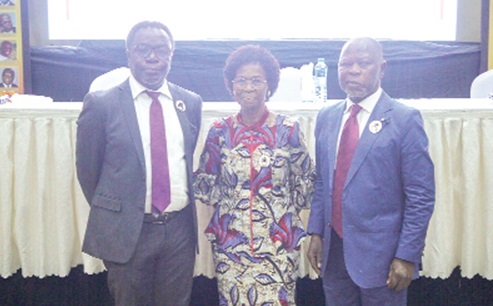
The President of the Ghana College of Physicians and Surgeons (GCPS), Professor Samuel A. Debrah, has called for increased national investment in specialist medical education, describing it as a critical driver of the nation’s health, economic and social development.
That, he said, was because postgraduate medical education should no longer be viewed merely as a component of health sector expenditure but as a strategic national development investment.
“We often measure development by what we can readily see — roads, bridges, airports, interchanges and so on.
Yet, the elimination of maternal mortality, the reduction of infant deaths, the prevention of disability and the extension of healthy life expectancy are equally important metrics of development, even if they are less accessible.”
“Investment in postgraduate medical education is an investment in health, prosperity, resilience and the future of our dear nation, Ghana,” he stated.
Prof. Debrah made the call while delivering the fifth Inaugural Lecture of the Ghana Academy of Arts and Sciences (GAAS) held in Accra last Thursday. It was on the theme: “Postgraduate Medical Education and Training in Ghana: Now and the Future.”
Specialist deficit
Prof. Debrah said the country’s health system continued to face a significant shortage of specialist doctors despite progress made by the Ghana College of Physicians and Surgeons since its establishment in 2003.
Citing analyses undertaken by the college, he disclosed that the country required about 4,000 additional specialists to meet current and future healthcare demands.
To address the gap, he advocated expanding accredited regional training centres to increase the number of specialists and improve the distribution of healthcare professionals across the country.
He said evidence increasingly showed that specialists trained in regional settings were more likely to remain and practise in those areas after qualification.
“The principle of training where you work should become an increasingly important feature of postgraduate medical education in Ghana,” he stressed.
Prof. Debrah also called for a shift in workforce planning from focusing solely on producing specialists to ensuring their equitable distribution and retention within the national health system.
He proposed the establishment of a National Health Workforce Observatory to continuously monitor specialist numbers, geographical distribution, retirement patterns, migration trends and future workforce requirements to support evidence-based policymaking.
Financing
On financing, Prof. Debrah said the rising cost of specialist training, healthcare delivery and technological advancement required a sustainable and diversified funding model.
He suggested a blended financing approach involving government support, health insurance contributions, employer-sponsored training, research grants, philanthropy and strategic private-sector investment.
“The future sustainability of the college should not depend on any single funding source,” he said, cautioning that governments alone might not be able to meet all future healthcare and educational costs.
Technology
The renowned surgeon further underscored the growing importance of technology in health care, urging the integration of artificial intelligence, digital health, data science and innovation management into specialist training programmes.
He mentioned that future healthcare systems would increasingly shift from a “diagnose and treat” model to a “predict and prevent” approach, requiring doctors to acquire competencies beyond traditional clinical practice.
Prof. Debrah also advocated stronger collaboration among African institutions in medical education, research and innovation, arguing that the continent must increasingly rely on its own expertise and institutions in an era of geopolitical uncertainty.
GCPS
Reflecting on the achievements of the Ghana College of Physicians and Surgeons over the past 23 years, he said the institution had significantly increased specialist production, strengthened local training capacity and improved the retention of healthcare professionals in the country.
He, however, emphasised that achieving the country’s future healthcare goals would require bold reforms, sustainable financing, technological innovation and strong leadership.
“The future challenge before Ghana is not merely to produce specialists.
It is to produce the right specialists in the right numbers, in the right place and with the right competencies,” he said.
