
The University of Cape Coast (UCC) School of Optometry and Vision Science has called for urgent nationwide action to curb the rising cases of refractive errors among schoolchildren.
It has warned that Ghana could be heading towards an eye health crisis if preventive measures were not strengthened.
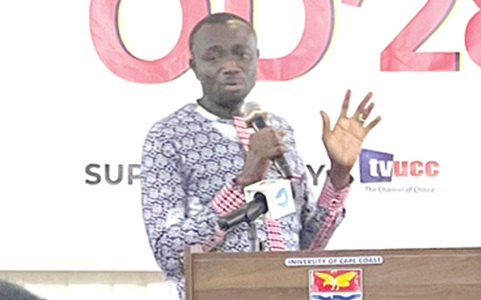
The Director of STEM Studies at the College of Distance Education, UCC, and Professor of Optometry, Prof. Emmanuel Kwasi Abu, raised the alarm during the second White Coat Ceremony and Refractive Error Day symposium held on the theme: “Eyes on the future, refractive error correction today, success tomorrow.”
Global surge
Delivering a scientific presentation, Prof. Abu highlighted a global surge in myopia, particularly among school-age children in highly urbanised regions.
He noted that in parts of East Asia, including Japan, Singapore, China, and Taiwan, myopia prevalence among older children and adolescents had reached about 80 per cent, a dramatic rise from levels recorded five decades ago.
“Globally, refractive error affects about 35.8 per cent of the population. In adolescents, one in every three is affected by myopia.
In Africa, the prevalence is still low at about 4.7 per cent, but the environmental conditions driving the surge elsewhere are increasingly present in our societies,” Prof. Abu stated.
He explained that although genetics played a role, environmental factors remained the strongest drivers of the condition.
These include prolonged near-work activities, intensive early schooling, increased use of digital devices, and reduced outdoor exposure.
“Children now spend long hours reading, using tablets, phones and computers. Schooling begins very early, sometimes as early as one year.
Even at home, learning continues with assignments and screen use. Home has become an extension of the classroom,” he said.
Local concerns
Prof. Abu further revealed emerging local evidence showing a growing gap between urban and rural prevalence rates, with myopia recorded at 9.2 per cent among urban schoolchildren compared to 4.3 per cent in rural settings.
He warned that without deliberate intervention, Ghana risks replicating the trends seen in countries that have experienced a myopia epidemic.
Prof. Abu, therefore, advocated structured interventions, including mandatory outdoor activity for children, regular school-based eye screening, and national eye health education.
“We must educate parents, teachers, and the public. Children should be exposed to at least two hours of outdoor activity daily.
Early detection is critical because untreated refractive errors can lead to complications, including lazy eye and permanent visual impairment,” he stressed.
Essential tools
The Dean of the School of Optometry and Vision Science, UCC, Prof. Steven Ocansey, described spectacles as essential tools for learning and productivity, not luxury items, urging stakeholders to prioritise vision health in education systems.
He emphasised that refractive error remained the most common and easily correctable cause of visual impairment, yet it continued to affect millions of people, including an estimated 2.2 million Ghanaians.
The Principal Optometrist at the Lady of Grace Hospital and General Secretary of the Ghana Optometric Association, Yaw Osei-Akoto, reinforced the need for early detection, stressing that children should undergo routine eye screening before starting school and every two years thereafter.
He noted that undetected vision problems significantly affected academic performance, as children depended heavily on clear vision for learning.
Ceremony
The ceremony marked the induction of 73 optometry students into clinical training, signalling a new phase in their professional journey as Ghana strengthens its response to refractive error and vision impairment.
It brought together leading optometrists, academics, health professionals, students, and stakeholders in eye health.
In his remarks, the UCC's Vice-Chancellor representative, Prof. Rofela Combey, described the White Coat Ceremony as a symbolic transition into professional responsibility, urging students to uphold integrity, ethics, and patient-centred care.
Lieutenant Commander Dr Prince Opuni Quarcoo also reminded students that the white coat represents responsibility, not status, and called for discipline, professionalism, and ethical conduct in clinical practice.
The event also highlighted ongoing efforts by the Ghana Optometric Association to strengthen training and capacity building, including donations of ophthalmic equipment to support student training.
