
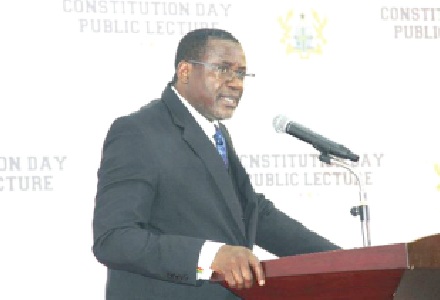
The Vice-Chancellor of Methodist University Ghana (MUG), Professor Philip Ebow Bondzi-Simpson, has called on Ghana’s Judiciary to move beyond its celebrated legacy and urgently embrace technology, institutional reforms and greater transparency to deliver faster, more efficient and people-centred justice in an increasingly digital age.
He observed that while the country's judicial system has endured for 150 years, public confidence in the administration of justice would increasingly depend not only on the quality of judicial decisions but also on how quickly cases were heard, how accessible the courts became and how transparent judicial processes remained.
"A justice system cannot be effectively free when what it aspires to is not really available," he said, stressing that delayed justice often undermines the very confidence citizens place in the courts.
Prof. Bondzi-Simpson made the remarks while delivering the maiden anniversary lecture to commemorate the 150th anniversary of Ghana's Judiciary at the University of Cape Coast (UCC).
The lecture, the first in a three-part national series, formed part of activities marking the Judiciary's sesquicentennial celebration on the theme: "Honouring the past, celebrating the present and defining the future."
Speaking on "Cape Coast in the making of Ghana's legal architecture," Prof. Simpson used the occasion not only to retrace the evolution of Ghana's judicial system but also to outline practical reforms he believed were necessary to prepare the Judiciary for the future.
Technology no longer optional
Central to his recommendations was the urgent need for the Judiciary to fully integrate technology into court administration.
He said that although significant progress had been made in some superior courts, the time had come for every courtroom in the country, regardless of its level, to be equipped with modern digital recording facilities.
Prof. Bondzi-Simpson said accurate electronic recording of proceedings would improve transparency, preserve judicial records, strengthen appeals and reduce unnecessary disputes over court proceedings.
"The technology is available. Every court should have the facility to capture proceedings," he stressed.
Prof. Bondzi-Simpson also challenged long-standing courtroom practices that often placed excessive emphasis on lawyers' seniority rather than the timely administration of justice.
He maintained that justice should never depend on the rank or experience of counsel but on the equal opportunity afforded every citizen to be heard.
"The interest of justice is not dependent on the seniority of counsel. Everyone who comes before the court deserves to be heard, regardless of who represents them," he stressed.
Cape Coast's enduring legal legacy
Tracing the country's legal history, Prof. Bondzi-Simpson argued that Ghana's judicial story did not begin in 1876 as is commonly assumed.
He explained that although the Supreme Court Ordinance of 1876 laid the foundation for Ghana's contemporary judicial system, an earlier Supreme Court Ordinance had already been enacted in 1853 when the Gold Coast formed part of the British West African settlements.
Prof. Bondzi-Simpson further stated that Cape Coast occupied a unique place in that history because it served as the centre of colonial judicial administration before the capital was transferred to Accra in 1877.
More than a celebration
The Chairman of the Judiciary at 150 Planning Committee and Justice of the Supreme Court, Richard Adjei-Frimpong, said the anniversary was intended not merely to celebrate the Judiciary's longevity, but to reflect on its evolution and redefine its future.
He said Cape Coast was deliberately chosen to host the maiden lecture because it is the cradle of Ghana's modern judicial administration.
"It was here that the very seed of Ghana's legal architecture was planted," he said, adding that before the establishment of the Supreme Court in 1876, the first High Court in British West Africa had already been established in Cape Coast in 1853.
A fitting homecoming
The acting Vice-Chancellor of the University of Cape Coast, Prof. Denis Worlanyo Aheto, said returning to Cape Coast to commemorate 150 years of the Judiciary was more than selecting a venue; it represented a homecoming to where an important chapter of Ghana's legal history began.
The next generation
The Chief Justice’s representative, Justice Gabriel Scott Pwamang, reminded the audience that the anniversary celebration was ultimately about preserving the Judiciary for future generations rather than celebrating those who currently occupied judicial office.
