
Government has established a Presidency Delivery Unit to strengthen the monitoring and implementation of government policies and programmes.
The Chief of Staff, Julius Debrah, who announced the initiative, explained that the unit was created as part of the government's Resetting Ghana Agenda to ensure active tracking of policy commitments and to identify implementation gaps in real time.
He maintained that the initiative aimed to improve accountability and ensure that the government delivered on its social contract with citizens.
Speaking at the opening of the ninth Evidence to Action (E2A) Conference and Exhibition in Accra yesterday, Mr Debrah, in a speech read by a Deputy Presidential Spokesperson, Shamima Muslim, said the unit would help the government to move beyond policy announcements to measurable results for citizens.
“The Presidency Delivery Unit has been established to ensure active tracking of government policies, programmes and promises, identify implementation gaps in real time and ensure that we deliver on our social contract with the citizens of Ghana," he stated.
E2A conference
The conference seeks to document, promote and scale up African-led evidence-use practices, deepen cross-country learning and drive systems-level reforms that position Africa as a global leader in evidence-informed policymaking.
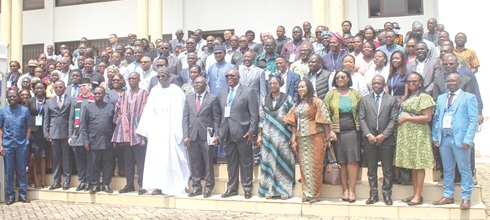
On the theme, “Reimagining the evidence-informed policy and decision-making ecosystem in Africa,” the three-day event, which ends on June 26, has brought together policymakers, researchers, practitioners and innovators from across Africa and beyond.
It was organised by the International Centre for Evaluation and Development (ICED), the University of California, Davis, in conjunction with the Institute of Statistical, Social and Economic Research (ISSER) and other partners.
Institutionalising evidence
Mr Debrah stated that the administration was taking deliberate steps to institutionalise evidence-informed decision-making across ministries, departments and agencies to improve policy outcomes.
He explained that efforts were underway to strengthen analytical capacity within key ministries and ensure that major policy proposals were supported by evidence reviews before decisions were taken.
“We are working to institutionalise the expectation that major policy proposals be accompanied by evidence reviews, and we are creating a feedback system so that what implementation teaches us, including what fails and why, informs the next generation of decisions,” he said.
He added that although the reforms were still work in progress, they reflected the government's commitment to embedding evidence-informed governance as a core discipline in planning, implementation and evaluation.
Evidence not the loudest voice
Mr Debrah said research evidence was often only one of several factors considered during policymaking and was not always the most influential voice in government deliberations.
He explained that when ministers presented major policy proposals, considerations such as costs, public sentiment, implementation capacity and political realities frequently competed with evidence in shaping decisions.
He added that researchers needed to understand the environment in which government decisions were made better if they wanted their findings to have a greater impact on policy outcomes.
Role of Parliament
The First Deputy Speaker of Parliament, Bernard Ahiafor, stressed the need to strengthen the role of legislatures in promoting evidence-informed governance across Africa.
He stated that parliament, through its legislative, oversight and representative functions, had a responsibility to ensure that public policies, programmes and expenditures were guided by credible evidence and aligned with citizens' needs.
“Parliament occupies a unique position within the democratic governance of every country, and has the responsibility to ensure that public policies, programmes and expenditures are informed by credible evidence and aligned with the needs and aspirations of citizens,” he said.
He added that efforts were being made to strengthen parliamentary research services, improve committee systems and deepen engagement with academia, think tanks and development partners to enhance the use of evidence in legislative processes.
Bridging research and policy
The Director of ISSER, Prof. Robert Darko Osei, stated that despite the strong tradition of rigorous research produced by universities and research institutions across Africa, a significant gap remained between knowledge generation and policy implementation.
He said the conference sought to address that challenge by promoting stronger links between evidence, policymaking and societal transformation, ensuring that research findings translated into tangible development outcomes.
He added that the conference demonstrated the value of partnerships in strengthening Africa's evidence ecosystem and advancing evidence-informed decision-making across the continent.
