
For years, tree planting has been presented as one of the most visible responses to climate change and land degradation across northern Ghana.
From national campaigns to community-level drives, millions of seedlings have been planted with the hope of restoring degraded landscapes and reversing environmental decline.
Despite these efforts, large portions of the savannah ecological zone continue to experience worsening land degradation, declining soil fertility, and shrinking vegetation cover due to human activities and the shortcomings of tree planting.
Environmental experts and field observations over time suggest that a significant number of planted trees fail to survive beyond their early stages in the northern belt due to prolonged dry seasons, erratic rainfall, bush fires, and grazing pressures.
This reality has raised questions about the long-term effectiveness of tree planting as a standalone solution to climate change in vulnerable northern landscapes.
At the same time, climate trends in Ghana’s northern belt continue to show increasing temperature levels, delayed rainfall patterns, and more frequent dry spells, all of which are placing additional pressure on agriculture and rural livelihoods.
Community drive
Against this backdrop, Farmer-Managed Natural Regeneration (FMNR) has gradually emerged as a more resilient and community-driven alternative to conventional reforestation approaches.
Rather than depending on nursery-grown seedlings, FMNR is an easy and low-cost land and forest restoration technique used to increase the number of trees in the field without necessarily planting new ones, by protecting and managing existing trees and shrubs through pruning to enable them to regenerate naturally.
Over the years, evidence from FMNR interventions in northern Ghana has shown encouraging results.
In several communities, particularly in parts of Talensi District, where World Vision Ghana first introduced the initiative in 2009, and later in the Kassena Nankana West District, all in the Upper East Region, the approach has contributed to improved vegetation cover, enhanced soil fertility, and increased crop yields.
More importantly, 421 degraded lands in Kassena Nankana West and West Gonja District in the Savanna Region have been restored.
It formed part of a four-year Farmer Managed Natural Regeneration (FMNR) component of a $5-million EU-funded landscapes and environmental agility across the nation (LEAN) project implemented by World Vision Ghana.
Farmers involved in FMNR practices have also reported better availability of fodder, fuelwood, and shade, while degraded farmlands have gradually shown signs of ecological recovery.
The approach has been widely praised for its low cost, high survival rate of trees due to adaptability, and strong community ownership, which contrasts sharply with the challenges often associated with conventional tree planting programmes.
These outcomes are also becoming increasingly significant at a time when climate change continues to affect farming systems across northern Ghana. Farming seasons that were once predictable have become uncertain, with rainfall patterns shifting and planting calendars increasingly delayed.
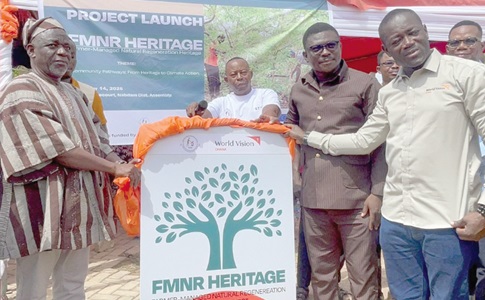
It is within this growing climate pressure and search for more effective solutions that World Vision Ghana, a Christian relief, development and advocacy organisation, has launched a new Farmer-Managed Natural Regeneration (FMNR) Heritage Project in the Nabdam District.
New Project
The project, launched on May 14, 2026, at Nangodi, is expected to restore about 1,500 hectares of degraded land and directly benefit more than 10,000 people, particularly women, youth, and vulnerable households.
The initiative is being implemented in collaboration with the Centre for Community Development Initiatives (CODI), with funding support from the European Union (EU) under the Sustainable Forest and Cocoa Programme through the European Forest Institute.
Major intervention
Addressing stakeholders at the launch, the Strategy and Integrated Programme Director of World Vision Ghana, Joshua Richard Baidoo, described the initiative as a major intervention aimed at restoring dignity to degraded lands and building resilience among vulnerable communities.
He noted that northern Ghana had, over the years, experienced erratic rainfall, loss of vegetation cover, declining soil fertility, and poor crop yields, resulting in food insecurity and economic hardship for farming families.
“Today marks a significant milestone in our collective journey to restore dignity to our land and resilience to our people,” he said.
Mr Baidoo explained that the FMNR Heritage Project would empower farmers to regenerate trees by nurturing naturally occurring stumps and roots instead of relying solely on expensive tree-planting exercises.
According to him, the approach would improve soil fertility, restore biodiversity, increase crop yields, and provide fodder and shade for livestock.
Climate Change
The FMNR Heritage Project Manager of World Vision Ghana, Jonas Bugre, cited delayed rainfall patterns, prolonged dry seasons, and destructive windstorms as evidence of worsening climate change impacts in northern Ghana.
Mr Bugre said farming seasons had become increasingly unpredictable compared to previous years, when farmers could begin planting in April.
“We used to plant crops in April, but now May is ending and there is still no sign that farmers are getting ready to plant,” he said.
A representative of the European Forest Institute, Elvis Kudaar, underscored the importance of collaboration in environmental restoration efforts.
He explained that the FMNR Heritage Project formed part of the Sustainable Forest and Cocoa Programme, which focused on restoration, forest governance, and sustainable land management.
According to him, the programme aimed to restore at least 5,000 hectares of degraded land and benefit more than 20,000 farmers across Ghana within the implementation period.
Mr Kudaar commended World Vision Ghana for integrating sustainability mechanisms into the project and involving traditional authorities, district assemblies, and local institutions.
Support and Partnership
The Project Manager at the Centre for Community Development Initiatives (CODI), Julius Agolisi, pledged the organisation’s commitment to supporting the project, saying the project was a renewed commitment to restoring the environment and empowering communities to take ownership of their natural resources.
The District Chief Executive for Nabdam District, Francis Yenwona Tobig, said the initiative would help restore degraded lands, strengthen livelihoods, and improve food security in communities affected by climate change and declining agricultural productivity.
“FMNR is not just a technical solution. It is a heritage movement, one that connects our past, our present, and our future,” he stated and pledged the district assembly’s support for the project.
