

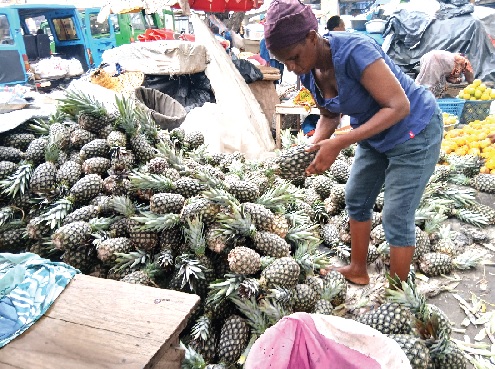
Fruit sellers at the CMB Market in Accra say Ghanaians seem to be increasingly embracing healthy eating by buying more fruits and are appealing to the government to help address the growing problem of post-harvest losses.
The banana queen mother for the Tafo–Begoro Station market, Madam Akosua Ntiniwaa, said the patronage of fruits had improved significantly because many Ghanaians now understand the health benefits of eating fruits.
According to her, many families now include fruits in their daily meals, with parents often packing bananas and other fruits in their children's lunch boxes.
She explained that aside from retailers and wholesalers, many households bought fruits directly from the market for consumption.
Fruit spoilage
Despite the increasing patronage, Madam Ntiniwaa said fruit spoilage remained the biggest challenge facing traders.
"When the fruits get spoilt, we lose a lot of money," she said.
She appealed to the government to establish a system for the daily collection and disposal of spoiled fruits or introduce measures to help reduce post-harvest losses.

"Because this is a seasonal business, there isn't much we can do when large quantities arrive on the market. We wish the government would provide a means of collecting the spoiled fruits daily. It would help us a lot," she said.
Madam Ntiniwaa explained that although some consumers considered fruits expensive, prices were largely determined by seasonal availability.
She said bananas were usually cheaper between August and February but were currently more expensive because they were out of season.
She, however, noted that pineapples, watermelons and oranges were currently in season and encouraged consumers to take advantage of their affordability.
Observation
The Mirror observed that oranges were in abundance on the market last Thursday, as the fruit is in season.
An orange seller, Madam Yaa Kate, told The Mirror that both oranges grown locally and from Togo were available on the market.
According to her, many consumers preferred the Togolese variety because it was sweeter, a quality she attributed to the nature of the soil.
She explained that whenever customers visited her stall, they were given the option to choose between the Ghanaian and Togolese oranges after the differences between the two varieties had been explained to them.
Togolese and Ghanaian oranges
The Mirror further observed that the Togolese oranges had a smoother appearance, while many of the locally produced oranges had dark spots.
Despite the difference in appearance, both varieties attracted buyers depending on consumers' preferences.
Having sold bananas for more than 27 years, Madam Yaa Kate said the period between November and December was particularly difficult for traders because sales were slow while fresh consignments arrived daily.

"When you come here during that period, you will see heaps of unsold bananas surrounding us. It is really painful," she said.
She added that many of the spoilt bananas were given to livestock farmers for animal feed, although not all were collected.
A fruit seller with more than 20 years' experience, Madam Adwoa Serwaa, called for the establishment of cold storage facilities for fruits to minimise wastage.
"If we tell you the huge quantity of fruits that go to waste every day at the CMB Market, it is a great loss to the nation. Just as we have cold stores for meat, we can also have storage facilities for fruits. The market is good, and people buy, but a large quantity still goes to waste," she said.
Another trader, Madam Yaa Comfort, who has sold fruits since 1993, expressed concern about the financial losses traders suffer due to spoilage.
"Sometimes, when you come here during the banana season, you will cry for us," she said.
A pineapple seller, Maa Annan, who has been in the business for 20 years, also observed that Ghanaians had become more conscious of the need to eat fruits.
She explained, however, that weather conditions affected consumer demand.
"When the weather is cold, people don't really buy or eat pineapple. So, when you come here, you may think people are not buying because there are many pineapples, but they actually do buy," she said.
She said pineapples had a shelf life of about four days, after which they start going bad.
"The trick is to sell quickly and at a lower price. Otherwise, you will be in trouble," she said.
The CMB market queen, Naa Kwanua, said that the sale of bananas declined during the recent Muslim fasting period.
She attributed the low patronage partly to media reports highlighting concerns over the excessive use of fertilisers to hasten fruit production and prolong shelf life.
She, therefore, appealed to farmers to reduce the use of such fertilisers and urged the government to introduce measures, including the provision of storage facilities, to reduce fruit wastage and support traders.
Writer’s email:
