
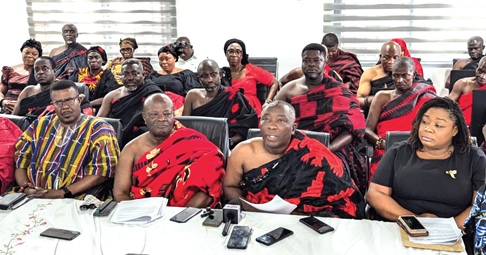
The chiefs and people of Apinto Divisional Council in the Tarkwa Nsuaem Municipality in the Western Region have appealed to the government to hand over the Gold Fields mining concession to a wholly Ghanaian-owned company when the current lease expires in April 2027.
They said such a move would enable a local mining company to maximise the benefits from the country's mineral resources, rather than leaving them under foreign control.
At a news conference in the community, the Gyasehene of the Apinto Divisional Council, Nana (Dr) Adarkwa Bediako II, said the call presented a historic opportunity for the country to derive maximum benefits from its natural resources while correcting the long-standing imbalance between mineral extraction and the development of host communities.
He urged the sector ministry, the government, Parliament, Minerals Commission, civil society organisations and well-meaning Ghanaians to appreciate that the time had come for Ghanaians to own their mines.
“We believe this initiative will usher in a new era of inclusive, responsible, and sustainable mining that benefits both the nation and its host communities,” he said.
Nana Bediako said the traditional council was in full support of the call for the state to establish a state-owned mining operation in Tarkwa.
Foreign-owned mine
“It is our considered view that the transition from a foreign-owned mine to a Ghanaian-owned mining enterprise will not only advance Ghana's national economic interests, but will also ensure that the traditional authorities and host communities of Apinto, whose ancestral lands have sustained mining for generations, benefited,” Nana Bediako.
The Apinto Divisional Council, he said, had witnessed the operations of multinational mining companies such as Gold Fields Ghana, AngloGold Ashanti Iduapriem, among others, for several decades.
“However, despite their long presence in our area, their operations have not contributed significantly to the overall development of the host communities.
A recent tour of the Gold Fields Ghana mine in Tarkwa by the Apinto Divisional Council revealed that more than 4,000 hectares of Apinto lands have been degraded, depriving many young people and indigenous communities of their livelihoods, access to farmlands, and the effective enjoyment of their surface rights,” Nana Bediako said.
Degradation of lands
He said it was the view of the traditional authority that the operations of Gold Fields Ghana in Tarkwa over the decades had been less beneficial to the Apinto communities than it should have been.
Nana Bediako said “we must state that the level of development support provided by Gold Fields Ghana is not commensurate with the extent of the degradation of our lands and the socio-economic challenges confronting our communities”.
These, he said, included poor roads, inadequate school infrastructure, insufficient healthcare facilities, unemployment among the youth, and many other pressing concerns.
“Today, we want to inform the people of Ghana that the Apinto Divisional Council has developed an Apinto Shared Prosperity Proposal, which will be submitted to the government of Ghana for its consideration and approval.
“Our proposal is founded on the principles of history, justice, equity, and sustainable development. Long before colonial rule, the people of Wassa Fiase were the original owners, regulators, and beneficiaries of gold mining,” Nana Bediako said.
“The Apinto Divisional Council supports responsible mining and welcomes investment.
However, we believe that the next phase of mining in the Tarkwa-Apinto area must move beyond royalties and handouts in the form of corporate social responsibility projects towards a genuine partnership among the government, investors and host communities.
Communities, benefits
The proposal of the chiefs, Nana Bediako said, sought to change the lopsided mining narrative in the country by promoting a model in which mining was an investment that benefitted the state, host communities and investors alike.
The traditional area’s proposal to the state, he said, demanded not charity but fairness.
“It presents a practical model that balances national interests, investor confidence and meaningful community participation,” he said.
