


Gold Fields Ghana has defended its application asking for a renewal of the mining lease at Tarkwa, saying that in the three-decade partnership with host communities in the Western Region, it has made significant economic contributions to Ghana.
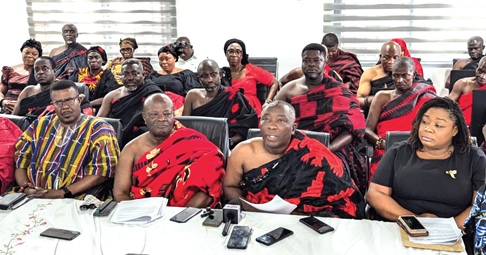
The chiefs and people of Apinto Divisional Council in the Tarkwa Nsuaem Municipality in the Western Region have appealed to the government to hand over the Gold Fields mining concession to a wholly Ghanaian-owned company when the current lease expires in April 2027.
According to them, such a move would enable a local mining company to maximise the benefits from the country's mineral resources, rather than leaving them under foreign control.
At a news conference in the community, the Gyasehene of the Apinto Divisional Council, Nana (Dr) Adarkwa Bediako II, said the call presented a historic opportunity for the country to derive maximum benefits from its natural resources while correcting the long-standing imbalance between mineral extraction and the development of host communities.
Gold Fields' reaction
But in a statement released on Monday [July 27, 2026] following the Apinto Divisional Council's call, Gold Fields said it has maintained regular and transparent engagement with the Apinto Divisional Council and community representatives through established platforms, including the Tarkwa Mine Community Consultative Committee, community forums, and other governance structures on which traditional authorities are represented.
It said these bodies, have provided regular opportunities for matters relating to the mine’s operations—including environmental management, rehabilitation, and lease renewal—to be raised and addressed.
For more than 30 years that Gold Fields has operated the Tarkwa mine, one of Ghana’s largest and most prolific gold producers, the company said the proposal for lease renewal was informed by priorities raised through these ongoing engagements.
It said the proposal seeks to deepen local participation, strengthen community benefits, expand local procurement, support skills development, and enhance long-term socio-economic value creation.
Economic Impact: 74 cents of every dollar stays in Ghana
Gold Fields said the Tarkwa mine has a role as a cornerstone of Ghana’s economy and that approximately 74 cents of every dollar of value generated by the mine remains in the country through taxes, royalties, dividends to the government (via its 10% free-carried equity ownership), salaries and benefits, local procurement, and community investment.
In 2025 alone, the company said it paid approximately GH¢5.8 billion to the government of Ghana in corporate taxes, royalties, dividends, and other statutory payments. It also spent approximately GH¢8.8 billion through local procurement across the country, of which GH¢6.5 billion was directed to suppliers from host communities. The company said 99% of its workforce is Ghanaian, with approximately 70% of employees at the Tarkwa mine originating from host communities—a reflection of its commitment to local employment and skills development.
Community Development: The Gold Fields Ghana Foundation
It said community investment is channelled primarily through the Gold Fields Ghana Foundation, whose projects are determined by community representatives and traditional authorities through formal consultative structures. To date, the Foundation has invested more than US$110 million in host communities, spanning infrastructure, education, health, water and sanitation, agriculture, enterprise development, and environmental conservation.
Notable projects, it said include the 33-kilometre Tarkwa-Damang asphalt road, the Tarkwa and Abosso Sports Stadium, more than 52 schools, scholarships for hundreds of students in mining and other disciplines, the Artificial Intelligence (AI) SmartLab, skills development programmes, healthcare facilities, and water infrastructure. The Foundation’s work has touched nearly every facet of community life, from basic education to advanced technology training, it said.
Environmental stewardship and rehabilitation
The company added that through responsible environmental stewardship, it remains central to its operations. Since 2016, the company has invested approximately US4.2 million. Rehabilitation is undertaken concurrently with mining and includes reforestation, biodiversity restoration, and the establishment of productive agricultural land for community use. More than 818,000 trees have been planted since 1998, with over 33,000 trees currently being raised at the company’s nursery.
It said the Tarkwa mine has maintained ISO 14001 Environmental Management certification for 23 years and International Cyanide Management Code certification for 18 years, and it remains in full compliance with applicable environmental regulations. The company noted that its environmental performance is subject to regular internal monitoring, external assurance, certification processes, and regulatory oversight. It also continues to engage with regulatory authorities and community stakeholders on environmental management and land rehabilitation.
Lease renewal process and government engagement
Gold Fields said it submitted an application for the renewal of the Tarkwa mining leases in November 2025 and followed up with a lease-renewal proposal to the government of Ghana in July 2026. The company said it remains actively engaged in the renewal process and is awaiting feedback from the relevant authorities, while continuing its engagement through appropriate channels.
Under Ghanaian law, mineral resources are held by the state in trust for the people of Ghana, and the lease renewal process is managed through government. Gold Fields said it respects this legal and regulatory framework and will continue to engage government while maintaining open and respectful dialogue with traditional authorities, employees, and communities.
Addressing the Apinto Divisional Council’s position
In its statement, Gold Fields acknowledged the recent news conference regarding the Apinto Divisional Council’s position but said the council’s stance is not reflective of the company’s partnership with traditional authorities or its record of community investment. The company noted that it has met recently with the council and will continue to engage constructively on the matters raised.
While the details of the renewal proposal remain subject to further engagement with government, Gold Fields described its approach as forward-looking and designed to enhance investment in Tarkwa and support greater value sharing with all stakeholders.
Local participation and the Damang precedent
Gold Fields highlighted its commitment to Ghanaian participation, citing its constructive engagement with government and local stakeholders in the transition of the Damang mine to local Ghanaian ownership. However, it stressed that Tarkwa is a significantly larger and more complex operation, requiring substantial capital investment, deep technical expertise, and long-term operational capability to secure its future success.
The company argued that it is best positioned to deliver the next phase of Tarkwa given its balance sheet strength, access to competitive financing, technical expertise, and institutional knowledge. Continued Gold Fields operatorship, it said, would support the growth of Ghanaian skills, suppliers, and mining capability by combining increased local participation with the technology, global experience, and investment capacity of an international mining company. This, it added, would strengthen local businesses, support national champions, and position Tarkwa as a long-term contributor to Ghana’s mining sector and broader economy.
Call for stability and investor confidence
Gold Fields said it supports Ghana’s ambition to increase local participation and maximise benefits from the country’s mineral resources. However, it argued that this should be pursued in a manner that upholds the rule of law, sustains investor confidence, and reinforces Ghana’s position as a stable and attractive destination for international investment.
The company emphasised that protecting jobs, supporting local businesses, and ensuring responsible mining continues to deliver long-term value for Ghana and its people are central to its proposal. It concluded by reaffirming its commitment to Ghana, to Tarkwa, and to the communities that have hosted and supported its operations over many years.
Industry context and next steps
The Tarkwa mine is one of Ghana’s most significant gold-producing assets, and its lease renewal is being closely watched by industry observers, investors, and civil society. A decision by the Minerals Commission and the Ministry of Lands and Natural Resources is expected in the coming months. Should the renewal be granted, Gold Fields will continue to operate the mine for another 10 to 15 years, subject to the terms of the new lease. If denied, the company could face a costly transition or legal challenge.
For now, Gold Fields has made its case forcefully—pointing to its economic, social, and environmental record as evidence that it is the best steward for Tarkwa’s future. Whether the Apinto Divisional Council and government will agree remains to be seen, but the company has left no doubt that it intends to fight for the renewal.
Read also: Apinto Traditional Council seeks indigenisation of mineral resources
The chiefs and people of Apinto Divisional Council in the Tarkwa Nsuaem Municipality in the Western Region have appealed to the government to hand over the Gold Fields mining concession to a wholly Ghanaian-owned company when the current lease expires in April 2027.
They said such a move would enable a local mining company to maximise the benefits from the country's mineral resources, rather than leaving them under foreign control.
At a news conference in the community, the Gyasehene of the Apinto Divisional Council, Nana (Dr) Adarkwa Bediako II, said the call presented a historic opportunity for the country to derive maximum benefits from its natural resources while correcting the long-standing imbalance between mineral extraction and the development of host communities.
He urged the sector ministry, the government, Parliament, Minerals Commission, civil society organisations and well-meaning Ghanaians to appreciate that the time had come for Ghanaians to own their mines.
“We believe this initiative will usher in a new era of inclusive, responsible, and sustainable mining that benefits both the nation and its host communities,” he said.
Nana Bediako said the traditional council was in full support of the call for the state to establish a state-owned mining operation in Tarkwa.
Foreign-owned mine
“It is our considered view that the transition from a foreign-owned mine to a Ghanaian-owned mining enterprise will not only advance Ghana's national economic interests, but will also ensure that the traditional authorities and host communities of Apinto, whose ancestral lands have sustained mining for generations, benefited,” Nana Bediako.
The Apinto Divisional Council, he said, had witnessed the operations of multinational mining companies such as Gold Fields Ghana, AngloGold Ashanti Iduapriem, among others, for several decades.
“However, despite their long presence in our area, their operations have not contributed significantly to the overall development of the host communities.
A recent tour of the Gold Fields Ghana mine in Tarkwa by the Apinto Divisional Council revealed that more than 4,000 hectares of Apinto lands have been degraded, depriving many young people and indigenous communities of their livelihoods, access to farmlands, and the effective enjoyment of their surface rights,” Nana Bediako said.
Degradation of lands
He said it was the view of the traditional authority that the operations of Gold Fields Ghana in Tarkwa over the decades had been less beneficial to the Apinto communities than it should have been.
Nana Bediako said “we must state that the level of development support provided by Gold Fields Ghana is not commensurate with the extent of the degradation of our lands and the socio-economic challenges confronting our communities”.
These, he said, included poor roads, inadequate school infrastructure, insufficient healthcare facilities, unemployment among the youth, and many other pressing concerns.
“Today, we want to inform the people of Ghana that the Apinto Divisional Council has developed an Apinto Shared Prosperity Proposal, which will be submitted to the government of Ghana for its consideration and approval.
“Our proposal is founded on the principles of history, justice, equity, and sustainable development. Long before colonial rule, the people of Wassa Fiase were the original owners, regulators, and beneficiaries of gold mining,” Nana Bediako said.
“The Apinto Divisional Council supports responsible mining and welcomes investment.
However, we believe that the next phase of mining in the Tarkwa-Apinto area must move beyond royalties and handouts in the form of corporate social responsibility projects towards a genuine partnership among the government, investors and host communities.
Communities, benefits
The proposal of the chiefs, Nana Bediako said, sought to change the lopsided mining narrative in the country by promoting a model in which mining was an investment that benefitted the state, host communities and investors alike.
The traditional area’s proposal to the state, he said, demanded not charity but fairness.
“It presents a practical model that balances national interests, investor confidence and meaningful community participation,” he said.