
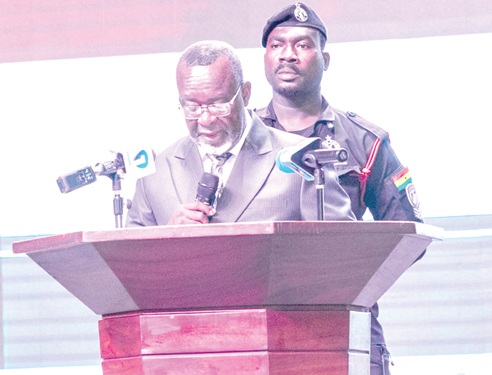
The Chief Justice, Justice Paul Baffoe-Bonnie, has called on all stakeholders in the legal education sector to prioritise institutional cooperation over rivalry in implementing the Legal Education Reform Act 2026, (Act 1170), describing the legislation as a defining moment in the country's legal history.
Speaking at a colloquium on legal education reform at the Central Law School of the Central University at the Christ Temple Campus, Abossey Okai, Accra last Thursday, the Chief Justice described legal education as a national responsibility that no single institution could shoulder alone, stressing that the task of preparing future judges, advocates, legislators, prosecutors, academics, diplomats, corporate counsel and public servants demanded collective effort.
"No law school, however distinguished, possesses a monopoly on wisdom, expertise or innovation," he said.
"The future of legal education in Ghana must be characterised not merely by institutional excellence but by institutional cooperation. Our law faculties must increasingly see one another as partners in a common enterprise,” he said.
Justice Baffoe-Bonnie made the call when he delivered the keynote address at a colloquium on the theme: "Implementing the New Legal Education Reform Act: Institutional Readiness, Accreditation and the Future of Legal Training."
Colloquium
The colloquium, organised by the Central University Law School, featured panel discussions on institutional readiness for the new law.
Present at the event included former Chief Justice Justice Sophia Akuffo, former President of the Ghana Bar Association (GBA), Anthony Forson Jnr, and founder of MountCrest University College and former Director of Legal Education at the Ghana School of Law, Kwaku Ansa-Asare.
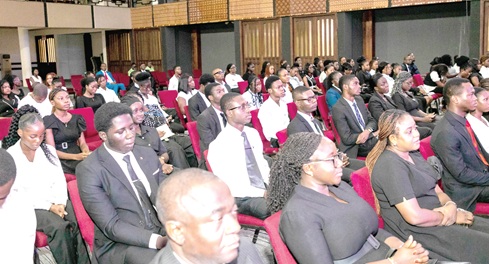
The event brought together other law faculties and institutions, legal practitioners, academics, policymakers, students, and other stakeholders to examine the implementation of the Legal Education Act, 2026 (Act 1170), institutional reforms, accreditation processes and the future of legal training in the country.
Joint conferences
The Chief Justice urged law schools to pursue joint conferences, shared academic programmes, faculty exchanges, collaborative publications and inter-university moot competitions as regular features of Ghana's legal education landscape.
"Senior academics in one institution should be able to contribute to the growth of another. Distinguished practitioners and judges should be encouraged to support legal education across institutions rather than within a single institutional silo," he added.
The Chief Justice cautioned that laws did not implement themselves and that the success of Act 1170 would depend entirely on the integrity, discipline and professionalism of the institutions and individuals entrusted with its execution.
"Governance and regulatory preparedness must be substantive, not symbolic,” he said, adding that accreditation processes must be objective, transparent, timely and must never become a mere formality.
History
Drawing on Ghana's post-independence history, the Chief Justice recalled that when the first batch of locally trained lawyers graduated from the Ghana School of Law in 1963,
President Kwame Nkrumah understood that political independence could not be sustained without strong national institutions.
"For Nkrumah, legal education was never intended to be merely a pathway to professional advancement or personal success. It was a nation-building enterprise," he said.
He argued that Act 1170 was not a departure from those national aspirations but a continuation of them.
The Chief Justice underscored the need to train lawyers who were intellectually rigorous yet ethically grounded; who could compete globally yet remain committed to national service; “who understand technology but are guided by humanity; and who appreciate that the rule of law is one of the foundations upon which democratic societies are built”.
Standards
The Vice-Chancellor of Central University, Professor Samuel Kwasi Dartey-Baah, cautioned that expanding access to legal education without maintaining rigorous quality standards would be dangerous.
He underscored the need for a modern and forward-looking legal education system capable of equipping future lawyers to navigate an increasingly complex and technology-driven world..
Prof. Dartey-Baah said the legal profession was being transformed by artificial intelligence, digital commerce, cybersecurity threats, cross-border transactions and rapidly evolving regulatory systems, and that legal education had to respond accordingly.
A former Director of Legal Education at the Ghana School of Law, Kwaku Ansa-Asare, who chaired the colloquium, commended the initiative and highlighted the importance of collaboration among legal education stakeholders in advancing excellence in legal training and professional development.
The Dean of the Central University Law School, Prof. Kenneth Agyemang Attafuah, reaffirmed the school's commitment to contributing to national conversations on legal education reform and the development of a legal profession equipped to meet the needs of a changing society.
