
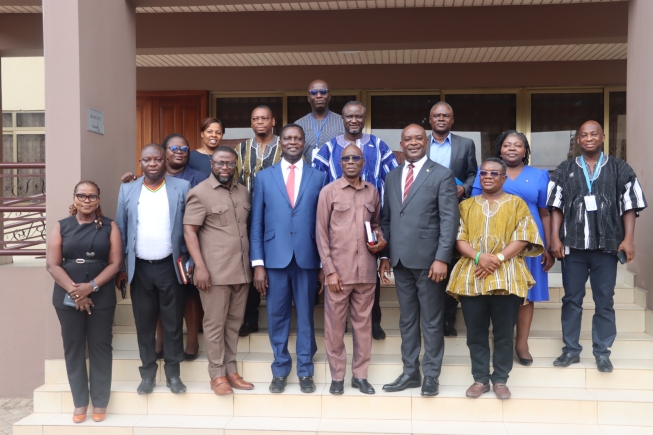
A member of the Parliamentary Select Committee on Education, Dr Fred Kyei Asamoah, has expressed concern about the exorbitant fees charged by universities running distance education programmes.
He said the fees charged by the universities were too high and called on the Ghana Tertiary Education Commission to look into the matter.
Dr Asamoah was speaking during a working visit to the GTEC Headquarters in Accra by the committee to familiarise itself with the activities of the commission and to take its concerns.
The committee, which was led by its Chairman, Peter Nortsu-Kotoe; Vice Chairman, Joseph Kwame Kumah; and Ranking Member, Dr Yaw Osei Adutwum, included Dr Fred Kyei Asamoah, Edem R.K. Kpolosu, Professor Nyako, and Abdul-Fatawu Alhassan as members.
Dr Asamoah was concerned that the trend was becoming an incentive for traditional universities to run such programmes at the expense of the public.
"This issue of disparity between the distance programmes and the regular programmes is way expensive, while in other jurisdictions, it is the other way round," he observed, and asked what the Commission was doing about that.
Other members of the committee shared the same concerns and noted that the development needed to be checked because, under the pretence of expanding tertiary education to adults who could not go through the normal way, the universities were taking undue advantage.
On the relevance of programmes run by some universities, Dr Adutwum expressed concern that some of the programmes did not guarantee any job for such graduates. He therefore advised GTEC to seek funding from development partners to do programme ranking of universities to get society to judge them.
Dr Adutwum explained that he knew the universities would push back against GTEC, "but you can still get them by getting the society to make a judgement on them."
"Do the ranking so that people don't continue to live on their past glory," he said, adding that society would support such a move because people would not want to go to a university where they knew that their programmes were not needed on the job market.
He observed that there was a lot that GTEC had to do, adding that "the very transformation of Ghana depends on what happens in this institution."
Dr Adutwum stressed that the development of the country hinged on tertiary education and promised that the select committee would push for support for the commission.
Explaining the rationale for the visit, Mr Nortsu-Kotoe said it formed part of the committee's monitoring engagements with agencies under the Ministry of Education to gain first-hand understanding of their operations and gather insights that would inform policy decisions and legislative interventions aimed at improving education outcomes.
Responding, the Director-General of GTEC, Professor Ahmed Jinapor, explained that fees charged under distance education programmes were not under the control of GTEC.
He said the distance or weekend programmes were private arrangements where faculty members used them as part-time work.
"GTEC does not regulate the fees because those fees are not regulated by Parliament. We only come in when Parliament says this is the fees that are to be charged by the traditional universities," he said.
"What we do is to ensure that the quality is not compromised. So, if you want to run a distance programme, our position is that the infrastructure must be there," Prof Jinapor explained.
He said GTEC was aware of those distance and weekend programmes and the amount they charged.
"As for the fees, it is a market system. We have the regular—you can go for the regular programme and pay the regular fees, which GTEC regulates," Prof Jinapor said, adding that there were some programmes where students were paying over GH¢20,000.
"We are aware, but unfortunately I don't think the law allows us to regulate distance programmes unless you want to give that power, so that we can reference Parliament and regulate them," he further explained.
Touching on programmes run by universities, Prof Jinapor explained that most graduates came out of university very frustrated because they were unable to secure any job. He noted that most of the universities were doing cut and paste of programmes, irrespective of the environment they found themselves.
"There is a penchant for institutions to just cut and paste programmes from outside Ghana and replicate them here, and we are fighting it," Prof Jinapor stated.
Prof Jinapor described the visit as a valuable opportunity to deepen collaboration between Parliament and the Commission in advancing a world-class tertiary education system that supported national development.
During a comprehensive presentation on the state of tertiary education, the Director of Corporate Affairs, Jerry Sarfo, on behalf of the Director-General, highlighted major achievements recorded by the Commission in the past year.
