
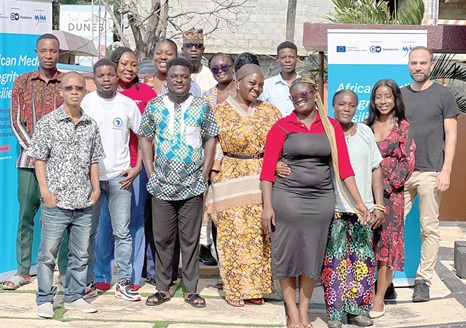
Twelve media personnel have completed a five-day intensive training programme on constructive journalism aimed at equipping media practitioners with innovative storytelling skills to address societal challenges through solution-oriented reporting.
The workshop, held from June 8 to 12 under the African Media Integrity and Resilience (AMIR) Programme, introduced participants to the principles and rubrics of constructive journalism and explored how the approach could be applied within Ghana's media landscape.
Training
Participants were taken through practical sessions on identifying solutions-focused story angles, incorporating evidence-based reporting and balancing problem-centred narratives with responses and opportunities for change.
As part of the training, the participants were grouped into teams and assigned practical projects to enable them to apply the knowledge and skills acquired during the workshop.
The exercises challenged participants to identify pressing social issues and develop stories that not only highlighted problems but also examined solutions, lessons learned and opportunities for improvement.
Experience
A participant, Grace Hammoah-Agyemang, described the training as insightful, impactful and timely, saying it had broadened her understanding of journalism.
"In a world where people are always looking for new ways of doing things, it was refreshing to learn about constructive journalism, which does not only report problems but also looks at solutions that give people hope and inspiration," she said.
Ms Hammoah-Agyemang added that the training had equipped participants with practical skills that could improve reporting and called for more of such programmes to keep journalists abreast of emerging trends and approaches in the profession.
Importance
A trainer with DW Akademie, Isaac Kaledzi, said constructive journalism was particularly relevant to Ghana's media landscape, where news coverage often focused heavily on problems and negative developments.
He explained that while it remained important for journalists to expose challenges and hold duty bearers accountable, there was also a need to highlight credible responses and solutions.
According to him, constructive journalism can help rebuild public trust in the media by providing more balanced and accurate reporting.
"We are not saying journalists should stop reporting problems.
We are saying they should also pay attention to responses and solutions.
This approach gives audiences hope, inspiration and a fuller understanding of issues affecting society," he said.
Mr Kaledzi urged media organisations to embrace constructive journalism, warning that audiences could lose confidence in traditional media if news coverage continued to be dominated by negative stories without offering perspectives on possible solutions.
Perspective
A Project Manager with DW Akademie Ghana, Cecil Ato Kwamena Dadzie, said the workshop was designed to provide journalists with an additional lens to tell stories.
He noted that although Ghanaian journalists were already doing commendable work, the evolving media landscape and changing audience expectations required new approaches to reporting.
"Audiences are demanding more than just an account of what went wrong. Constructive journalism highlights responses, resilience and solutions alongside problems, making journalism even more impactful," he said.
Programme
The workshop forms part of the broader African Media Integrity and Resilience (AMIR) Programme, a European Union-funded initiative aimed at strengthening professionalism, safety, integrity and sustainability within Ghana's media ecosystem.
The programme, which runs from January 2026 to May 2028, is being implemented by International Media Support (IMS) of Denmark in partnership with DW Akademie Ghana and the Media Foundation for West Africa.
Beyond capacity-building workshops, the programme includes legal literacy and protection initiatives for journalists, mentorship opportunities for female investigative journalists, support for community media sustainability, media education reforms and a nationwide media literacy campaign.
The AMIR Programme is being implemented across eight regions of the country, namely Greater Accra, Eastern, Central, Ashanti, Bono East, Savannah, Northern and Upper West regions.
