
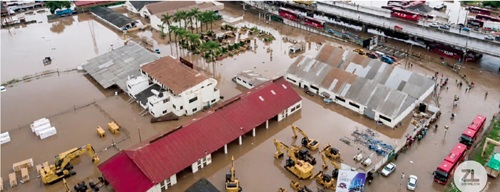
Ordinarily, news of flooding in our republic is not really jaw-dropping news because the spectacle seems to be set on permanent replay - alongside market fires, another recurrent event that never seems to go away, even if the scale of this year’s floods is enough to cause one to pay particular attention.
I would not be surprised if some of our citizens greet this recycled news with nothing more than a shrug and then get on with their lives. One can hardly blame them.
Standard script
The script is the same, tiring one year in, year out.
Accra in particular wakes up to media reports of impassable roads due to overnight floods, stranded and frustrated commuters struggling to get to work, of people whose homes and shops have been destroyed, and to lives lost tragically and needlessly.
The images and video clips of misery and displacement are beamed into our homes and on social media, and we watch in distress and spout righteous anger, asking questions and demanding answers through our computer keyboards and phone keypads from the cosiness of our dry homes.
Then the politicians step in, first to tour affected areas, empathise with the people and gravely vow to take action so that this does not happen again, as cameramen dutifully follow them around.
Then political blame games and finger-pointing begin as the two sides - government and main opposition - square up to each other, telling us who did what and who failed to do what.
Citizens get their share of the blame for indiscriminate waste disposal and building in watercourses, as if the state has no coercive power to deal with these.
The National
Disaster Management Organisation (NADMO) then sluggishly wakes up and scurries around to deliver its mandate as we all watch this slow-motion movie unfold.
The morning shows on both radio and television are not left out.
They assemble all manner of persons, including politically biased apparatchiks with prepared scripts, and the issue is dissected ad nauseum on how to ensure this does not happen again.
The prospect of moving the national capital away from Accra slides into the conversation.
When enough noise has been made and we are all exhausted, the nation simply moves on, and the matter goes into coma - until the rains come back the following year, whereupon the media, politicians and citizens rise from the smouldering ashes for another round of flood-induced, righteous, synthetic anger and tough talk.
Distracted nation
Talking of being distracted, this year’s World Cup could not have provided a more perfect cover.
With Ghana’s match against Colombia imminent when the floods broke, it did not take very long for the public interest in the floods to start receding, long before the flood waters had receded.
Even after we have been booted out, World Cup fever remains and the vulnerable, the dispossessed and destitute have already faded away from our screens and from the headlines.
No big news of any efforts by NADMO in particular or the state in general to resettle them or bring them relief.
Nobody is asking questions anymore.
We are already asleep and snoring on this issue.
Tragic as it sounds, perhaps this unsurprising reality reflects our inability as a nation to stay the course when it comes to asking questions on matters of national importance, which allows our political class to get away with everything, safe in the knowledge that the storm will soon blow over.
They just have to grit their teeth and lie low. It works.
Some hold the view that if Ghanaians held politicians to the same strict standards that they do with the national football team, perhaps this country would be in a much better place.
It is hard to counter that argument, even though the dynamics are of course different.
Human stories
Many tragic stories emerged in the wake of the floods.
A young man desperately trying to protect his television and other gadgets - perhaps the only valuable things he owned - electrocuted in the process, most likely out of ignorance.
A wailing woman whose one-week-old baby was swept away by the floods.
A deflated poultry farmer in Dawhenya whose entire stock of chickens, bar just one, was completely wiped away by the flood.
The scenes were truly distressing.
Perhaps what hit me most was that in this disaster, it took ordinary people to rise and stretch out at the frontline for their fellow human beings, armed with nothing but grit, compassion and basic humanity.
Whilst the politicians bickered and our tax-funded state agencies dithered, ordinary citizens slithered into the fast-moving waters to save lives.
‘Area boys’ went out of their way, without any monetary demands or motivation or much consideration for their own safety, to step into the gushing waters to rescue people trapped in their posh, but now useless vehicles - the very people who would not have given them as much as a glance had they chanced upon them on the road, their windows rolled up as they sped by and enjoyed the cool blast of their air conditioning.
A young man, perched on a safe ledge, stretched out his arms to provide anchor to a stranger being swept away to his certain death by the currents, much to the relief of onlookers.
The rescue of a three-year-old child and his mother by some ‘area boys’.
Many such stories abound.
In those desperate moments, ethnicity, political affiliation, social or economic class mattered little.
What mattered was raw basic humanity and a pressing desire to save lives. In this, a flicker of hope emerges: that despite the social fractures and tensions we may experience as a nation, the ordinary Ghanaian spirit is essentially that of tenacity, compassion and humanity.
Beyond gold, timber and cocoa, these are perhaps our most valuable assets as a people and we must make every effort to nurture that sense of community and of belonging.
I truly wish our religious groupings in this country would throw open their doors to provide sanctuary to those vulnerable citizens whose lives have been turned upside down, in line with giving practical meaning to their teachings on humanity and compassion for fellow humans.
But above all, with tens of people dead, thousands displaced and the risk of a cholera outbreak, the state, through its agencies, must expedite action and provide immediate relief with a clear road map in place.
The victims deserve no less.
Frankly speaking, the annual conversation about floods is getting rather tiring.
Email:
