
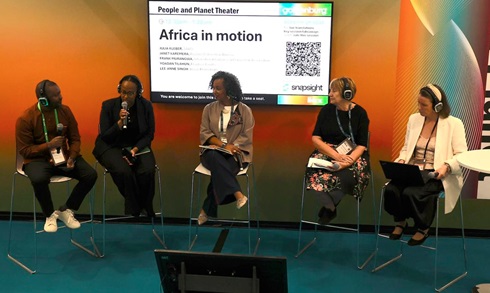
One of the leading global business events took place this week, IMEX Frankfurt.
When the global business events industry gathers at such major trade shows, the discussion inevitably centres on infrastructure, capacity and market share.
For decades, Africa’s Meetings, Incentives, Conferences and Exhibitions (MICE) sector featured in these conversations more as a promise than a performer – admired for its leisure appeal but underrepresented in the competitive world of international association meetings.
That narrative is now changing, and decisively so. One of the panel discussions, Africa in Motion, featured prominent professionals in the meetings space and they looked at what is ticking Africa’s MICE box.
Insights from the ICCA
GlobeWatch: Business Analytics Report launched at IMEX Frankfurt confirm what many practitioners have observed on the ground. While Africa currently accounts for roughly four per cent of the global association meetings market, the real story lies not in share, but in momentum.
Across the continent, business events are being repositioned as instruments of economic development, trade facilitation and knowledge exchange – not simply as tourism extensions.
For Ghana, and indeed West Africa, this evolution offers both a lesson and a roadmap.
The trillion-dollar prize
The economic scale of the business events sector is immense.
According to the 2026 Global Economic Significance of Business Events Study by the Events Industry Council and Oxford Economics, the industry convenes more than 1.6 billion participants annually across 180 countries, generating approximately US$1.3 trillion in direct spending.
This exceeds the direct output of entire global industries such as aerospace and air transport.
By 2028, direct spending from business events is projected to reach US$1.6 trillion. Africa’s current MICE market is estimated at about US$45 billion, with forecasts suggesting growth towards US$85 billion by the early 2030s.
Each delegate generates an average of US$785 in direct business sales, feeding airlines, hotels, transport services, food suppliers and a wide network of local enterprises. For economies seeking diversification beyond commodities, the returns are difficult to ignore.
Structural bottlenecks
Africa’s historical underperformance in global MICE rankings is not due to a lack of demand but to long-standing structural constraints.
Intra-African air connectivity remains a major challenge, with travel between neighbouring capitals often routed through Europe or the Middle East.
While conventional infrastructure has improved significantly, particularly in capital cities, gaps remain outside primary hubs.
Visa regimes, although easing in parts of the continent, continue to affect planner confidence.
Less visible but equally damaging has been the absence of structured data reporting.
Numerous international meetings hosted across Africa go uncounted in global rankings because they are not systematically tracked or reported
Without consistent data submission to international bodies, destinations lose visibility – and visibility remains central to winning future bids.
Strategic workarounds
What is notable today is how African destinations are responding.
Across the continent, national convention bureaux are being established, supported by formal MICE strategies that centralise bidding, marketing and stakeholder coordination.
This institutional clarity alone has transformed how African destinations engage with international associations.
Equally important is the strategic dispersal of events beyond traditional metropolitan centres.
South Africa offers a compelling example.
While Cape Town and Johannesburg continue to dominate, international meetings are increasingly being channelled to destinations such as Sun City, Paarl and Pilanesberg.
This is not accidental; it is deliberate economic design.
By pushing high-value delegates into regional locations, business events become tools for inclusive growth. Local small and medium enterprises are integrated into global value chains, and sustainability is redefined – not only in environmental terms, but in community and economic impact.
Owning intellectual property
Another critical shift is the move towards event self-creation.
Rather than waiting years to secure rotating, foreign-owned association congresses, leading destinations are creating, owning and anchoring their own intellectual property.
Rwanda has executed this model with discipline.
Kigali’s consistent rise in continental rankings is underpinned by home-grown platforms focused on governance, fintech, agriculture, green finance and trade.
By owning the content and the platform, destinations insulate themselves from volatile bid cycles while ensuring that event themes align directly with national development priorities.
This approach turns meetings into long-term economic assets rather than one-off wins.
Skills as competitive currency
As global competition intensifies, the determinants of success have shifted. Natural beauty and hotel stock are no longer sufficient.
International associations now assess institutional capability – bid quality, governance literacy, legacy planning and delivery consistency.
Continuous professional development is, therefore, essential.
Destinations that invest in training their convention bureau teams, professional conference organisers and venue managers build credibility and trust, which remain the ultimate currencies in global bidding.
The Continental leaderboard
Latest ICCA data illustrates where momentum is strongest: Top MICE countries in Africa– 1st: South Africa, 2nd: Morocco, 3rd: Kenya, 4th: Egypt, 5th: Rwanda.
Top MICE cities in Africa– 1st: Cape Town, South Africa; 2nd: Kigali, Rwanda; 3rd: Nairobi, Kenya; 4th: Cairo, Egypt; 5th: Kampala, Uganda; 6th: Marrakech, Morocco; 7th: Johannesburg, South Africa; 8th: Rabat, Morocco, 9th: Accra, Ghana; 10th: Stellenbosch, South Africa.
Ghana’s strategic window
Within this evolving landscape, Ghana’s position is encouraging.
As a country, Ghana sits comfortably within Africa’s top ten MICE destinations, while Accra ranks among the continent’s leading cities. Kumasi’s emergence, though modest, signals the potential for purposeful regional dispersal.
Accra’s greatest advantage lies in its geopolitical role as host of the AfCFTA Secretariat.
This provides a natural anchor for pan-African trade, policy and investment meetings.
business events are deliberately aligned with this positioning, Accra evolves from a host city into a convening capital for continental decision-making.
The lesson from across Africa is clear – MICE success is not accidental; it is designed.
The new architects of African MICE are proving that the continent is no longer merely a leisure destination with potential, but a serious marketplace where ideas are exchanged, deals are struck and futures are shaped.
For Ghana to climb higher, the path forward lies in strong national coordination, intentional regional dispersal and sustained investment in professional skills.
The opportunity is real – and increasingly within reach.
