
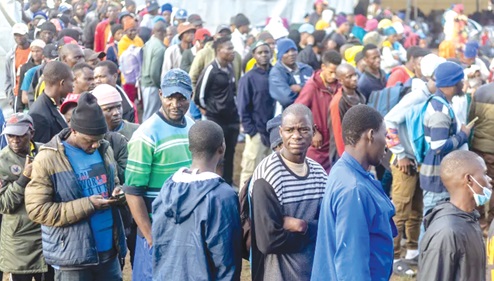
The troubling scenes unfolding in South Africa, where fellow Africans are being harassed, threatened and told to “go back home,” should unsettle every conscience on this continent.
As the June 30 ultimatum reportedly issued by vigilante groups such as March and March approaches, the urgency of the situation demands a simple but profound question: if Africans must go, where exactly should they go?
Though seemingly rhetorical, the question is rooted in reality, history and the future we claim to seek as Africans.
In many ways, Africa is confronting itself through the events unfolding in South Africa.
The borders that now define who belongs and who does not were never organically ours.
They were imposed by colonial powers and drawn largely to serve administrative and extractive interests.
Yet today, we invoke those same artificial boundaries with renewed vigour, using them to justify exclusion and division among our own people. In doing so, we risk entrenching a fragmented identity imposed on us to undermine our collective potential.
Before these borders existed, Africans moved, traded and lived across vast territories defined more by culture, commerce and coexistence than by rigid territorial barriers.
That history must count for something, including for young South Africans who may not fully appreciate the continental sacrifices that helped free their country from the shackles of apartheid.
Economically driven
The demand for Africans to leave South Africa elevates nationality above our shared continental identity.
It also ignores a fundamental reality: migration within Africa, as elsewhere in the world, is a natural response to uneven development.
People move in search of opportunity, security and dignity.
These conditions remain unevenly distributed across the continent.
Many Africans migrate to South Africa because economic opportunities exist there.
They take up jobs, establish businesses and fill gaps in sectors where opportunities are available.
This is not unique to South Africa. Across Ghana, Nigeria and many other African countries, people relocate temporarily or permanently to study, work or invest in pursuit of a better future.
Telling migrants to “go back home” without addressing the structural conditions that drive migration is not a solution. It is merely an attempt to deflect responsibility from deeper economic challenges.
Foreigners are not the problem
There is no denying that unemployment, poverty and inequality in South Africa, particularly among the youth, are serious and urgent challenges.
However, portraying fellow Africans as the cause of these problems is both inaccurate and dangerous. It misdiagnoses the issue while fuelling tensions that serve no one.
The frustrations of young South Africans are understandable, but directing them at vulnerable migrants only deepens the crisis rather than resolving it.
More importantly, the push to expel African migrants represents a step backward at a time when Africa must move forward together.
The continent stands at a pivotal geopolitical moment.
The world is competing for access to Africa’s vast reserves of critical minerals and natural resources.
Whether it is gold from Ghana, cobalt and copper from the Democratic Republic of Congo, lithium from Zimbabwe or bauxite from Guinea, Africa sits at the centre of global supply chains.
As the world accelerates its transition to electric vehicles, renewable energy and advanced technologies, demand for African resources continues to grow.
This presents an opportunity not merely for extraction, but for industrialisation, value addition and shared prosperity.
That opportunity cannot be realised in isolation. It requires coordination, integration and unity.
African economies must increasingly connect through trade, investment and harmonised policies.
Initiatives such as the African Continental Free Trade Area (AfCFTA) were created precisely to reduce internal barriers and promote intra-African commerce.
That vision becomes hollow if Africans are simultaneously made to feel unwelcome in African markets.
Weakening bargaining power
If we fragment ourselves along national lines, we weaken our collective bargaining power.
We compete against one another instead of collaborating.
We make it easier for external actors to dictate terms, much as colonial powers intended when they divided the continent.
A divided Africa cannot fully optimise its resource wealth.
A united Africa can.
There is also a practical economic dimension that should not be overlooked.
African migrants in South Africa are not merely job seekers.
Many are entrepreneurs, traders and service providers who sustain businesses, facilitate commerce and contribute to local economies.
Their abrupt removal will not automatically create jobs for South Africans.
On the contrary, it could result in the closure of small enterprises, disruptions in supply chains and reduced economic activity in already struggling communities.
There is also the broader question of South Africa’s position on the continent.
For decades, South Africa has been regarded as a gateway economy that attracts investment, tourism and talent from across Africa and beyond.
That reputation is built not only on economic strength but also on openness and inclusivity.
Sustained hostility toward fellow Africans risks undermining that standing and weakening South Africa’s appeal as a continental hub.
Beyond the reputational damage are the potential consequences for investment, economic growth, employment and social welfare.
Remedy
At this critical juncture, leadership matters. Watching African governments coordinate repatriation efforts for citizens fleeing hostility is deeply unfortunate.
It undermines the vision championed by leaders such as Kwame Nkrumah and Nelson Mandela, who believed in an Africa united beyond colonial divisions.
South Africa still has an opportunity to change course.
As the June 30 deadline approaches, authorities must engage constructively with the youth, address legitimate grievances through lawful channels and firmly reject vigilantism, mob action and unlawful expulsions.
The rule of law must prevail, but so too must the principles of dignity, fairness and African solidarity.
Africa cannot afford scenes of mass deportations or widespread unrest.
Such developments would reverberate far beyond South Africa’s borders, deepening divisions and undermining confidence in the continent at a time when unity is most needed.
Ultimately, the issue before us is not merely about migration.
It is about identity and direction.
Do we see ourselves primarily as citizens of separate and competing states, or as participants in a broader African project that transcends colonial boundaries in pursuit of shared progress?
The notion that expelling fellow Africans will solve economic challenges is misguided.
It closes doors at a time when we should be opening them.
If Africa is to thrive in a rapidly changing global order, it must do so as a cohesive force, not as a collection of inward-looking enclaves defined by borders drawn by outsiders.
So once again, we must ask: if Africans must go, where should they go?
Surely not away from one another.
Instead, we must move toward deeper integration, stronger cooperation and a renewed commitment to the idea that, despite our diversity, we remain one people with a shared destiny.
The writer is a Ghanaian businessman and philanthropist
