
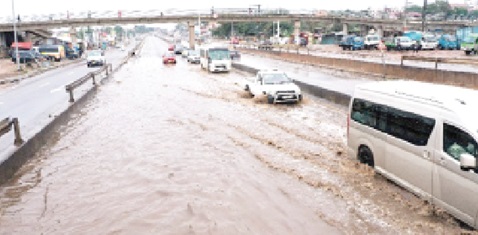
Thirty-four people have died in the devastating floods that struck on Monday, June 29.
Around 90,000 people are displaced.
Unsettled weather and moderate-to-heavy rainfall are expected in Accra this week.
The Ghana Meteorological Agency and the Interior Ministry have issued flood alerts for low-lying areas.
Regularity of flooding
Some families in Accra have lost everything: furniture, clothing, essential documents.
Everything they worked for lost – due to floods that arrived, on schedule, in June.
This is not a one-off, a random ‘act of God’.
Accra floods every rainy season – and has done so for decades.
Over 150 people died in a single night in June 2015 due to floods.
A decade later, in May 2025, storms deposited 132 millimetres of rainfall on Greater Accra.
Four people died and over 3,000 were displaced, with roads submerged in Kaneshie, Adabraka, Adentan, Oyarifa, Weija, and parts of Tema.
The tragedy is not that Accra floods: it is that the capital floods every year.
What is surprising is not the regularity of the floods.
What is astonishing is that successive governments have been so dilatory in addressing the issue.
This is not rocket science: measures exist to deal with serious flooding in Accra.
Why then is nothing done to mitigate the regular flooding problem?
President Mahama’s response
President John Dramani Mahama has called on Ghanaians to remain united, grateful and prayerful despite the floods and the associated loss of life and destruction of property in parts of Accra.
Several self-styled prophets who claimed to have divinely foretold or delayed the floods faced intense public backlash and police scrutiny, with critics accusing them of using the tragedy for financial gain.
Speaking at the National Day of Prayer and Thanksgiving held at the forecourt of the State House in Accra on July 1, 2026, the President noted that the nation had gathered not because all its challenges had been solved, but to reflect, give thanks to God and renew its commitment to the country’s development.
Senior Christian leaders joined government and traditional authorities to console the bereaved and pray for the nation’s recovery.
President Mahama explained that throughout Ghana’s history, the nation had consistently turned to God during both difficult and successful times, describing faith as one of the country’s strongest pillars.
He stated that ‘We gather not as members of different political parties, ethnic groups or religions, but as one people under God’.
Faith’s response
The President joined the Men’s Ministry of the Assemblies of God Church at the Gomoa Pentecost Convention Centre for their Faith Conference on July 4, 2026.
At the event, he underscored the importance of faith, character and leadership, stressing that every generation needs people of faith.
He urged Ghanaians to demonstrate their faith in various ways, including suitable management of public resources and service to others as key pillars of a life rooted in faith.
Ghana’s faith leaders responded to the recent floods with a mix of national prayer, direct humanitarian relief, and calls for structural reform.
Many Clergy mobilised food and support for displaced victims.
Others used the disaster to push for long-term urban planning and greater environmental responsibility.
Prominent Clergy, including Archbishop Nicholas Duncan-Williams and delegations from the Church of Pentecost, personally visited the hardest-hit suburbs such as Tetegu, Awoshie, and Afuaman to distribute relief items and offer spiritual encouragement.
Umbrella groups – such as the Christian Council of Ghana and Ghana Catholic Bishops' Conference – reiterated that the Church should take the lead in teaching environmental stewardship.
Faith leaders highlighted that the floods were exacerbated by human behaviour, including indiscriminate refuse dumping in drains and building on natural watercourses.
The future
The Church of Pentecost’s leadership has publicly challenged Ghana’s leaders to draw up, implement and manage permanent drainage solutions and long-term national development plans that extend beyond short political election cycles.
Such calls have been made for years without, it seems, being taken seriously by those in power.
This is not a partisan issue: neither New Patriotic Party or National Democratic Congress governments have shown themselves capable of seriously addressing the flooding problem.
I do not have space in this sort article to list the reasons why this is the case – but much would rely on political will and state capacity to enforce planning regulations.
So, we know what needs to be done – what will it take for government to act decisively to fix things?
The writer is Emeritus Professor of Politics, London Metropolitan University, UK
