
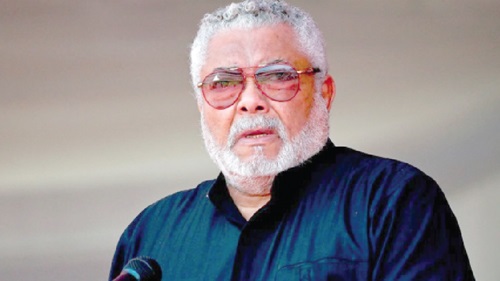
The National Democratic Congress (NDC), in conjunction with the J.J. Rawlings Foundation, is organising commemorative events to mark the 79th birthday of the party’s founder, Flt Lt Jerry John Rawlings, on Monday, June 22, 2026.
The theme for the commemoration is ‘From Revolution to Fourth Republic: The Rawlings Legacy’.
Apart from guest speakers, including academic and lawyer Tsatsu Tsikata, former Minister for Local Government and current Board Chairman of the Ghana Investment Promotion Centre, Dr Akwasi Opong Fosu, and former Minister for Information and National Security and current Board Chairman of Ghana Gas, Kofi Totobi Quakyi, members of the public, party members, supporters and cadres are all invited to participate in celebrations of Flt Lt Rawlings’ birthday and honour his life and legacy.
As I explained in my recent book, Revolution and Democracy in Ghana. The Politics of Jerry John Rawlings (Routledge, 2023; https://www.routledge.com/Revolution-and-Democracy-in-Ghana-The-Politics-of-Jerry-John-Rawlings/Haynes/p/book/9781032135496), Jerry John Rawlings has left a complex legacy.
A lengthy period in power began on December 31, 1981, via a military coup. It followed an earlier period, May-September 1979, when he headed the Armed Forces Revolutionary Council (AFRC), whose aim was to ‘houseclean’ Ghana, and punish those deemed guilty of egregious ‘corruption’.
The AFRC’s brief period in power was followed by the return of democracy in September 1979, following multi-party elections. Unhappy with a dysfunctional democracy, Rawlings soon returned to power, via another military coup, on December 31 1981.
This time, he proclaimed a ‘revolution’. To the astonishment of many, Jerry John Rawlings returned democracy to Ghana on November 3, 1992. He was democratically elected Ghana’s president, as well as the founder and leader of a new political party, the National Democratic Congress (NDC), and he served two presidential terms, leaving office in January 2001.
Revolution and the return of democracy
Flt. Lt. Rawlings is a highly significant and controversial figure in Ghana, second only to Kwame Nkrumah. Like Nkrumah, Rawlings is a polarising figure: some Ghanaians revere him, others abhor him.
Rawlings began a decade (1982-92) as a revolutionary populist, without party affiliation. Critics allege that Rawlings’ government became increasingly authoritarian over time, exacerbated by Ghana’s attempt to institute a neo-liberal economic reform programme from 1983, following agreement with the International Monetary Fund and the World Bank.
Rawlings’ revolution’ was a prolonged, inconsistent period, with two phases. First, there was an initially revolutionary populist phase, when he proclaimed the goal of bringing about a ‘true democracy’ in Ghana.
Later, however, he turned to what I refer to as ‘authoritarian populism’, diminishing or removing some freedoms, including the right to form political parties and the liberty of the press.
In addition, his government presided over a long period characterised by a ‘culture of silence’: many Ghanaians were unwilling to voice opposition due to perceived fear of the consequences of doing so.
By the early 1990s, a decade of ‘provisional’ government was coming to an end, and ‘true democracy’ remained elusive.
Flt. Lt. Rawlings was persuaded by senior advisors that the political order needed to be regularised.
A return to multi-party democracy ensued, following a national referendum.
The Fourth Republic is now 34 years old.
Rawlings’ legacy
Data from a recent Afrobarometer survey indicates that a slim majority (51 per cent) of Ghanaians believe the military should intervene if elected leaders abuse their power.
Although data are not available, there was likely a similar sentiment in Ghana when Rawlings took over in 1979 briefly and again in 1981 for much longer.
Arguably, one of Flt. Lt. Rawlings’ key legacy is stimulating Ghanaians’ outrage at poor and corrupt government, including during times of democracy.
A second legacy is a growing willingness to accept military government under some circumstances.
Neighbouring Burkina Faso currently has a military government, whose ideological characteristics are uncannily reminiscent of Rawlings’ revolutionary regime: anti-imperialist, pan-Africanist and economically populist.
Like Flt. Lt. Rawlings, the transitional president of Burkina Faso, Captain Ibrahim Traoré, rejects both Western influence and multi-party democratic frameworks in favour of a ‘progressive people’s revolution’ focused on absolute national sovereignty and state-led economic nationalism.
This is very reminiscent of what Jerry John Rawlings was working towards in 1982, before his revolution foundered on economic realities.
Captain Traoré has highly praised Jerry John Rawlings, expressing his deep admiration for his ideological alignment with revolutionary movements and his commitment to pan-Africanism.
After more than three decades of multi-party democracy, Ghana may have come full circle; such is the popular disillusionment with democracy that many Ghanaians, including among the youthful who are far too young to remember earlier periods of military rule, would apparently welcome a military regime, perhaps along the lines of that in neighbouring Burkina Faso.
This should give Ghana’s current rulers food for thought: fix democracy – and soon.
The writer is an Emeritus Professor of Politics, London Metropolitan University, UK.
