
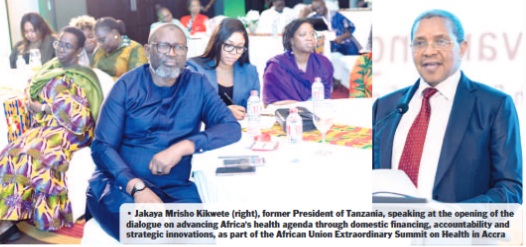
A former President of Tanzania, Jakaya Mrisho Kikwete, has stressed the need for Africa to increasingly finance, manufacture and secure its own health future, explaining that the historical model of heavy reliance on external aid was no longer sustainable.
He said aid had become unreliable and statistics had since confirmed it, pointing out that official development assistance fell by 23 per cent in 2025 and external health aid dropped by as much as 40 percent, making it the largest annual decline ever recorded.
He, therefore, called on governments on the continent to treat health as a strategic investment embedded in their national development plans and fiscal frameworks; accelerate domestic resource mobilisation through insurance reforms, health insurance reforms, innovative taxation and efficiency gains.
“We must promote essential services like those for HIV, malaria, immunisation, maternal health, and child health through the funding transition,” he said.
Mr Kikwete said this in Accra last Monday evening at the opening of a dialogue on advancing Africa’s health agenda through domestic financing, accountability and strategic innovations, organised on the sidelines of the African Union Extraordinary Summit on Health currently ongoing in Accra.
Co-convened by the Africa Renaissance Trust and the Jakaya Mrisho Kikwete Foundation, the dialogue brought together distinguished leaders from governments of Africa, continental institutions, development partners, civil society, academia, and the private sector to explore practical solutions that can advance Africa's health agenda.
Agenda 2063
Africa continues to pursue the vision of a healthier and more prosperous continent, in line with the vision of Agenda 2063.
Yet, it stands amid a rapidly evolving global environment characterised by increasing debt pressures, climate-related challenges and humanitarian crises.
The dialogue, therefore, seeks to address the fundamental question of how Africa can sustainably finance its health priorities, strengthen accountability for investments and harness strategic innovation to deliver better health outcomes for all Africans.
Mr Kikwete said the COVID-19 pandemic had taught Africa that dependence created vulnerability, pointing out that Africa still imports about 80 to 90per cent of its medicines and over 99 percent of its vaccines.
He said Africa must institutionalise accountability so that every amount of money spent on health would deliver a measurable outcome.
He also called on countries on the continent to strengthen regional collaboration, adding that Africa’s strength had always been in solidarity.
Health expenditure is strategic investment
The African Union Commissioner Health, Humanitarian Affairs and Social Development, Amma Twum-Amoah, said Africa's health future must be financed sustainably and predictably, governed accountably, and transformed through purposeful innovation.
She said expenditure on health was not merely a social cost but a strategic investment in human capital, economic growth, productivity, national security, as well as resilience.
“A healthy population is the foundation of a productive economy. A resilient health system is the first line of defence against epidemics and other emergencies.
Equitable access to healthcare is essential to dignity, stability and social cohesion.
However, no health system can be truly sustainable if it depends predominantly on external assistance. Africa's health security cannot be outsourced,” she said.
She called on governments on the continent to demonstrate not only how much was allocated to health but also where the resources go, whom they reach and what results they achieve.
The Deputy Minister of Health, Dr Grace Ayensu-Danquah, mentioned various programmes the government had introduced that were aimed at preventive health care and providing health financing.
She called on governments of the continent to strengthen domestic health financing and invest in institutions that would sustain Africa’s health ambitions, from regulation and local manufacturing to research, innovation and workforce.
She said Ghana remained committed to working with the African Union, its institutions and partners to advance their shared objectives.
“Together, we will build health systems that are stronger, more resilient and better prepared for the generations to come,” she said.
