
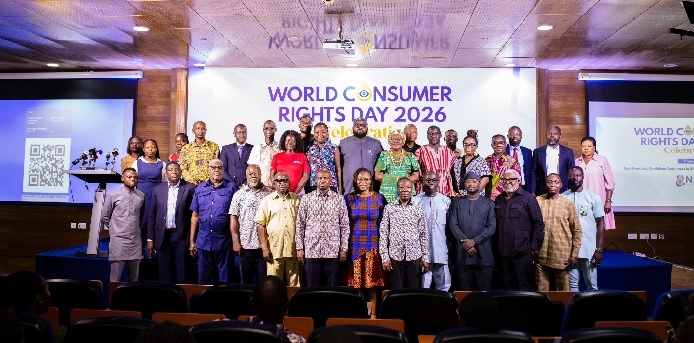
The National Petroleum Authority (NPA) has held its first-ever World Consumer Rights Day Celebration aimed at addressing key challenges in the petroleum downstream sector.
The celebration, held in collaboration with CUTS International West Africa Centre, focused on fuel safety, product quality, pricing transparency and effective redress mechanisms.
It was held last Thursday, in Accra on the theme "Safe Products, Confident Consumers in Ghana's Downstream Petroleum Sector."
The event brought together regulators, representatives from oil marketing companies, consumer advocates academia and other stakeholders to deliberate on pressing issues and propose practical solutions for enabling environment for both consumers and industry players.
Notable among the attendees were the CEO of NPA, Godwin Edudzi Tameklo and his Deputy, Dr Sheila Addo, CEO of Chamber of Oil Marketing Companies, Dr Riverson Oppong and Director of CUTS International West Africa Centre, Mr Appiah Kusi Adomako.
Transparency
Speaking at the event, CEO of the National Petroleum Authority (NPA), Godwin Edudzi Tamakloe emphasized that consumer confidence must be built through accountability, quality assurance and fair pricing.
He acknowledged growing public concerns about transparency in fuel measurement and delivery, saying that mistrust — such as motorists doubting fuel quantities — highlights the urgent need for reforms.
To address these challenges, he said the NPA has enhanced its institutional framework by upgrading its Consumer Services Department into a full directorate and establishing 24/7 call centres to improve responsiveness and complaint resolution.

"The newly established Directorate is complemented by state-of-the-art Consumer Core Centers designed to provide timely, efficient, accessible support to the public. Consumers may contact the center on 030-2550-380, 0800-12000 or 054-500-611 for prompt assistance and redress."
"And let me assure you, we have a team of dedicated staffs who are manning the call center 24/7. This strategic initiative underscores the authorities commitment to strengthening its responsiveness to consumer concerns, deepening public awareness of consumer rights and ensuring robust, accessible, effective redress mechanism within the downstream sector," he stated.
Priority
Mr Tameklo stressed that ensuring safe, high-quality petroleum products remains a top priority, supported by strict inspection and monitoring systems.
On pricing, he explained that policies like the fuel price floor were introduced to prevent unfair competition and stabilise the market, but assured that stakeholder concerns would inform ongoing reviews.
"Let me assure you that at the National Petroleum Authority, we remain committed to deepening collaboration with partners such as CUTS International and all stakeholders to ensure that Ghana's downstream petroleum sector delivers safe, affordable, reliable products to every citizen."
He also noted that global geopolitical tensions continue to impact fuel prices, underscoring the need for adaptive and transparent regulation.
Ultimately, he called for stronger collaboration among stakeholders to build a petroleum sector that delivers safe, affordable, and reliable products while restoring public trust.
Fuel underdelivery
For his part, the Director of CUTS International West Africa Centre, Appiah Kusi Adomako called for stronger consumer protection and fair competition in the country’s downstream petroleum sector.
He said the theme was highly relevant given the persistent challenges facing consumers.
Mr Adomako mentioned that despite the sector’s critical role in everyday life, issues such as fuel quality concerns, adulteration, and underdelivery remain widespread.
"At CATS International, consumer welfare and fair competition are not just part of our work, but they are also our DNA. For over a decade in Ghana and across Africa, we have championed evidence-based advocacy that puts the ordinary consumer at the center of policy decision," he said.
Citing findings from the Ghana Standards Authority, he revealed that nearly 90 per cent of oil marketing companies sampled in a recent exercise were involved in underdelivery, raising serious concerns about consumer trust and regulatory enforcement.
He emphasized the need for evidence-based advocacy, stronger oversight and policies that prioritise the ordinary consumer, ensuring that markets serve the people rather than exploit them.
