
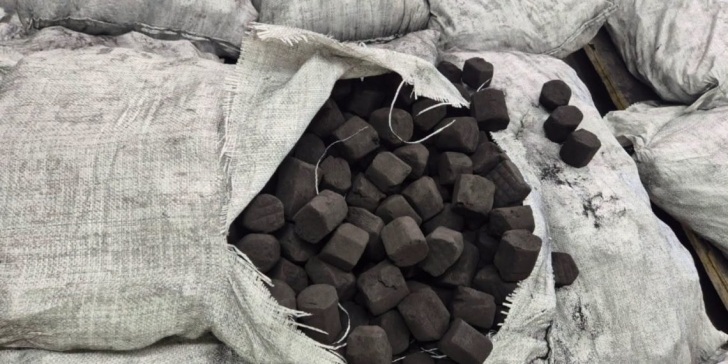
The Narcotics Control Commission (NACOC) has admitted that established procedures were not followed, which is how 320-kilogrammes of methamphetamine with a street value of US$208 million slipped through the system at the port in Ghana and was intercepted in Australia.
It was the Australian Federal Police (AFP) that announced last week that it had foiled an attempt to import 320 kilogrammes of methamphetamine, concealed in bags of charcoal shipped from Ghana.
The AFP, in a statement, said it launched an investigation in April 2026 after Australian Border Force officers at Sydney's Port Botany detected anomalies in two shipping containers from Ghana.
But for the announcement in Australia through a statement, Ghanaian officials had not said anything.
The Director-General of the NACOC, Brigadier General Maxwell Obuba Mantey, on Wednesday [June 24, 2026] however told journalists on the sidelines of an event to destroy seized drugs that a lead suspect has been arrested.
He did not name the person and added that “My officers slept out of their homes for three months and successfully picked up the person who led that enterprise,” he said, but still did not give a hint of who the suspect was.
Brigadier General Mantey described the arrest as just the first step of a broader operation to dismantle the entire network behind the shipment, with security agencies preparing to make further arrests as investigations continue.
“This afternoon [Wednesday, June 24], we’ll be picking more," he added.
The suspect is the shipper - Deputy NACOC Director-General hints
In a radio interview monitored by Graphic Online on Accra-based Joy FM on Thursday morning [June 25], responses provided by a Deputy Director-General of NACOC in charge of Enforcement, Control and Elimination, Alexander Twum-Barimah, raised fresh questions about lapses in export checks and procedures.
But for the arrest in Australia, the Ghanaian officials had no idea such a consignment had slipped through the port in Ghana.
Speaking in the Joy FM interview, Alexander Twum-Barimah said the investigation was like a journey of a thousand miles, and so they needed to start from somewhere, and gave the hint that the lead person who did the shipment is the one who has been picked by NACOC for a start in the investigation.
"As at yesterday [June 24], some other names had come up, which we are also going to work on and get them picked, either today or by tomorrow latest. And I know very well that once we get them, other names will also come up.
Asked about how come the Ghanaian officials did not notice this until it got to Australia, Mr Twum-Barimah said "for now I'll not give you the actual reason because investigation is still ongoing but something happened, but I can't pronounce it, indeed something happened and the investigation is going to reveal so many things."
"As at yesterday, those that we had were making one or two points, but it is early days yet, because once we say things, it will give leads to others," he said.
Mr Twum-Barimah's explanation followed a series of developments in the case that has drawn international attention and placed Ghana's cargo export procedures under scrutiny.
In April 2026, officers of the Australian Border Force intercepted two shipping containers that arrived at Port Botany in Sydney from Ghana. The containers had been declared as carrying bags of charcoal. A forensic examination confirmed that about 320 kilogrammes of methamphetamine had been concealed in the cargo. Australian authorities estimated the street value of the drugs at AU$296 million, equivalent to about US$208 million. They said the quantity could have supplied as many as 3.2 million street-level deals if it had reached the market.
The drugs were removed under controlled conditions before the containers were delivered to a storage facility in Girraween, western Sydney, on April 20, 2026, as part of an operation to identify those behind the shipment.
Three people have since been charged in Australia over the attempted importation. They include British actress Emaa Hussen, 34, who allegedly visited the Girraween facility and supervised the unloading of the consignment. An Australian couple, a 30-year-old woman and a 32-year-old man, were separately arrested in South Australia after allegedly attempting to rent storage units in Sydney using false identities. All three remain before the Australian courts.
On the Ghana side, NACOC announced on June 19, 2026, that it had begun investigations after receiving information from the Australian Federal Police.
On Wednesday, June 24, 2026, during the Commission's annual drug destruction exercise in Accra, the Director-General of NACOC, Brigadier General Maxwell Obuba Mantey, said a three-month intelligence operation involving NACOC, the National Investigations Bureau and other national security agencies had led to the arrest of the suspected ringleader. He described the arrest as a breakthrough and said no person linked to the case would be protected because of institutional affiliation.
Responding to questions about why Ghanaian authorities had no knowledge of the shipment until Australian authorities intercepted it, Mr Twum-Barimah confirmed that NACOC began its investigations only after the seizure abroad.
Asked whether anything had prevented the consignment from being detected before it left Ghana, he said: "It's because certain procedures, for now I can say, were not duly followed."
Mr Twum-Barimah did not state which procedures had been overlooked or identify the agencies involved, saying ongoing investigations would establish responsibility. Asked whether officials at Ghana's ports should have detected irregularities before the shipment left the country, he replied: "Investigations will lead to that."
The admission marks the first time a NACOC official has publicly acknowledged that there was a procedural lapse on the Ghana side of the operation.
It also raises fresh questions about whether the country's export screening and cargo documentation processes are adequate to prevent Ghana from being used as a transit or source point for international drug trafficking.
Mr Twum-Barimah said investigators spent four nights conducting surveillance after the first arrest before locating the main suspect. He added that investigations had since widened.
He explained that international cargo shipments involve several actors, including freight forwarders, documentation agents and people responsible for cargo processing and clearance. He said every person who played a role in facilitating the shipment would be investigated.
"As of yesterday, some other names have come up, which we are also going to work on and get them picked up today or by tomorrow at the latest," he said on Thursday.
While declining to comment on details of the ongoing investigations, Mr Twum-Barimah said investigators were keeping an open mind about the possible involvement of people higher up the criminal network than the suspect already in custody. He added that the woman who had been arrested might not have been the mastermind behind the operation.
"Everything is possible when it comes to criminal investigations," he said. "We have opened the net so wide that we will bring every person who played any role into it."
Mr Twum-Barimah said NACOC would continue pursuing every lead until investigators established the full circumstances under which the consignment left Ghana.
Writer's email:
Follow @enochfrimpong Follow @Graphicgh
