
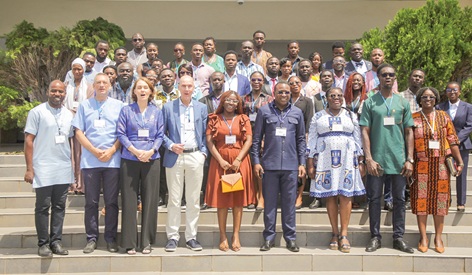
A student of the University for Development Studies (UDS), Christiana Assah, will represent Ghana at the global Falling Walls Lab finale in Berlin, Germany, after winning the 2026 German Academic Exchange Service (DAAD) innovative science and creativity pitch competition.
Ms Assah impressed judges and beat 21 others with her project, “Breaking the Wall of Toxic Malaria Diagnosis”, which explored the use of natural plant-based dyes as safer and more sustainable alternatives to conventional synthetic stains used in malaria testing.
Using extracts from hibiscus, sorghum and dandelion, she developed formulations that successfully stained malaria-positive samples, offering a cheaper, environmentally friendly and locally sourced diagnostic solution for healthcare facilities.
Bridget Boamah Appiah of Bellview Eyecare and Optical Services placed second with her project, “Breaking the Wall of Passive Bionic Vision”, while Joel Senyo Ahadzi of the University of Energy and Natural Resources secured third place with “Breaking the Wall of AI Bidirectional Ghana Sign Language Translation”.
Competition
The competition dubbed “Falling Walls Lab Ghana” is an innovation and pitch competition that provides a platform for students, researchers and early-career professionals to showcase breakthrough ideas, research projects and social initiatives.
The event, organised by the DAAD Information Centre Accra, challenges participants to present a pressing problem and propose a solution in just three minutes.
This year’s competition featured 22 contestants whose ideas were assessed by a seven-member jury drawn from science, business, policy and innovation sectors.
Addressing challenges
The Deputy German Ambassador to Ghana, Sivine Jansen, commended all participants for applying research and innovation to address the country’s development challenges.
She said the competition celebrated not only excellence, but also curiosity, creativity and the courage to challenge established ways of thinking.
Ms Jansen stated that many of the ideas presented tackled local issues in health, agriculture, education, climate resilience and technology.
She emphasised the importance of scientific collaboration between Ghana and Germany, adding, “Remember that every breakthrough begins with the courage to challenge a barrier and the vision to connect people, keep breaking walls, keep building bridges, and turn bold ideas into innovations that shape a better future for Ghana and the world.”
The Programme Officer of DAAD Ghana, Felix Barnes, said the competition continued to serve as a reminder of the remarkable creativity and innovation of young researchers and entrepreneurs since its inception in 2016.
He added that the platform had showcased the strength of the country’s innovation ecosystem while fostering cross-border collaboration, recalling that participants from Nigeria joined the maiden edition.
Mr Barnes expressed hope that this year’s winner would proudly represent the country in Germany and compete successfully for the coveted global title.
AI impact
The event featured a panel discussion where discussants emphasised that the greatest artificial intelligence (AI) challenge in West Africa was not access to technology, but the lack of organised, local datasets.
They argued that African innovators should focus on collecting, annotating and structuring data that reflected local realities rather than copying solutions developed elsewhere.
AI, they said, was most effective when built around real problems and user needs, particularly in sectors such as health, agriculture and language technology.
The speakers enumerated the importance of inclusivity, advocating solutions that work in local languages, on low-bandwidth platforms such as WhatsApp, and within existing social and economic systems to ensure scalability and meaningful impact.
