
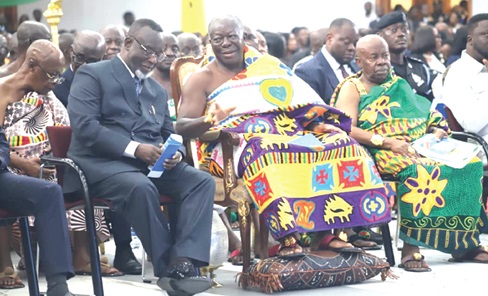
The Asantehene, Otumfuo Osei Tutu II, has said the machinery of chieftaincy adjudication of cases requires urgent modernisation to ensure the speedy resolution of cases brought before chiefs.
Addressing a Supreme Court @150 anniversary lecture series at the Manhyia Palace yesterday, he said judicial committees of houses of chiefs must be trained and, where necessary, reformed.
By so doing, he said, "It will ensure that chieftaincy disputes are resolved with the speed and finality that both litigants and communities deserve."
The well-attended lecture was on the theme: “Honouring the past, celebrating the present and defining the future”.
It was graced by some Justices of the superior and lower courts, leadership of the Ghana Bar Association (GBA), lawyers, law students and some students from selected senior high schools (SHSs).
He said delay in matters of stool and skin was not merely justice denied to individual claimants, but it was stability denied to entire communities.
He added that greater doctrinal clarity was needed on the precise boundaries between the exclusive jurisdiction of the judicial committees and the jurisdiction of the regular courts, particularly the superior courts, supreme and appellate roles.
He said continued dialogue between the bench, Bar, and the House of Chiefs, duly amplified as part of the anniversary celebration, was essential to that clarity between the key stakeholders.
In Ghana, he said the final stage of the process involved in the making of a chief is the registration of the name of the said chief in the National Register of Chiefs, saying, “the role the various houses of chiefs play in this registration process deserves much consideration.”
Particularly, he stressed that the role of the regional houses of chiefs in the registration process had sparked so much agitation and sometimes controversy, he added that the regional houses of chiefs were mandated to transfer the chieftaincy declaration forms to the National House of Chiefs upon receipt and confirmation of their accuracy.
Otumfuo Osei Tutu II said the institution of chieftaincy was not merely tolerated by our modern constitutional order but was entrenched within it and recognised as a co-equal pillar of our governance architecture.
Yet, he said recognition did not resolve every question as it had fallen to traditional councils, judicial committees of the Houses of Chiefs and ultimately the Supreme Court to give that recognition practical content.
He said the Supreme Court, over the decades, developed substantial and increasingly sophisticated jurisprudence on chieftaincy matters, determining several matters, including boundaries of the exclusive jurisdiction of the judicial committees, adjudicating vexed questions of stool and skin succession, among others.
“In this role, the Supreme Court has acted not as a rival to chiefs, but it’s best seen as a steadying institutional partner, a forum of last resort where the ancient wisdom of custom is tested against,” he said.
Enduring purpose
The Chief Justice, Justice Paul Baffoe-Bonnie, said the Supreme Court and the chieftaincy institution existed for the same enduring purpose to preserve justice, secure peace, and protect the dignity of every person.
“One draws its authority from the republic and the other from the wells of history. Our duty is to run faithfully to preserve what must be preserved, to reform what needs reform and to hand over a stronger court to those who will come after us,” he said.
He expressed deep respect for the enduring contribution of the chieftaincy institution to the peace and stability of the country, saying, “many disputes that could have plagued our courts are resolved quietly in our communities through wisdom, patience and reconciliation”.
“I pray that these two great institutions will continue each within its constitutional mandate to strengthen one another in the common pursuit of justice.
“Justice has never belonged to judges alone; it belongs to the people,” he added.
ADR
Delivering the lecture on the topic: “Supreme Court and the institution of chieftaincy, the past, present and future”, a distinguished academic, Ivor Agyeman-Duah, highlighted the fusion of tradition and modernity, especially the use of Alternative Dispute Resolution (ADR), in dispute resolution.
He said it took many years to resolve the Dagbon and Bawku crises, which ranged across many administrations, stressing that their final resolution through the Asantehene and his eminent chiefs, who endorsed many verdicts by the courts, demonstrated how an alternative source of authority working together can still be peaceful.
“It showed that when traditional leadership and customary institutions come together, it makes settlement of disputes possible.
“Therefore, the Supreme Court and the chieftaincy institution must continue to collaborate to ensure proper justice delivery,” he said.
The President of the National House of Chiefs, Ogyeahoho Yaw Gyebi II, who chaired the event, underscored the importance of the chiefs as they continued to settle internal chieftaincy disputes and community-level civil disputes that could have been taken to court for settlement.
