
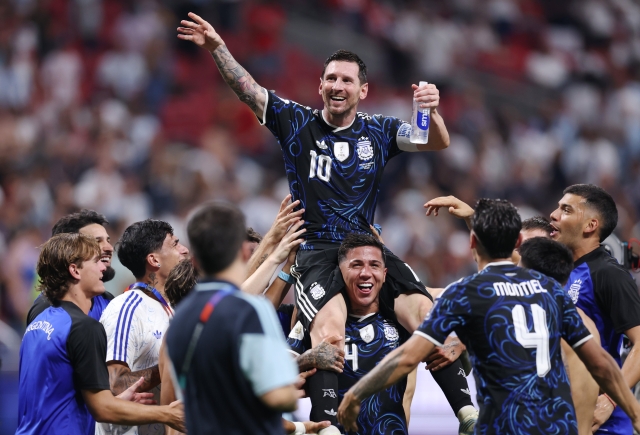
Four decades after Diego Maradona produced one of football's defining performances to eliminate England from the FIFA World Cup, Lionel Messi authored his own chapter in one of the sport's most emotionally charged rivalries at the Atlanta stadium on Wednesday.
Exactly 40 years and 23 days (equivalent to 2,090 weeks and 367 days before Messi was born) later on the impact felt remarkably familiar even though the venues and goals were different.
With Argentina seemingly heading for elimination at the penultimate stage, Messi produced another football masterclass to dismantle England's resistance in the closing stages, supplying two decisive assists to inspire a dramatic 2-1 comeback victory that sent the reigning champions into Sunday's final against Spain in East Rutherford, New Jersey.
For a player whose career has long invited comparisons with Argentine icon Maradona, this was another performance before football royalty that will inevitably become part of that conversation. In his first World Cup meeting with England, Messi did not need spectacular solo goals. Instead, he relied on timing, intelligence and an extraordinary understanding of space from his rich experience at the highest level to prise open one of the tournament's most disciplined defensive structures.
England had spent much of the evening executing their German manager Thomas Tuchel's tactical blueprint. Anthony Gordon's 55th-minute strike appeared to have placed the Three Lions within touching distance of a first World Cup final since 1966.
Then Messi produced the magic he has been noted for to rewrite the script. Closely shadowed throughout the contest and no longer blessed with the physical presence and explosive acceleration of his younger years, the 39-year-old simply waited for England's concentration and physical intensity to fade. Where others saw a veteran increasingly confined to walking between phases of play due to England’s tight marking, Messi saw opportunities to exploit.
Playing before a crowd of 68,239 with football royalty in attendance, including former England captain and his Inter Miami FC boss David Beckham, Messi finished with nine completed dribbles, dictated Argentina's attacking rhythm and repeatedly manipulated England's defensive shape before delivering the two moments that transformed the match.
The equaliser arrived in the 85th minute as the vociferous Three Lions fans were almost in dreamland in an anxious wait for the final whistle in regulation time. Tuchel’s side, retreating deeper in an attempt to preserve their lone-goal advantage, struggled to organise after defending a short corner. Messi drifted into space, received possession and calmly tossed the ball into the path of Enzo Fernández, whose magnificent strike from outside the penalty area flew beyond England's goalkeeper Jordan Pickford who had made world-class saves to deny the Argentines deserved goals.
The momentum instantly shifted, as Messi and his teammates sensed vulnerability and intensified the pressure that had been building throughout the closing stages of the cliff-hanger. Deep into stoppage time, the supremely talented midfielder again found the decisive opening, delivering a perfectly weighted cross that substitute Lautaro Martínez converted from close range to complete an extraordinary turnaround and book Argentina's place in another World Cup final.
It was a victory carrying significance far beyond qualification. England and Argentina have contested one of football's most compelling rivalries for more than six decades, shaped by unforgettable World Cup encounters, political history and iconic individual performances.
Few international rivalries carry the historical and emotional baggage of England against Argentina. From Maradona's twin acts of genius and controversy in Mexico '86 to Beckham's dismissal in Saint-Étienne in 1998, the fixture has repeatedly produced defining World Cup moments. The legacy of the 1982 Falklands War continues to lend each meeting an intensity that transcends the sport itself.
Messi acknowledged that history immediately after the final whistle. "The fans wanted this victory more than any other, because of what it means to face England in a semi-final and reach another World Cup final," he said to reporters and dedicated the win to the 1996 World Cup-winning captain Maradona, whose legacy continues to define Argentine football.
"Without a doubt, Diego is enjoying this immensely from up there because today was a very special day for him," Messi said. Being able to give him this joy and for him to experience it however he wants from up there. Let him enjoy it because it's a gift for him too."
From a tactical perspective, England's plan initially worked. Tuchel's midfield denied Messi the central pockets from which he has dictated games throughout his career, forcing him away from the congested middle of the pitch. But Argentina adapted. Rather than persist in traffic deep in midfield where the English defenders had laid ambush, Messi drifted wider, particularly towards the right flank, stretching England's defensive organisation and creating new passing lanes.
It became less about explosive running and more about manipulation by football’s supreme artist. Every move drew the English defenders out of position. Every touch slowed or accelerated the game's rhythm according to Argentina's needs. As England’s defenders began to show exhaustion, the spaces Messi required finally appeared, and he exploited them.
Now the defending champions stand one victory from retaining the World Cup, with Sunday's final against Spain in East Rutherford offering another historic occasion. It will be the first World Cup final between the reigning European and South American champions and the first since FIFA introduced world rankings in 1992 to feature the teams ranked No. 1 and No. 2.
