
At first glance, the gigantic Articulated Dump Truck (ADT) towering over her looked intimidating.
Its tyres were almost as tall as she was.
The machine's metal frame seemed too enormous for the petite young woman standing beside it.
When Nafisatu Osman Mairiga told her mother she wanted to learn to operate the machine, her mother's response was disbelief.
"She looked at the machine and said, 'No, you can't do it'," Ms Mairiga recalled.
Today, the young woman who once trembled at the sight of an ADT confidently starts its engine, drives it, transports loads and even detects faults.
"If you give me the key today, I can start the machine, reverse it and operate it.
I was scared initially, but now I control the machine.
The machine doesn't control me," she said.
Stereotypes
Ms Mairiga is among a growing number of young women challenging long-held stereotypes that heavy-duty equipment operation is exclusively a man's job.
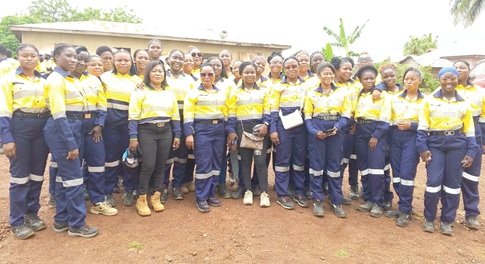
At the Global Institute of Mines and Safety (GIMS), a private training institution at Afrisipakrom in the Tano North Municipality of the Ahafo Region, dozens of women are learning to operate excavators, dump trucks, wheel loaders, graders, bulldozers, forklifts, mobile cranes and drilling equipment.
The institute was established to equip young people with practical and employable skills and rescue them from unemployment.
At the graduation ceremony last Friday, 260 trainees completed various heavy-duty equipment programmes.
They comprised 216 males and 44 females, reflecting the growing interest among women in the sector.
Among the graduates were 135 young people from six mining host communities at Akyem in the Eastern Region, who underwent a three-month intensive training programme sponsored by the Zijin Akyem Development Foundation (ZADeF).
Inspired to break barriers
Many of the female trainees say their decision to venture into the traditionally male-dominated field has been inspired by the elevation of Vice-President Professor Jane Naana Opoku-Agyemang to the country's second-highest office and the need to explore alternative career opportunities amid limited employment prospects.
"What gave me the passion is that our Vice-President is a woman. It has given us the courage to do what men can do and even do it better," Ms Mairiga said.
She believes women should never allow fear, educational limitations or societal expectations to prevent them from pursuing their ambitions.
"We can also do everything done by men.
We are not afraid of the machines or the mining sites.
We can also do it," she said.
As the eldest of six siblings, Ms Mairiga said she was determined to set an example for younger girls and demonstrate that women could excel in careers traditionally reserved for men.
Biggest obstacle
She, however, observed that financial constraints remained one of the biggest obstacles preventing many women from enrolling in such programmes.
"Some women are passionate about learning but do not have the money. Society often gives more opportunities to men and assumes women will eventually marry and stay at home.
"We need support because if women are given opportunities, we will make Ghana proud," she said.
Changing perceptions
The Head of Business Development and Partnership at the National Youth Authority (NYA), Edmund Ofosu-Yeboah, said changing economic realities and government policies on inclusion were driving more women into non-traditional careers.
"Apprenticeship is often associated with hairdressing and dressmaking, but there is much more to it.
We have engineering and heavy-duty equipment operations and women are increasingly participating in these areas," he said.
Mr Ofosu-Yeboah explained that unemployment had compelled many young females to explore opportunities outside traditional career paths.
"If you dwell on one aspect of employment, you may be left out. That is why government policies now focus on inclusion," he said
Mr Ofosu-Yeboah said the NYA deliberately created opportunities for women and persons with disability to participate in programmes that were previously male-dominated.
He added that deliberate measures had been put in place to increase female participation in skills development programmes and break barriers in sectors traditionally dominated by men.
"If you are taking 10 males, you should have at least three females," he said.
Building futures
The Chief Executive Officer (CEO) of GIMS, Larry Gabriel Yennugu, urged the graduates to remain resilient, disciplined and adaptable in an increasingly competitive world.
"You have earned your certificates, but more important, you have earned the confidence that comes from learning, practising, making mistakes and improving.
Mr Yennugu explained that graduation was not the destination, "it is the departure lounge".
The CEO said the institute collaborated with public bodies such as the Ghana National Fire Service (GNFS), the National Ambulance Service (NAS), the Driver and Vehicle Licensing Authority (DVLA) and the Minerals Commission to train the beneficiaries.
Mr Yennugu said GIMS was providing holistic training to trainees to equip them with practical, employable skills and prepare them for the demands of the job market.
He encouraged the graduates to continuously assess their strengths and weaknesses, embrace lifelong learning and develop communication skills and professionalism.
Conclusion
As the country strives to tackle youth unemployment and promote gender inclusion, the sight of women confidently mounting excavators and climbing into dump trucks signals a quiet but significant transformation.
For young women such as Miss Mairiga, heavy-duty equipment is no longer a symbol of masculine strength.
It is a vehicle of empowerment, independence and the determination to rewrite society's expectations, one machine at a time.
Writer's email:
