
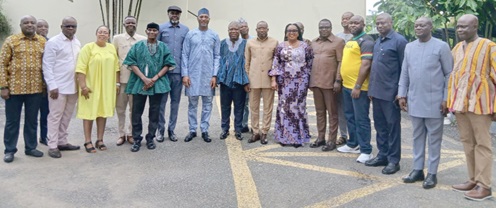
The Minister for the Interior, Muntaka Mohammed-Mubarak, has urged regional ministers to desist from arbitrary or partisan use of security apparatus in their jurisdictions.
Such actions, he said, amounted to the ministers contributing to destabilising their respective regions.
"You cannot just be arbitrary with your actions. Unlawful operations or partisan use of security institutions have no place within this framework. We must exercise authority with restraint.
“Recognising the power without legality breeds abuse. Lead your Regional Security Council (REGSEC) with purpose. Convene regularly, interrogate intelligence vigorously and ensure that decisions are followed through,” he advised.
Training
Speaking at the opening of a day’s training for regional ministers on the new National Security and Intelligence Agencies ACT 2026 (ACT 1168) in Accra yesterday, Mr Mohammed-Mubarak said the most important thing was for regional ministers to build trust, which was the foundation for sustainable security.
The training, which was organised by the National Security Council Secretariat and attended by regional ministers across the country, formed part of a deliberate and structured national effort to modernise and strengthen national security governance architecture.
Passed in March this year, Act 1168 provides a legal framework for the security architecture of every region in the country and the training was expected to help the regional ministers to understand, embrace and apply it consistently.
Act 1168
Mr Mohammed-Mubarak said as representatives of the President and the foremost line of political leadership in the regions, when crises arose, the actions of regional ministers, particularly in critical moments of a threat, could determine whether a situation escalates into chaos or was contained in calm order.
He said ACT 1168 ensured that their responsibilities were not left to ambiguity but were clearly defined and actionable.
He said the ACT provided three critical imperatives, namely clarity of responsibility, accountability and coordination, explaining that as regional ministers, they were not mere observers of regional security but empowered to convene, demand intelligence and direct coordinated responses within the framework of the national policy.
“Your decisions must be lawful, documented, and executed impartially.
You are accountable, not only to Parliament and the courts, but ultimately to the people of Ghana,” he stressed.
NAIMOS
The National Security Coordinator, Commissioner of Police (COP) Razak Abdul-Osman, reminded regional ministers that with the reconstitution of the National Anti-Illegal Mining Operations Secretariat (NAIMOS), national security persons were not supposed to be involved in the fight against galamsey.
He, therefore, urged the regional ministers to desist from using personnel wearing khakis purported to be national security uniforms to go about acting in the names of ministers.
The Volta Regional Minister, James Gunu, on behalf of his colleagues, pledged their support and commitment to sustain the peace in the regions and the country as a whole.
