
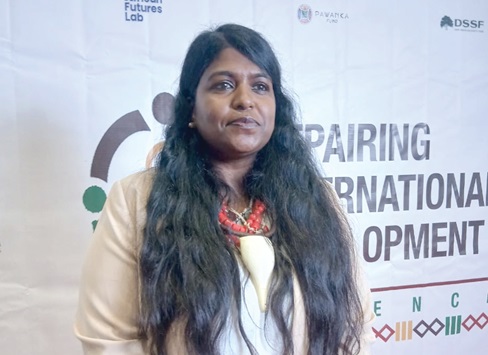
The United Nations has urged the South African government to take the necessary steps to ensure that foreigners living in the country are protected, especially now that vigilantism is at its peak in the country in the name of hyper-nationalism.
Making reference to the xenophobic attacks in the country, the UN Special Rapporteur on Contemporary Forms of Racism, Racial Discrimination, Xenophobia and Related Tolerance,
Dr Ashwini K.P., said there should be a strong national action plan in terms of controlling the situation and ensuring that the rule of law prevailed.
“The government should not allow individuals to take the law into their own hands. It is necessary to maintain law and order,” she said.
Dr Ashwini said this yesterday at the sidelines of the Repairing International Development (RID) Conference that is currently ongoing in Accra.
The conference, which is being attended by over 150 participants from across the world, is a government-partnered platform to promote dialogue, innovation, research, investment, policy engagement, reparatory justice and sustainable development.
It was organised by Reform Initiatives in partnership with African Futures Lab, Pawanka Fund and Deep South Solidarity Fund (DSSF).
South Africa
South Africa has in recent weeks been attacking other African migrants living in the country, as well as their businesses, describing them as immigrants and blaming them for high crime rates and worsening unemployment.
The attacks have compelled the government of several African countries, including Ghana, Malawi, Nigeria, Mozambique and Zimbabwe, to repatriate their nationals living in the country.
Tuesday, June 30, marked the official deadline set by anti-migrant groups for foreigners to leave South Africa, and there were huge demonstrations across the streets in Johannesburg with demonstrators demanding all undocumented migrants leave the country.
Dr Ashwini said there had to be an immediate action plan by the government, which had a precautionary approach in terms of mitigating the damage that the attacks could cause to foreigners in South Africa who have been at the receiving end of xenophobia and racism.
The Executive Chair of the Southern Africa Political Economy Series (SAPES, TRUST), Professor Ibbo Mandaza, who described Afrophobic attacks in South Africa as a sickness and embarrassment, called for systematic education for its people in order to resolve it.
“Afrophobia is hating someone who looks like you, and I have great fears for South Africa because this will certainly descend into intra-South African violence, what we call tribalism. That's where it's heading. In 2008, out of the many who were killed, 31 were South Africans who were killed mistakenly as foreigners,” he said.
Repairing
The Founder and Director of Reform Initiatives, Makmid Kamara, said the time had come for Africa to move beyond talk about decolonisation to talking about repairing and re-educating, adding that as it rebuilt its systems that had been broken, dismembered and disconnected through colonialism, Africa could reconnect them in ways that made meaning for its people and communities.
Other speakers at the opening ceremony included the Head of Secretariat, African Union Economic, Social and Cultural Council, William Carew; the Chairperson, Pawanka Fund, Dr Myrna Cunningham, and the co-Founder of DSSF, Noel Didla.
