
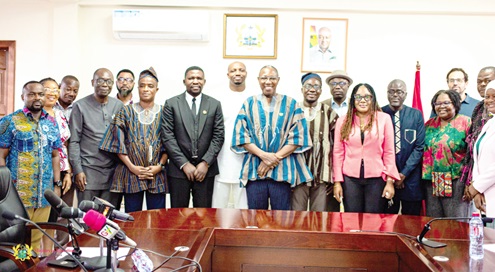
The maiden edition of the National Schools Awards (GALOP Edition) to reward excellence, strengthen accountability and improve learning outcomes in schools in the country has been launched in Accra.
The event is an initiative of the National Schools Inspectorate Authority (NaSIA) under the Ghana Accountability for Learning Outcomes Project (GALOP).
Under the framework, schools will be assessed and recognised based on verifiable evidence of improvement in instructional leadership, teaching effectiveness, school management, and learner achievement.
Recognition would, therefore, be based not on perception but on demonstrated results.
The maiden edition, which would cover public and private primary schools, aligns directly with the government's commitment to data-driven reforms and targeted interventions that strengthen foundational literacy, numeracy, and overall learning outcomes.
Outcomes
The theme for this year's awards, “Resetting Education for Improved Learning Outcomes”.
At the launch of the awards ceremony in Accra yesterday, a Deputy Minister of Education, Dr Clement Abas Apaak, said the awards reinforced an important principle that excellence must be recognised, celebrated and replicated.
He said the occasion was a bold statement of “our national commitment to improving learning outcomes, strengthening accountability, and recognising excellence within our schools”.
Again, he said, it was a practical demonstration of the vision of the President to reset the country through a more equitable, accountable, and high-performing education system that delivered meaningful results for every child.
“Over the years, Ghana has made remarkable progress in expanding access to education.
More children are in school today than ever before. However, access alone is no longer enough,” he said.
Dr Apaak said that was why the government remained firmly committed to eliminating learning poverty, narrowing inequalities in educational opportunities, and ensuring that quality education was not determined by geography, socio-economic background, or circumstance.
“Our focus is, therefore, shifting decisively from enrolment to learning, from participation to achievement, and from effort to measurable outcomes,” he said.
GALOP
“The GALOP has played a significant role in advancing this vision.
Through targeted interventions, GALOP has strengthened school leadership, supported teachers, improved instructional practices, and enhanced learning outcomes, particularly in underserved schools. Building on these achievements, the National Schools Awards – GALOP Edition introduces a credible and transparent framework for recognising schools that demonstrate measurable improvement and excellence,” he said.
Dr Apaak said the initiative was not merely about rewarding success but about creating a culture where continuous improvement is valued, where innovation is encouraged, accountability is strengthened, and schools are motivated to pursue higher standards of performance.
“I wish to commend the NaSIA for its leadership and dedication in advancing quality assurance across the educational system.
Through its inspection and evaluation mandate, Dr Apaak said, NaSIA continued to provide the evidence and insights needed to drive meaningful school improvement and inform policy decisions.
Appreciation
Dr Apaak expressed the government's sincere appreciation to the World Bank and the country’s development partners for their invaluable support through GALOP.
“Your partnership has strengthened systems, enhanced implementation, and contributed significantly to improving learning outcomes across the country. The progress we celebrate today demonstrates the power of collaboration and our shared commitment to educational transformation.
“To our teachers, headteachers, district and regional education directors, school improvement officers, and all stakeholders gathered here, this initiative belongs to all of us,” he said.
Commitment
For his part, the Inspector-General of Schools, Prof. Tahiru Salifu Azeko, said the awards would ensure that all sections of schools were covered in a way that would be true and transparent in awarding institutions.
