
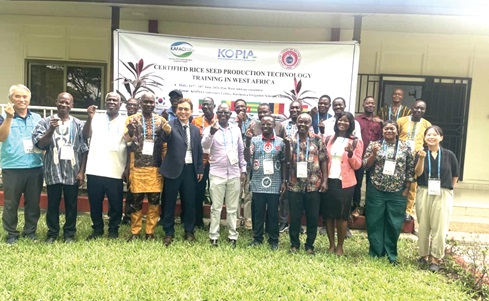
Korea Partnership for Innovation of Agriculture (KOPIA) Ghana Centre, in collaboration with the Council for Scientific and Industrial Research (CSIR) and the Korea-Africa Food and Agriculture Cooperation Initiative (KAFACI), has begun a three-day Certified Rice Seed Production Technology Training Programme aimed at strengthening agricultural capacity across West Africa and accelerating Ghana’s drive towards rice self-sufficiency through the production of high-quality certified rice seeds.
K-Rice project
The initiative forms part of the Korea Rice-Belt Project from 2023–2027, which seeks to strengthen rice seed systems, increase local rice production, and reduce Africa’s dependence on imported rice.
Since its inception, approximately 1,580 metric tonnes of certified rice seeds have been produced and distributed to farmers across Ghana.
The project targets 5,000 metric tonnes by 2027, enough to cultivate about 100,000 hectares of rice farmland, representing nearly a quarter of the country’s rice-growing area.
The programme was officially opened at the KOPIA in Accra last Wednesday, while practical sessions were held at the Dawhenya Irrigation Scheme from June 17 to 18.
Participants from Ghana, Benin, Burkina Faso, Chad, Mali and Togo received training in rice varieties, fertiliser application, pest and disease management, weed control, and certified seed production techniques.
The training also included field demonstrations and stakeholder discussions to promote knowledge sharing and best practice.
Focus
Addressing participants, the Director of the KOPIA Ghana Centre, Dr Young Jin Kim, said the project focused on improving rice seed quality, promoting advanced seed production technologies and strengthening the capacity of seed specialists across Africa.
He noted that the project currently supports seven African countries: Senegal, Gambia, Guinea, Ghana, Cameroon, Uganda and Kenya in developing sustainable systems for improved rice seed production and distribution.
Delivering a speech on behalf of the Deputy Director-General of CSIR, Senior Research Scientist, Dr Samuel Mahama, said Ghana had made progress in rice research, seed multiplication and technology dissemination through collaboration between CSIR, the Ministry of Food and Agriculture, KOPIA and development partners.
He, however, stressed that stronger regional partnerships and expanded knowledge-sharing platforms were still needed to achieve full self-sufficiency.
A rice breeder at the CSIR Crop Research Institute, Dr Kirpal Ofosu, said the country currently produces about 48% of its rice demand, leaving an import gap of over 50%.
He explained that achieving self-sufficiency began with seed quality, noting that poor seeds affect the entire production
"When you get it wrong from seed level, everything goes wrong," he said.
