
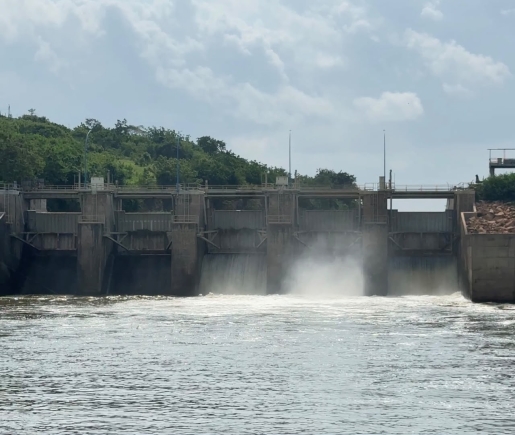
Municipal assemblies must take full responsibility for the occasional flooding within the Weija Dam spillway.
This is because various human activities within the river’s buffer zone contribute to flooding in areas around the Weija Dam and not the controlled spillage of excess water from it.
In an interview, the Public Relations and Communications Director of the Ghana Water Limited (GWL), Stanley Martey, explained that the Riparian Buffer Zone Policy for managing freshwater bodies in the country, developed by the Water Resources Commission, recommended a buffer width of 60 to 90 metres for municipal reservoirs and shoreline protective buffer.
“Anybody who is beyond the 100 metres is generally safe, but people have built all around the watercourse and even inside the river channel.
That is why flooding continues to occur whenever there is heavy rainfall or controlled spillage from the dam,” he said.
Mr Martey explained that GWL did not have the mandate to demolish structures along the buffer zone, and management of the utility had consistently reported the encroachment because it affected its operations.
“There are task forces of the municipal assemblies that move through these communities every day, yet people continue to build with impunity,” he said.
Mr Martey insisted that no building, regardless of its size or value, should be allowed to remain within the buffer zone of the Densu River and around the Weija Dam because the encroachment could obstruct the natural flow of water into the sea and lead to flooding.
The Public Relations and Communications Director of the company, therefore, called for urgent dredging of the watercourse and the removal of all obstructions to restore the river’s natural flow.
“Structures, especially the ones in the water, must be cleared.
Sometimes it is disheartening when you see very beautiful and huge houses being demolished, but those houses are not more expensive than human lives, not even a single human life.
“Also, the floods that we are seeing now are not caused by the spilling of excess water; they are caused by encroachment along the buffer zone and even in the middle of the watercourse,” he said.
Mr Martey maintained that “the area is naturally flood-prone and waterlogged, and the watercourse itself has become shallow because of siltation and human activities”.
He said the Densu River, which originates from the Atiwa Forest and feeds the Weija Dam, was under severe pressure from farming, settlement expansion, refuse dumping and the discharge of untreated sewage.
“When people farm close to the river, they clear the trees, shrubs and vegetation that protect the river.
The topsoil is then washed into the water body during rainfall, causing siltation and reducing the volume of water that the river and dam can hold.
“The chemicals are washed into the river together with the soil, making the water more difficult and expensive to treat. We have to use more treatment chemicals to neutralise the contaminants before the water can be supplied to consumers,” he said.
Waste
Beyond farming activities, Mr Martey expressed concern over the discharge of sewage and waste into the river by communities and settlements along the river bank.
He explained that human excreta deposited into water bodies enriched the environment and encouraged the rapid growth of aquatic weeds, which affected water quality and water flow.
“A lot of settlements have diverted sewage and drainage systems into the river. Human waste and other pollutants are entering the water body every day.
This is wrong and illegal. All these pollutants eventually end up in the Weija Dam and increase the cost of treatment.
“People often ask why water tariffs keep increasing.
One of the reasons is the growing level of contamination in our water bodies.
The more polluted the water becomes, the more chemicals and resources are required to make it safe for consumption,” Mr Martey said.
