
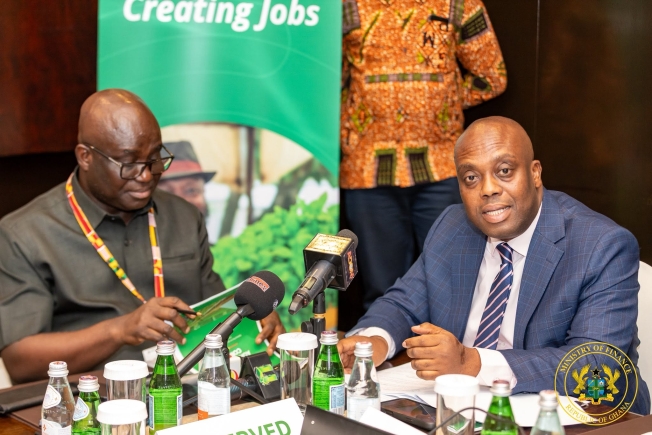
The Ministry of Finance has released GH¢1.677 billion to the Ministry of Food and Agriculture this year, representing 85 per cent of the ministry’s approved budget for goods, services and capital expenditure.
The Deputy Minister of Finance, Thomas Nyarko Ampem, who disclosed this in Accra last Wednesday, explained that the Mahama Administration was matching its agricultural transformation agenda with substantial financial commitments and targeted investments.
He said the government’s commitment to agriculture was evident in a number of flagship programmes being implemented under the leadership of President John Dramani Mahama.
Mr Nyarko Ampem was speaking at the launch of Ghana’s National Pact for Agricultural Transformation, Food Security and Employment (AgriConnect Compact).
VIDEO: The body language of Agric Minister Eric Opoku when the Finance Ministry announced the release of GH¢1.67bn for agric sector representating 85% of approved budget for goods, services and capital expenditure for 2026 https://t.co/ISFwjMpq2F pic.twitter.com/DIsilfjzA9
— DailyGraphic GraphicOnline (@Graphicgh) June 6, 2026
AgriConnect
AgriConnect is a five-year agricultural transformation initiative designed to create 2.6 million jobs, strengthen food security and reduce Ghana's dependence on food imports.
The compact, developed by the government in collaboration with development partners, including the World Bank, the International Fund for Agricultural Development (IFAD) and the African Development Bank (AfDB), is aimed at strengthening key agricultural value chains, improving productivity and expanding agro-processing across the country.
The home-grown initiative targets strategic commodities such as rice, maize, cocoa, oil palm and poultry, while placing smallholder farmers at the centre of efforts to transform agriculture into a modern agribusiness sector.
The $1.5 billion agricultural transformation and job creation project will drive rice self-sufficiency and eventually end its imports.
Vision for agriculture
The deputy finance minister added that the government’s vision for agriculture extended beyond increasing production to transforming the entire agricultural value chain, improving food security, creating jobs, and strengthening economic growth.
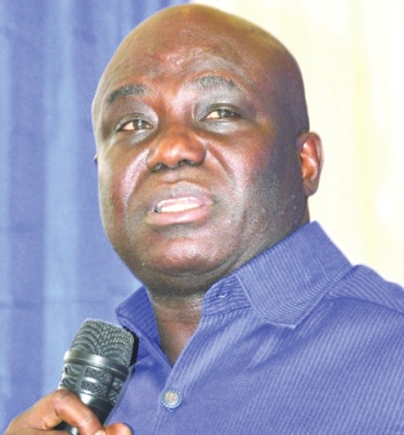
Eric Opoku, Minister of Food and Agriculture
It was to support that agenda that the Ministry of Finance released the amount well in time to fund critical interventions across the sector.
The announcement directly challenges claims that the Ministry of Finance has failed to provide adequate funding to key ministries and state institutions.
Breakdown
Giving the details, Mr Nyarko Ampem said the amount released included GH¢581.4 million for the establishment of 50 Farmer Service Centres across the country to support mechanisation and improve productivity; GH¢110 million for irrigation infrastructure projects to expand year-round farming to reduce dependence on rainfall and GH¢515.3 million released for the supply of fertilisers and certified seeds to farmers to boost crop yields and food production.
The deputy finance minister added that GH¢244.9 million had been released for the Poultry Farm-to-Table Project (Nkoko Nkitinkiti) to support the growth of the poultry industry, as well as GH¢200 million released for the National Food Buffer Stock Company (NAFCo) to address longstanding challenges in the storage, distribution and trading of agricultural produce.
Launch
Speaking at the launch the Minister of Food and Agriculture, Eric Opoku, said the programme was a major intervention to drive agricultural transformation, create jobs and increase value addition in the sector.
"For a long time, agriculture has been limited to farming.
This programme seeks to transform agriculture into agribusiness and create employment opportunities for the youth of our nation," he said.
He explained that the compact was prepared through a coordinated effort involving representatives from various ministries and development partners to support the government's agricultural transformation agenda.
Rice
Mr Opoku said the government would support rice processors with modern milling equipment to improve processing capacity and quality.
Under the programme, rice produced by farmers would be purchased by processors, milled, packaged and supplied to the domestic market, with each actor within the value chain being supported.
"The target is that after five years of implementation, Ghana should be able to produce 105 per cent of its rice requirement, which means five per cent above national demand.
After five years, Ghana will no longer import rice into the country," he said.
On poultry production, the Minister of Food and Agriculture said the initiative would help to reduce the country's heavy reliance on imports, while efforts would also be intensified to reverse declining cocoa production and expand local processing.
For oil palm, Mr Opoku said the programme would promote commercial production while ensuring that smallholder farmers remained at the centre of the transformation agenda.
Smallholder farmers
Mr Opoku said more than 80 per cent of the country's farmers were smallholders who produced the bulk of the country's food but often struggled to access markets.
He explained that the compact would create stronger linkages between farmers and processors, enabling farmers to produce for guaranteed markets.
The World Bank Practice Manager, Abel Lufafa, said AgriConnect was designed to help smallholder farmers increase productivity and incomes, while creating jobs along agricultural value chains.
He explained that the initiative formed part of a global programme by the World Bank and its partners to support 300 million farmers by 2030 to move from subsistence farming to commercially viable production.
Mr Lufafa said the initiative was intended to address food security and youth unemployment, the two major challenges facing many countries.
