
THE African Union (AU) has called for a fundamental rethinking of African diplomacy to respond to new threats such as artificial intelligence, drones, climate change and cyber warfare, stressing that “proactive diplomacy” must become the continent’s first line of peace.
The AU Commissioner for Political Affairs, Peace and Security (CAPS), Bankole Adeoye, made the call in Accra yesterday when he delivered the public lecture, “Proactive Diplomacy as Africa’s First Line of Peace”, at the launch and strategy session of the African Diplomatic Institutes Network (AfDIN).
Mr Adeoye said the training diplomats received decades ago could no longer meet the demands of today's diplomatic challenges, underscoring the need to rethink diplomatic training.
“In 1984, February 15, 1984, there was no AI. There was no internet.
There were no drones.
So, there was no climate change debate in 1984. Today, it's a different ball game.
“Therefore, the training that I received cannot be given to today's diplomat. It would be totally irrelevant.
Therefore, we have to equip and build a community of knowledge,” he stated
He said the AU, as the continent’s premier intergovernmental body, must showcase its best diplomats who understand today’s world and can protect the image of Africa from Addis Ababa to New York and even “in your little corner in Cape Verde”.
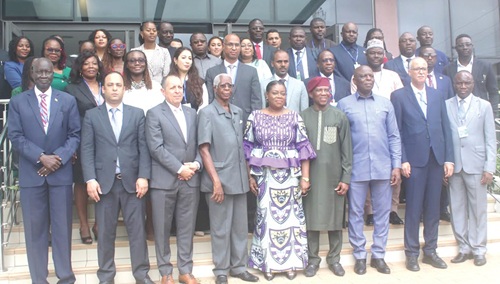
The two-day session, held at the Foreign Service Institute (FSI), brought together directors and senior officials of foreign service academies from Nigeria, Morocco, Tunisia, Mauritania, Ethiopia, Kenya and other AU-member states.
He said AfDIN was intended to build an African-centric curriculum anchored on “Agenda 2063: The Africa We Want”, and on the AU’s two main architectural frameworks — the African Peace and Security Architecture (APSA) and the African Governance Architecture (AGA).
“The African Union is just a spectator. The only thing we want to do is to help the governing councils to help shape a curriculum that is pro-Africa, that is African-centric,” he said.
Mr Adeoye explained that many young African diplomats knew the structure of the United Nations but not that of the AU Peace and Security Council, a 15-member body that he described as “the most powerful organ outside the Assembly of Heads of State and Government.”
He added that a Memorandum of Understanding to formalise working methods between regional mechanisms and the AU would be signed later this month in Addis Ababa.
Democracy, technology and peace
The Commissioner expressed concern over what he termed “democratic regression” on the continent, stressing that eight countries had experienced successful coups in the last four to five years, with six currently suspended from AU activities for unconstitutional changes of government.
He stressed that diplomats must be “watchdogs and guardians for democracy” and must promote human rights, the rule of law and social justice.
Mr Adeoye further warned that the threat landscape had expanded beyond terrorism to include technology.
“Drones can destroy the steady development progress we are making. Algorithms built by youngsters can destroy a whole empire. Public health is already a security challenge,” he said.
He urged African diplomatic institutes to produce diplomats who are “proactive, deliberate, knowledgeable and resource-driven” to advance the seven aspirations of Agenda 2063.
Ghana’s role
The Commissioner commended the government of Ghana, the Ministry of Foreign Affairs and FSI for hosting the launch.
He said Accra had “become part of the history of this network.”
He pledged that the AU Commission was ready to deploy experts to train students at member states’ institutes “at our own cost” to ensure the network thrives as a centre of excellence and knowledge.
“Peace is the foundation. Without peace, as I said, there will be no development, and without development, there will be no peace,” he said.
